BOK Financial (BOKF): Supplier relationships, funding partners, and operational constraints investors should track
BOK Financial operates as a regional bank holding company that monetizes through traditional commercial banking activities—net interest margin on loans funded by deposits and wholesale sources, plus fee-based services such as treasury management, payments, and asset servicing. The company’s supplier posture is defined by a tight coupling of liquidity partners and outsourced operations: wholesale funding relationships support balance-sheet flexibility while a concentrated set of service providers underpins core processing and data functions. For investors, that combination creates a clear tradeoff between funding agility and operational concentration risk.
Explore supplier intelligence at Null Exposure
Why the Federal Home Loan Bank relationship matters for liquidity and capital planning
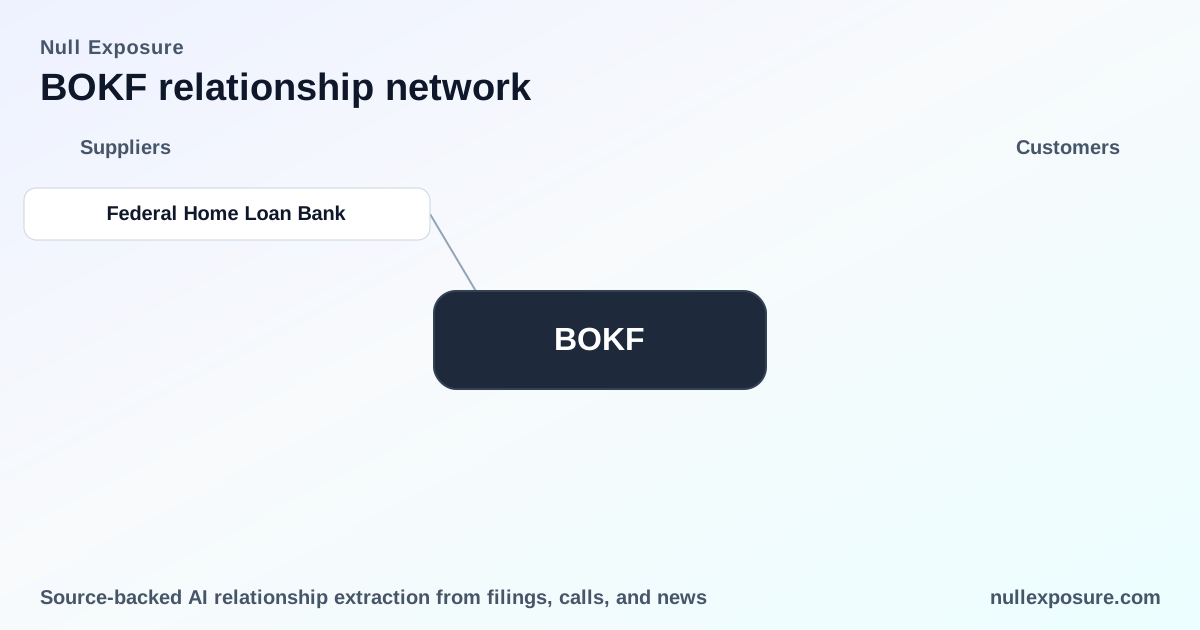
BOK Financial relies on both other financial institutions and the Federal Home Loan Bank (FHLB) system for supplemental funding. According to a TradingView summary of BOK Financial’s FY2026 10‑K filing, the company explicitly identifies the FHLB as a funding source that could be affected by market disruptions (TradingView, FY2026).
This relationship is funding-critical: wholesale credit lines with the FHLB provide a buffer for liquidity and enable asset growth that deposit flows alone would not support. Investors should treat the FHLB line as a structural component of short- to medium-term funding, and monitor the firm’s disclosures on advance availability, collateral eligibility, and usage patterns because stress to FHLB access will directly pressure net interest margins and funding costs.
The operational constraints that shape supplier risk and concentration
BOK Financial’s 10‑K articulates a set of supplier-level constraints that directly influence the company’s operating model and vendor risk profile. These are company-level signals about contracting posture and criticality:
- Long-term lease obligations: BOKF, NA is committed to a long-term lease for its downtown Tulsa premises with the renegotiated lease terminating December 31, 2034 and an option to renew for 10 years, creating a fixed-cost anchor for the bank’s operations (FY2026 filing).
- Critical outsourcing concentration: The company outsources a significant portion of information systems, communications, data management, and transaction processing to third parties and is heavily reliant on a single vendor for many of these functions, which the filing identifies as a source of material operational risk (FY2026 filing).
- Active service-provider relationships: The vendor relationships described are active and support core services, not peripheral functions, making continuity and SLA performance strategically important (FY2026 filing).
These constraints together produce three actionable implications for investors: first, the long lease increases fixed-cost leverage and reduces short-term flexibility for office footprint optimization; second, heavy dependence on a single technology/service provider creates operational concentration that is material to service continuity, regulatory exposure, and reputational risk; third, the active nature of these vendor relationships means remediation and transition options would be complex and time-consuming.
How supplier signals translate into investment and operational priorities
Investors should reframe vendor references in filings from procedural disclosures into strategic indicators of resilience. Concentration in funding and operations amplifies downside in stress scenarios:
- Funding: Track the proportion of wholesale funding that is FHLB-sourced, maturity ladder of advances, and collateral constraints that could limit access in a tightening market. FHLB reliance is a deterministic component of liquidity management and should be reported and trended in quarterly statements.
- Operations: Demand-side failure or cyber incidents at the single large vendor will produce outsized operational disruption and regulatory scrutiny. Monitor incident filings, remediation disclosures, and governance descriptions around third-party oversight.
- Cost structure: The long-term lease through 2034 is a hard obligation that reduces optionality on occupancy costs; evaluate branch rationalization plans and remote-work policies in earnings calls.
For investors who want a systematic view of supplier exposure and contract maturity, Null Exposure’s supplier coverage can accelerate due diligence.
Every named supplier in the record — concise investor-ready notes
Federal Home Loan Bank — BOK Financial sources supplemental liquidity from the Federal Home Loan Bank system, and its FY2026 10‑K warns that disruptions to those funding channels could affect funding availability and cost (TradingView summary of FY2026 10‑K; TradingView, March 2026: https://www.tradingview.com/news/tradingview:239b01411063f:0-bok-financial-corp-sec-10-k-report/).
Practical monitoring checklist for operators and investors
To convert the foregoing into executable monitoring, focus on four items: vendor concentration metrics, FHLB usage and collateral dynamics, lease maturity and fixed-cost exposure, and third-party incident disclosures. Keep attention on regulatory engagement around third-party risk management because a single-vendor failure will invite supervisory review and potential remediation costs.
- Vendor concentration metrics: percentage of core processing and transaction volumes handled by the top vendor, SLAs, and break-glass contingency plans.
- Liquidity telemetry: FHLB advance outstanding amounts, average cost of FHLB borrowing versus deposit funding, and collateral composition.
- Lease and real estate exposure: occupancy costs as a percentage of operating expenses and any disclosed sublease or renewal options.
- Governance and oversight: board-level reporting frequency on third-party risk and evidence of independent vendor performance audits.
If you want deeper supplier and risk intelligence on BOKF’s counterparties, visit Null Exposure for full coverage.
Bottom line — what investors should do next
BOK Financial’s supplier footprint is succinct: funding dependence on the Federal Home Loan Bank and heavy operational reliance on a concentrated set of service providers. These are structural characteristics that influence liquidity sensitivity, operational resilience, and regulatory risk. Active monitoring of funding disclosures, vendor incident reporting, and lease commitments is essential to understand downside scenarios. For portfolio managers and credit analysts focused on regional banks, this is a clear set of supplier signals to incorporate into stress tests, covenant reviews, and engagement agendas.
For ongoing supplier-level alerts and structured vendor intelligence, Null Exposure provides prioritized coverage and analysis.