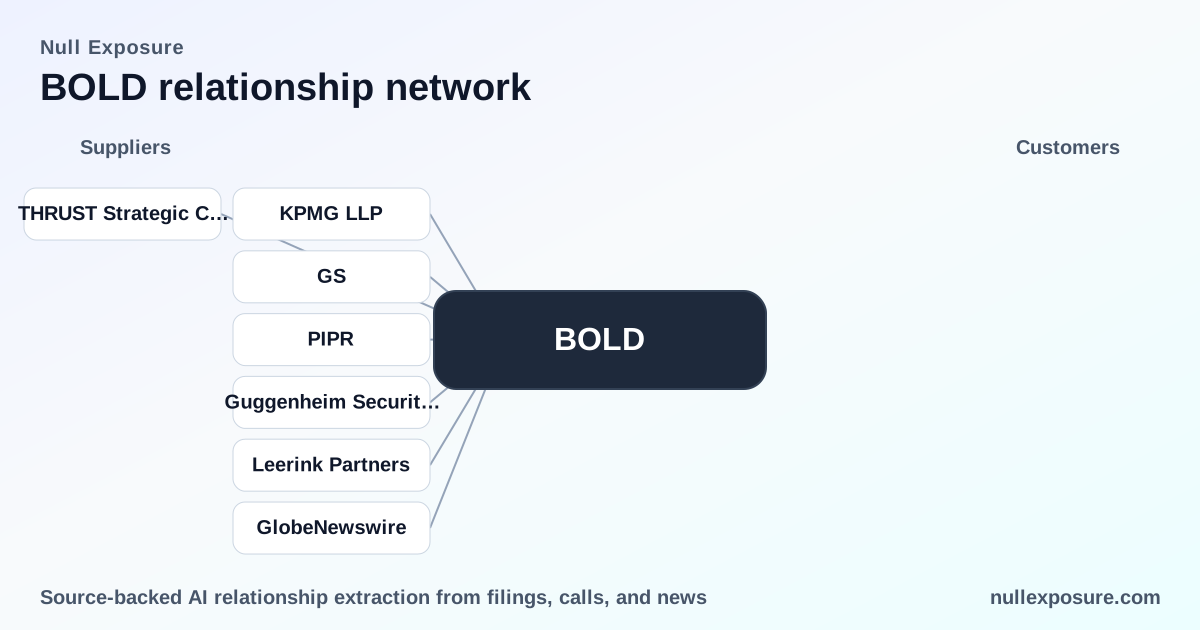
BOLD supplier relationships: what investors need to know
Boundless Bio (ticker BOLD) operates as an early-stage therapeutics company that outsources nearly all development, manufacturing and administrative functions. The company monetizes by advancing ecDTx candidates through clinical milestones and, ultimately, commercializing therapies — a model that converts scientific progress and regulatory validation into licensing, partnership and product revenue while carrying outsized vendor dependency and fixed real-estate obligations. For investors, the core question is how supplier concentration, contract tenor, and service criticality create either scalable operating leverage or single-point-of-failure risk. Learn more at https://nullexposure.com/.
Executive takeaway up front
Boundless’s supplier book is a mix: cancelable short-term services for trials and manufacturing paired with a single large long-term lease that creates a material fixed obligation. The company shows explicit dependence on third-party manufacturers and CROs for clinical supply and trial execution, which is operationally critical for timelines and commercialization. Detailed relationship notes follow, then a synthesis of contracting posture, concentration and investor implications.
Visit https://nullexposure.com/ for supplier risk tools and deeper diligence.
The relationships in the public record — concise investor notes
KPMG LLP
KPMG is listed as Boundless Bio’s independent registered public accounting firm for the fiscal year ending December 31, 2025. According to a Form 8‑K summary reported in FY2026, stockholder ratification included KPMG LLP as the company’s auditor (filing reported at https://www.stocktitan.net/sec-filings/BOLD/page-2.html).
Goldman Sachs & Co. LLC
Goldman Sachs acted as a joint book‑running manager on Boundless Bio’s IPO, underwriting the offering alongside other banks. The IPO syndicate role is documented in FY2024 press coverage of the offering (see https://aijourn.com/boundless-bio-announces-pricing-of-initial-public-offering/ and related San Diego Union‑Tribune coverage).
Piper Sandler
Piper Sandler served as a joint book‑runner on the IPO, sharing underwriting responsibilities for the public offering. This underwriting role is cited in the FY2024 IPO announcements and press (https://aijourn.com/boundless-bio-announces-pricing-of-initial-public-offering/ and https://www.sandiegouniontribune.com/2024/03/07/startup-boundless-bio-files-to-go-public-san-diegos-first-life-science-ipo-of-2024/).
Guggenheim Securities
Guggenheim Securities participated as a joint book‑running manager on the IPO and remains engaged with investor events where Boundless executives present. The underwriting role and event activity are documented in FY2024–FY2026 coverage (San Diego Union‑Tribune IPO coverage and a 2026 conference announcement summarized via GlobeNewswire/QuiverQuant: https://www.sandiegouniontribune.com/2024/03/07/startup-boundless-bio-files-to-go-public-san-diegos-first-life-science-ipo-of-2024/; https://www.quiverquant.com/news/Boundless+Bio+CEO+Zachary+Hornby+to+Speak+at+Guggenheim+Emerging+Outlook%3A+Biotech+Summit+2026).
Leerink Partners
Leerink Partners joined the IPO syndicate as a co‑manager, supporting the book‑running and distribution of shares. That role is described in FY2024 IPO filings and press releases (see https://aijourn.com/boundless-bio-announces-pricing-of-initial-public-offering/).
GlobeNewswire (press distribution)
GlobeNewswire distributed corporate press releases for Boundless, including presentation and investor event notices; a QuiverQuant aggregation in FY2026 notes an AI‑generated disclaimer but traces back to GlobeNewswire content. The press distribution relationship is documented in FY2026 coverage (https://www.quiverquant.com/news/Boundless+Bio+CEO+Zachary+Hornby+to+Speak+at+Guggenheim+Emerging+Outlook%3A+Biotech+Summit+2026).
THRUST Strategic Communications
THRUST Strategic Communications is referenced as an investor communications contact for a Boundless press release related to scientific presentations, showing engagement with a PR firm for investor and media outreach. This contact appears in FY2025 press distribution via GlobeNewswire and Manila Times syndication (https://www.manilatimes.net/2025/10/14/tmt-newswire/globenewswire/boundless-bio-announces-upcoming-presentation-at-the-2025-aacr-nci-eortc-international-conference-on-molecular-targets-and-cancer-therapeutics/2199866).
What the relationship map implies about operations and risk
Boundless outsources the operational backbone of drug development. Public excerpts and filings reveal three structural truths for investors:
- Contracting posture is hybrid: the company maintains short‑term, cancelable service contracts for CROs, preclinical work, testing and manufacturing, which enable flexibility and limit long‑term procurement lock‑in, but also carries execution risk if a provider fails. At the same time, the company has committed to a long‑term real‑estate lease (120 months with $72.5 million in base rent obligations) that creates a multi‑year fixed cost and cash‑flow requirement.
- Supplier roles are dual and critical: Boundless characterizes third parties both as service providers (CROs, clinical sites, testing labs) and manufacturers (third‑party production of ecDTx components). The company states it does not operate manufacturing facilities and relies on external production for clinical and possible commercial supply — a single point of failure for trial timelines and market launch.
- Concentration and spend profile matter: the long‑term lease and manufacturing reliance create concentrated exposures. The lease’s $72.5 million base rent obligation places the company in a $10m–$100m spend band for property commitments, while manufacturing and clinical spend are articulated as operationally material without minimum purchase commitments, implying variable but critical cash needs tied to trial pace.
These signals combine into a straightforward investor thesis: operational flexibility in contracting reduces locked‑in procurement costs but increases reliance on execution quality from partners; the large lease commitment increases fixed-cost leverage and funding needs.
Risk and opportunity for investors
- Major risk: third‑party manufacturing or CRO failure would delay trials and push cash burn, directly impacting value realization timelines. This is a material, high‑priority operational risk given the company’s explicit dependence on external manufacturers.
- Cost upside: cancelable service contracts provide negotiation leverage as programs scale, allowing the company to re‑price services or change vendors without long‑term purchase minimums.
- Balance sheet sensitivity: the long‑term lease is a non‑operational fixed charge that investors should model as a hard cash obligation when assessing runway and dilution risk.
Actionable next steps for investors: evaluate vendor redundancy clauses, service-level agreements, and the company’s contingency plans for supply interruptions; stress‑test cash models with the lease’s $72.5M base rent commitments.
Visit https://nullexposure.com/ for vendor concentration analytics and scenario modeling tools.
Final read: what to monitor moving forward
Track three categories of disclosures quarter to quarter: (1) contract awards and termination rights with manufacturing partners, (2) updates on supply‑chain continuity or disruptions for ecDTx components, and (3) any rent renegotiation, subleasing or impairment disclosures tied to the 2024 lease. Keep a close eye on any auditor communications from KPMG and on investor relations activity via PR firms and underwriters — changes there are early indicators of governance, capital markets access, and messaging discipline.
For targeted supplier diligence and to benchmark BOLD against peer outsourcing profiles, go to https://nullexposure.com/.