Bolt Biotherapeutics (BOLT) — supplier relationship briefing for investors
Bolt Biotherapeutics develops antibody-based immunostimulatory therapeutics and monetizes through strategic collaborations, licensing and eventual product commercialization while funding development with capital markets transactions. The company operates as a partnership-driven small-cap biotech: it outsources manufacturing and large-scale clinical activities, leverages co-development deals to extend platform reach, and uses underwritten offerings to maintain runway. For primary research on supplier exposure and partner concentration, visit https://nullexposure.com/ for a concise supplier-risk dashboard.
Quick read: why supplier relationships matter to valuation
Bolt’s pipeline progress and cash runway are directly tied to external suppliers and strategic partners. Manufacturing and CRO relationships are not peripheral — they are central to execution risk, timeline certainty and commercial optionality. Underwriting banks and investor-relations firms are also part of the ecosystem that controls access to capital and influence over market reception of program updates.
The relationship roster — who BOLT works with and what they do
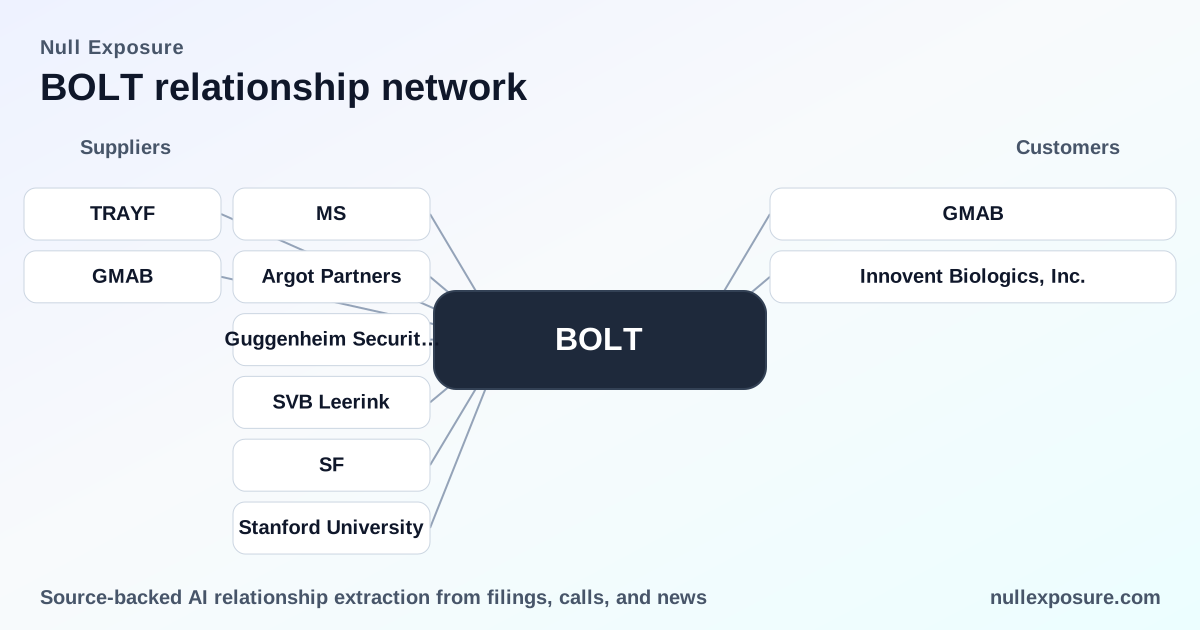
Below are plain-English summaries of every counterparty referenced in public reporting in the dataset.
-
Morgan Stanley, Guggenheim Securities, SVB Leerink and Stifel — These banks jointly managed a capital offering for Bolt, indicating the company uses established investment banks to underwrite financings and access public markets. According to a StockTitan report in March 2026, “The offering was managed by Morgan Stanley, SVB Leerink, Stifel, and Guggenheim Securities.”
Source: StockTitan news page (first seen March 2026). -
Argot Partners — Argot is Bolt’s investor relations and media contact on company press releases, handling communications for investor-facing announcements and conference participation; Argot is listed on press releases covering cash-runway updates and conference schedules in Oct 2025 and Feb 2026.
Source: GlobeNewswire investor-relations notices (Oct 2025; Feb 2026). -
Stanford University — Bolt’s platform is licensed from Stanford University, reflecting an academic spin-out origin and an intellectual-property dependency on the founding institution’s licensed technology. This licensing was referenced in a 2020 press release announcing an executive appointment.
Source: PR Newswire release (FY2020). -
Toray Industries / Toray — Toray provides proprietary antibodies and collaborates with Bolt to combine Toray antibodies with Bolt’s linker-payload technology for co-development of product candidates; multiple filings and coverage in 2025 reference the strategic collaboration supporting Bolt’s Boltbody ISAC platform.
Source: company updates cited on Intellectia and Bolt quarterly reporting and market commentary (FY2025). -
Genmab — Genmab is cited as a strategic collaborator that supports Bolt’s Boltbody ISAC platform, indicating another alliance that supplies antibody expertise or co-development capabilities complementary to Bolt’s linker-payload approach.
Source: RTTNews market commentary (FY2025).
What the relationships collectively reveal about operational posture
-
Outsourced manufacturing is baked into Bolt’s model. Public disclosures state Bolt does not have in-house manufacturing and relies on third parties to produce clinical and commercial supplies of its candidates. This is a fundamental operating constraint and raises supplier concentration and scale-up risk for late-stage development.
Evidence: company disclosure excerpt noting reliance on third-party manufacturing. -
Clinical execution is hybrid: internal trial management plus CRO support for scale. Bolt plans to run trials using internal clinical resources while leveraging CROs for large-scale studies; Bolt lacks the independent capacity to conduct Phase 3-sized trials without outside assistance. This creates execution dependence on external CRO performance and contract terms.
Evidence: company disclosure excerpt on intended use of CROs for large-scale trials. -
Capital markets partners influence access to liquidity. The use of multiple underwriters for offerings and professional investor-relations firms indicates Bolt relies on market intermediaries to secure financing and manage investor communications — a normal posture for smaller biotech but a channel that affects cost of capital and timing.
Investment implications: risk, concentration and timing
-
Execution risk is supplier-driven. With no internal manufacturing and an explicit plan to rely on CROs for large trials, development timelines and gross-margin prospects are contingent on external suppliers meeting quality, capacity and regulatory expectations. This elevates operational risk relative to peers with integrated supply chains.
-
Concentration can amplify disruptions. Strategic collaborations with a small set of partners (notably Toray and Genmab) advance the platform but increase counterparty concentration. A disruption or change in strategic alignment would materially affect the company’s development cadence.
-
Liquidity and narrative control are intermediated. Underwriters and IR firms are part of the go-to-market for Bolt’s financings; their participation supports access to capital but also signals reliance on favorable market conditions and bank syndicate distribution to sustain runway.
Key takeaway: Bolt operates as a partnership-first biotech where program delivery, regulatory timelines and commercialization economics are heavily mediated by external manufacturers, CROs and strategic antibody partners. Investors must value not only the science but also the supplier and financing architecture that will determine milestones.
For a consolidated view of supplier exposure and counterparty concentration, see https://nullexposure.com/.
Practical due-diligence checklist for operators and investors
- Confirm manufacturing vendors, capacity commitments, and tech-transfer timelines for lead candidates.
- Review CRO contracts for enrollment guarantees, milestone fees and termination clauses.
- Assess collaboration agreements (Toray, Genmab) for rights, economics and commercialization allocation.
- Monitor upcoming filings and conference presentations (IR handled by Argot Partners) to gauge operational progress and capital needs.
Final note and recommended next step
Bolt’s development thesis is scientifically driven but operationally dependent. Investors should treat supplier contracts and manufacturing/CRO backbone as valuation-sensitive assets rather than ancillary details. For a targeted supplier-risk report and ongoing monitoring of partner disclosures, visit https://nullexposure.com/.
If you want a tailored briefing that prioritizes manufacturing counterparties and CRO contract terms for Bolt, start here: https://nullexposure.com/.