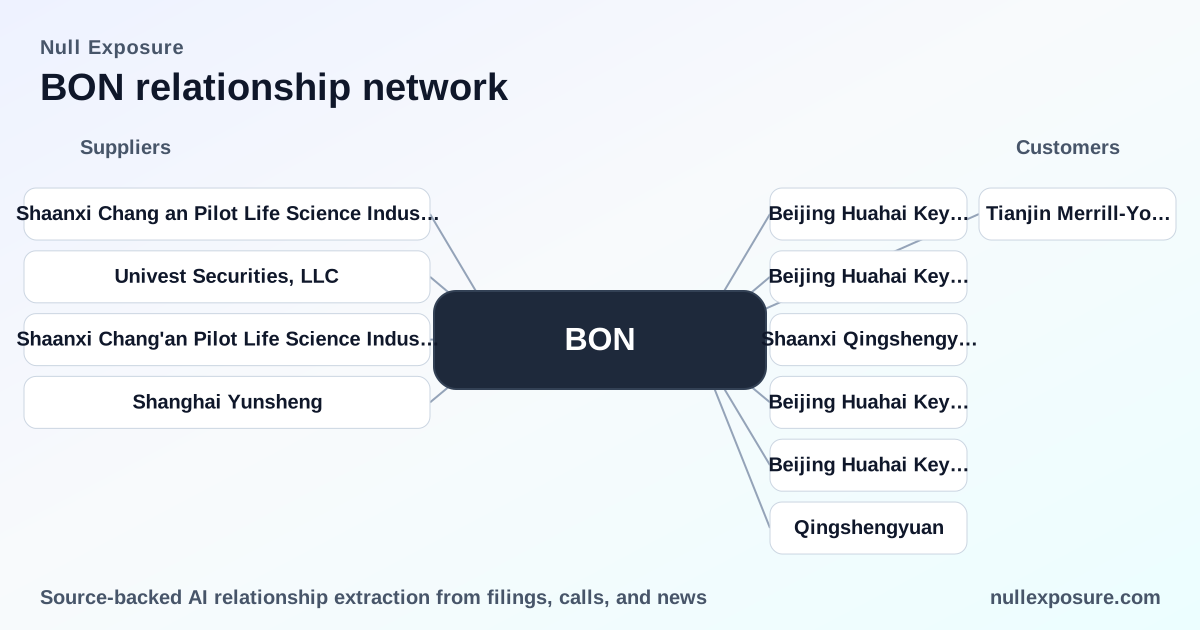
BON Natural Life: Supplier relationships that steer manufacturing and capital strategy
BON Natural Life operates as a consumer health and natural-ingredient manufacturer that monetizes through B2B supply contracts, proprietary product lines, and periodic capital markets raises to fund manufacturing scale-up and R&D. Recent supplier and partner announcements show a deliberate tilt toward onshore Chinese manufacturing capability and contracted supply revenue, supported by targeted capital raising activity to execute those plans. For investors and operators evaluating supplier risk and opportunity, the relationships below map directly to production capacity, technology transfer, and short-term funding posture.
For further supplier-focused intelligence, visit https://nullexposure.com/.
What the relationships are telling investors — quick read
BON’s public relationships fall into three practical buckets: a joint laboratory partnership to upgrade ingredient bio-manufacturing capability, a discrete supply agreement that creates near-term contracted revenue, and the use of a placement agent to access capital markets. Together these signals point to a growth-oriented operating model that relies on external partners for specialized manufacturing infrastructure and short-term financing to execute commercialization.
Shaanxi Chang'an Pilot: building onshore bio-manufacturing capability
BON inaugurated a Joint Laboratory with Shaanxi Chang'an Pilot Life Science Industry Innovation Center and its domestic operating subsidiary Xi’an App-Chem Bio-Tech on December 18, 2025, to develop natural-ingredient bio-manufacturing. According to a PR Newswire release carried by The Manila Times on February 17, 2026, Chang’an Pilot (established 2022) provides laboratory infrastructure and life-science services focused on AI-enabled manufacturing technologies, signaling a strategic move by BON to localize and upgrade R&D and pilot-scale production. (Source: PR Newswire / The Manila Times, 17 Feb 2026.)
Univest Securities, LLC: placement agent for a $12M best-efforts offering
Bon engaged Univest Securities as the sole placement agent for a $12 million best-efforts offering, indicating reliance on capital markets and placement agents to fund near-term initiatives. The company announced pricing of that offering in a GlobeNewswire release dated March 17, 2025, which frames the financing behavior that underwrites supplier contracts and capacity investments. (Source: GlobeNewswire, 17 Mar 2025.)
Shanghai Yunsheng: a $12M supply agreement that delivers contracted revenue
Bon secured a US$12 million supply agreement with Shanghai Yunsheng, a commercial supply deal that adds immediate contracted revenue and a customer channel for product lines such as the broccoli-derived sleep supplement the company has been promoting. This arrangement was reported in coverage by Mugglehead during FY2025 and represents tangible commercial traction in China. (Source: Mugglehead coverage, FY2025.)
How these relationships translate into operating constraints and business signals
The company-level operating signals from these relationships explain BON’s contracting posture and execution risks:
- Contracting posture — partner-led and milestone-driven. The joint laboratory partnership and the discrete supply contract show BON structures capability expansion and sales through dedicated partnerships rather than internal greenfield buildouts, which accelerates time-to-market but raises dependence on third-party timelines and governance.
- Concentration risk — supplier and customer clustering in China. The principal operational ties are with Chinese organizations (Chang’an Pilot, Shanghai Yunsheng). This concentrates both manufacturing execution risk and revenue exposure geographically.
- Criticality — high for manufacturing and product availability. The joint lab is strategic: it is critical for proprietary ingredient production and vertical control over formulations, elevating the importance of the Chang’an Pilot relationship to product continuity.
- Maturity — emergent operational stage leaning to commercialization. The use of a placement agent for a relatively modest $12M raise and the formation of pilot-scale labs indicate a company in early commercial expansion rather than a fully integrated manufacturer; the model prioritizes partnerships and financed growth.
These are company-level signals derived from the relationship facts; none of the above assigns constraints to a specific contract unless explicitly named in public disclosures.
Investment implications and risk-adjusted view
- Upside: The joint laboratory with Chang’an Pilot delivers a structural capability that can reduce input cost and improve gross margins if BON integrates successful scale-up into commercial runs. The Shanghai Yunsheng supply deal provides visible revenue and validation for the company’s formulations in China.
- Downside: Reliance on third-party manufacturing infrastructure and concentrated Chinese partners increases operational concentration and geopolitical exposure. The use of best-efforts financing via a placement agent highlights liquidity dependency on capital markets; that financing posture can dilute equity or constrain runway if market conditions tighten.
Key takeaways:
- Strategic partnerships are being used to fast-track manufacturing capability rather than internal capital-intensive builds.
- Near-term revenue and financing are tied to a handful of counterparties in China, which concentrates execution risk.
- The company is in a growth phase where capitalization events and partner performance will materially influence operating outcomes.
For a deeper read on how supplier relationships affect capital strategy and operational resilience, see more at https://nullexposure.com/.
Practical actions for investor and operator audiences
- For investors: stress-test valuation assumptions under different partner-performance and financing scenarios; treat the Chang’an Pilot lab and the Shanghai Yunsheng supply agreement as primary drivers of short-term revenue and medium-term margin expansion.
- For operators and procurement teams: prioritize contractual protections—service levels, IP controls, capacity commitments—and plan contingency sourcing given geographic concentration.
- For corporate development: consider diversifying manufacturing partners outside a single region and convert best-efforts financing into longer-term committed facilities where possible.
Closing perspective and next steps
BON’s supplier relationships reflect a coherent strategy: outsource and partner to scale ingredient manufacture while using targeted financing to bridge to commercial scale. That model accelerates market entry but creates concentrated execution risk tied to partner performance and capital availability. Investors should track partner deliverables from the Chang’an Pilot joint lab and revenue ramp from the Shanghai Yunsheng agreement, and operators should push for firm contractual commitments that reduce single-point failure risk.
Explore additional supplier intelligence and relationship mapping at https://nullexposure.com/.