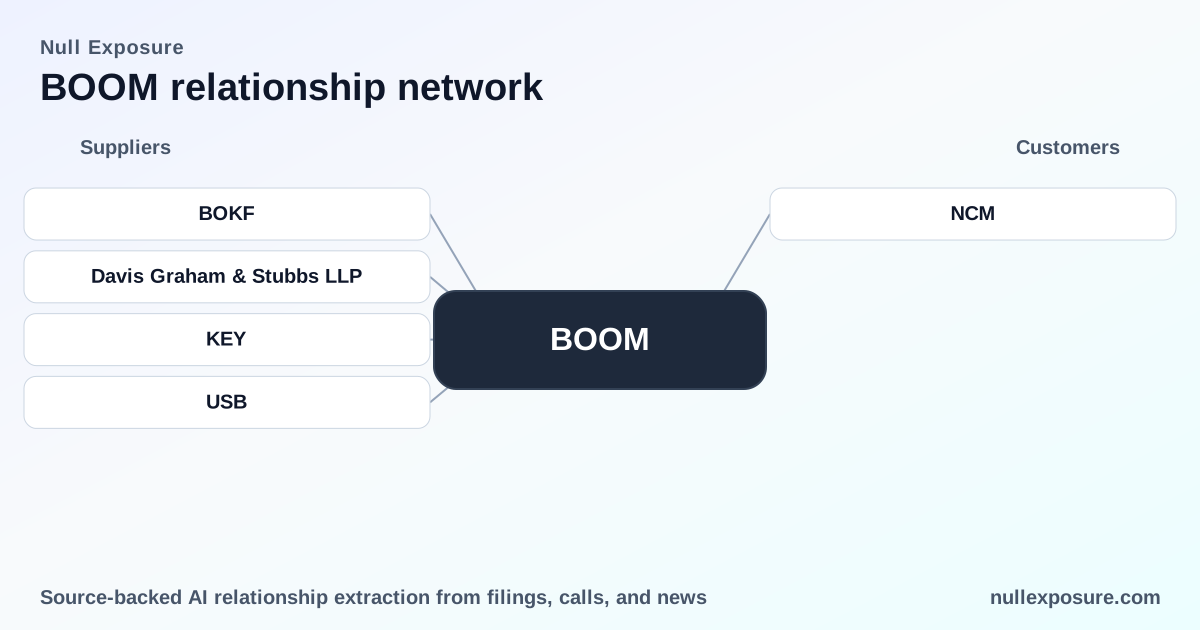
BOOM supplier relationships: who they rely on, what that means for investors
BOOM operates as an industrial supplier that sources key raw materials (notably aluminum) and sells components and services into large-enterprise manufacturing chains; the business monetizes through contract-driven sales and margin capture on material conversion while relying on external financial and legal partners to underwrite corporate financing and large transactions. Understanding BOOM’s supplier and service-provider footprint — and the banks and advisors that enable its capital structure — is essential for appraising liquidity, counterparty risk, and operational continuity. For a consolidated view of supplier exposures and third-party relationships, visit https://nullexposure.com/.
Why the financing and advisory relationships matter to a supplier
BOOM’s documented relationships are concentrated in the financial and legal services that support corporate transactions and working-capital facilities. Access to syndicated credit, bookrunners, and established legal counsel translates directly into the company’s ability to execute acquisitions, manage liquidity, and support growth initiatives. At the same time, sourcing characteristics — including reliance on aluminum and geographically diverse raw-material supply — shape operational risk and margin stability.
- Contracting posture: BOOM transacts with large-enterprise counterparties and institutional lenders, indicating standard syndicated financing and professional-service contracting rather than bespoke vendor arrangements.
- Concentration and geography: Evidence indicates global sourcing for raw materials, which reduces single-supplier concentration but raises exposure to cross-border logistics and input-price volatility.
- Criticality and maturity: Financial relationships are transactional and critical for corporate financing; vendor governance is ramping up, signaling a maturing third-party risk program.
Learn more about supplier relationship profiles at https://nullexposure.com/.
The counterparties in the record — concise takeaways
BOKF, NA
BOKF, NA acted as Documentation Agent in a five‑year syndicated credit facility that supported an acquisition financing package, placing it among the administrative and documentation banks on the deal. According to a GlobeNewswire press release (Dec 17, 2021), BOKF’s role was explicitly tied to the credit documentation for that transaction.
U.S. Bank National Association
U.S. Bank served as the Syndication Agent on the same five‑year facility, coordinating lender participation to fund the purchase price tranche disclosed in the release. The GlobeNewswire announcement (Dec 17, 2021) lists U.S. Bank NA as Syndication Agent for the transaction.
KeyBanc Capital Markets Inc. (and KeyBank National Association)
KeyBanc Capital Markets acted as Sole Bookrunner and, together with KeyBank National Association, as Joint Lead Arranger; KeyBank additionally served as Administrative Agent under the senior secured facility. The GlobeNewswire release (Dec 17, 2021) identifies KeyBanc/KeyBank as the primary arranger and administrative bank for the financing package.
Davis Graham & Stubbs LLP
Davis Graham & Stubbs LLP served as legal advisor to the acquiring company on the transaction, providing the corporate and transactional legal work necessary for closing. The GlobeNewswire release (Dec 17, 2021) lists Davis Graham & Stubbs LLP as counsel to the acquirer.
(Each of the above relationships is drawn from a GlobeNewswire press release announcing acquisition financing and advisory roles dated December 17, 2021.)
What these relationships imply for BOOM’s operating model
The pattern of counterparties in the record shows that BOOM (or the entity in scope) engages with large, institutional banks and established law firms to underwrite financing and transaction execution. This is a corporate‑grade supplier posture: financing and legal services are outsourced to major providers rather than retained internally.
- Counterparty type (large enterprise): Company-level language highlights sourcing from major suppliers and contracting with large financial institutions; that signals a procurement and treasury strategy aligned with enterprise-scale counterparties.
- Geography (global): Procurement language indicates raw materials and inputs are sourced internationally, which diversifies supplier risk but increases exposure to currency, freight, and geopolitics.
- Service-provider role and maturity: The company engages independent auditors and external cybersecurity assessors and is actively expanding its third‑party risk management program. This indicates service-provider relationships are material and the vendor-control posture is maturing, with explicit steps to strengthen monitoring and controls.
- Relationship stage (ramping): Vendor governance is in a growth phase — the firm is enhancing monitoring and third‑party risk programs, which reduces long-term operational risk but can create near-term execution costs and transition risk.
Risk and opportunity — investor takeaways
- Liquidity and financing access are strengths. Working with major banks and bookrunners provides access to syndicated credit markets and reduces refinancing risk relative to a purely bilateral banking model. The December 2021 financing roles by KeyBanc, KeyBank, U.S. Bank and BOKF demonstrate institutional support for material corporate actions.
- Input-price and logistics exposure remain critical. The company’s emphasis on aluminum as an important raw material and its global sourcing profile make margins sensitive to commodity cycles and supply-chain disruption.
- Governance is improving but still in transition. The company is expanding third‑party risk controls and engaging external auditors and cybersecurity assessors, which is constructive; however, the “ramping” descriptor signals this remains a work in progress and could produce temporary operational friction.
- Concentration risk is transactional, not supplier-centric. The recorded relationships are heavily skewed toward financing and advisory partners rather than a broad base of operating suppliers; this helps with capital execution but investors should validate the breadth and redundancy of physical suppliers beyond the financial advisory footprint.
Actionable next steps for investors and operators
- For credit and M&A desks: review covenants and facility terms behind the syndicated financing to assess leverage flexibility and event‑of‑default triggers tied to operating-supplier disruptions.
- For procurement and operations teams: map aluminum supply chains and freight corridors to quantify single‑point failures and hedging needs.
- For risk and compliance functions: accelerate vendor third‑party risk program milestones and prioritize cybersecurity assessments for critical service providers.
Explore tailored supplier-risk analytics and counterparty mapping at https://nullexposure.com/ for deeper diligence and monitoring.
Conclusion — distilled implications
BOOM’s supplier footprint, as represented in these records, is defined by institutional financial and legal partners supporting capital transactions and a company-level sourcing strategy that is global and aluminum‑intensive. That combination supports growth via access to capital while exposing margins to commodity and logistics cycles; strengthening vendor governance is already underway, which improves long-term resilience. For investors, the priority is verifying the operational supplier base and the covenant headroom behind financed transactions to form a complete risk-adjusted view.
If you want a deeper supplier-risk dossier or continuous monitoring of BOOM’s counterparty exposures, start here: https://nullexposure.com/.