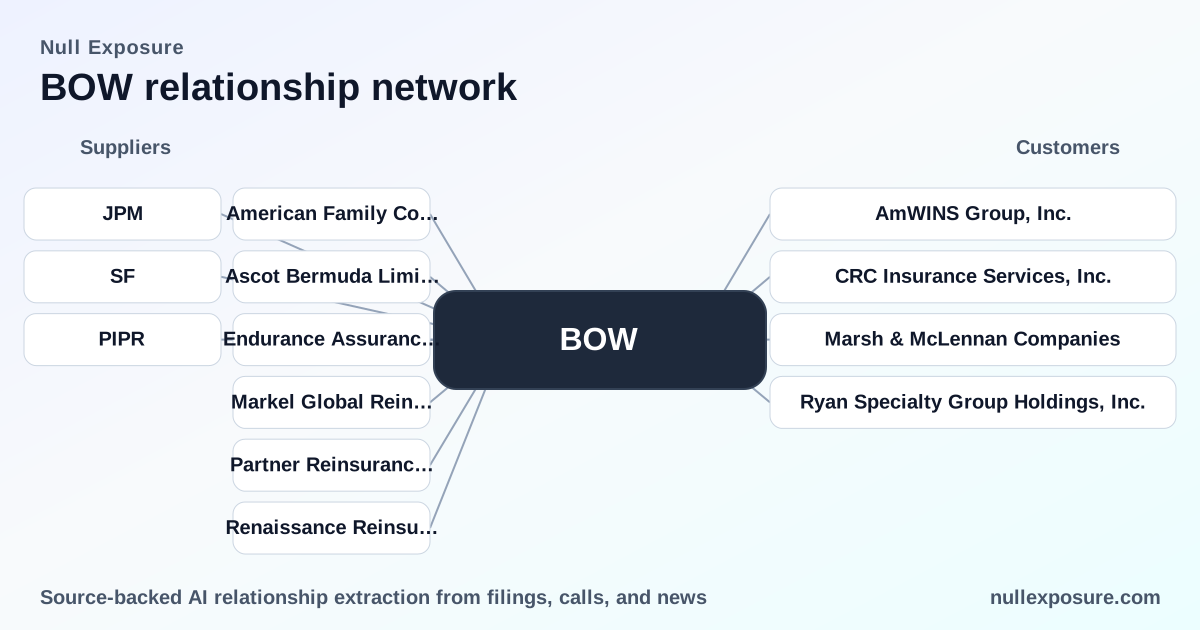
Bowhead Specialty Holdings: Reinsurance and supplier map for investors
Bowhead Specialty Holdings operates as a specialty property & casualty underwriter, monetizing through disciplined underwriting in niche lines, ceding risk through reinsurance arrangements, and generating investment income on its capital base. The company’s economic model hinges on selective underwriting and a concentrated set of reinsurance counterparties that materially shape loss economics and capital efficiency. For a faster look at Bowhead’s counterparty relationships, see https://nullexposure.com/.
Why counterparties matter for Bowhead’s return profile
Bowhead’s profit generation is not purely a function of premiums written; reinsurance partners determine net retention, recovery timelines, and the company’s capital charges. The 2024 disclosures show a small number of reinsurers accounting for meaningful shares of ceded exposures, which creates both negotiating leverage and counterparty concentration risk. Simultaneously, Bowhead relies on third-party vendors for pricing, IT and other services, making vendor continuity a tangible operational constraint.
Investors should note three immediate themes: concentration of reinsurance ceded, a mix of short-term treaty structures alongside longer financial facilities, and active reliance on external service providers and licensed systems. For trade execution or more detailed counterparty maps, visit https://nullexposure.com/.
The counterparties called out in Bowhead’s 2024 filing
Below are every relationship referenced in the available results, with one-sentence practical summaries and source context.
American Family Connect Property and Casualty Insurance Company
American Family Connect is listed as a cedant/partner representing 7.5% of the referenced allocation in the reinsurance listings; this is a mid-sized exposure and part of Bowhead’s ceded portfolio. According to Bowhead’s 2024 Form 10‑K, this counterpart is included among the company’s significant reinsurance relationships for FY2024.
Ascot Bermuda Limited
Ascot Bermuda Limited is recorded at 9.4% of the cited allocations, indicating a meaningful reinsurance relationship with Bowhead during FY2024; this places Ascot among the larger ceded partners in the 10‑K. (Source: Bowhead 2024 Form 10‑K.)
Endurance Assurance Corporation (A+)
Endurance Assurance Corporation appears with 23.8%, making it one of Bowhead’s largest named reinsurers and a primary channel for risk transfer in FY2024. Bowhead’s 2024 disclosures list Endurance as a material counterparty in the company’s reinsurance program.
Markel Global Reinsurance Company (A)
Markel Global Reinsurance Company is shown at 20.8%, another major ceded counterparty and a significant determinant of Bowhead’s net exposure profile for FY2024. The 10‑K explicitly identifies Markel among the top reinsurance relationships.
Partner Reinsurance Company of the U.S. (A+)
Partner Reinsurance Company of the U.S. is referenced at 8.5%, representing a meaningful but smaller slice of Bowhead’s ceded mix in FY2024. This company is cited in Bowhead’s Form 10‑K summary of significant reinsurance arrangements.
Renaissance Reinsurance U.S. Inc (A+)
Renaissance Reinsurance U.S. Inc is the single largest named counterparty in the excerpt at 29.8%, implying a concentrated dependency on Renaissance for transferring exposures in FY2024. This relationship is prominently called out in Bowhead’s 2024 10‑K.
J.P. Morgan, Keefe, Bruyette & Woods (Stifel), and Piper Sandler — capital markets counterparties
For FY2025 activity, Bowhead engaged J.P. Morgan, Keefe, Bruyette & Woods (a Stifel company) and Piper Sandler as joint book‑running managers on a senior notes offering, according to a market report dated March 9, 2026. This group executed capital markets financing for Bowhead, reflecting active use of debt markets for balance sheet management (source: AIJourn news report, 2026‑03‑09).
Operating-model constraints that shape supplier risk
The company filing language provides explicit constraints and operating signals that should be treated as company‑level characteristics:
- Contracting posture: mixed-tenor relationships. Bowhead operates with a short-term reinsurance rhythm—treaties are typically 12‑ or 18‑month—while its financial arrangements and real estate commitments include longer-dated facilities and leases, such as a senior secured revolving credit facility that matures in 2027 and operating leases through 2027–2028 (per the 2024 10‑K).
- Geographic footprint: global vendor reliance. Bowhead relies on vendors in the U.S. and abroad for IT, HR, investment management and other services, which introduces cross‑jurisdictional operational dependencies (2024 10‑K).
- Materiality and criticality: vendor failure is consequential. The 10‑K warns that loss of key vendor relationships or failures to protect proprietary data could affect operations—this elevates supplier risk to a material category for investors.
- Licensor + service provider posture. Bowhead both licenses third‑party systems and outsources key services (independent pricing services for securities, outsourced HR and investment services), which means continuity and contractual terms with licensors are strategic, not peripheral.
- Relationship stage: active. The public filings list these reinsurance programs and credit facilities as active as of December 31, 2024.
These constraints together frame Bowhead as a specialty underwriter that runs short-term reinsurance mechanics on the liability side while depending on longer-term financial plumbing and outsourced services on the asset/operations side.
How these relationships change the investment calculus
Concentration in a handful of reinsurers is the single largest counterparty risk: Renaissance (29.8%), Endurance (23.8%), and Markel (20.8%) together cover the majority of named ceded exposure, so counterparty credit events or rating actions at one of those firms would materially affect Bowhead’s loss recovery and capital needs. Conversely, the use of established market participants as book‑runners (J.P. Morgan, Piper Sandler, KBW) signals disciplined access to capital markets for liability management.
Key investor checklist:
- Counterparty concentration: quantify renewals, collateral triggers, and credit support for Renaissance/Endurance/Markel exposures.
- Short-term treaty risk: monitor renewal terms and pricing cycles every 12–18 months.
- Vendor and licensor continuity: validate service agreements and disaster recovery for licensed systems and outsourced pricing services.
For a deeper counterparty risk scorecard tailored to institutional needs, visit https://nullexposure.com/.
Final takeaways for research teams and operators
Bowhead runs a concentrated reinsurance book whose economics are materially determined by a handful of A/A+ rated market reinsurers, while operational continuity depends on third‑party licensors and service providers. That structural mix creates a credit and operational lens investors must monitor continuously—especially around treaty renewals and collateral provisions. For fund managers and risk officers, focus diligence on counterparty credit support, the cadence of treaty renewals, and contractual protections in vendor/license agreements.
If you want structured counterparty mapping and monitoring designed for institutional workflows, start here: https://nullexposure.com/.