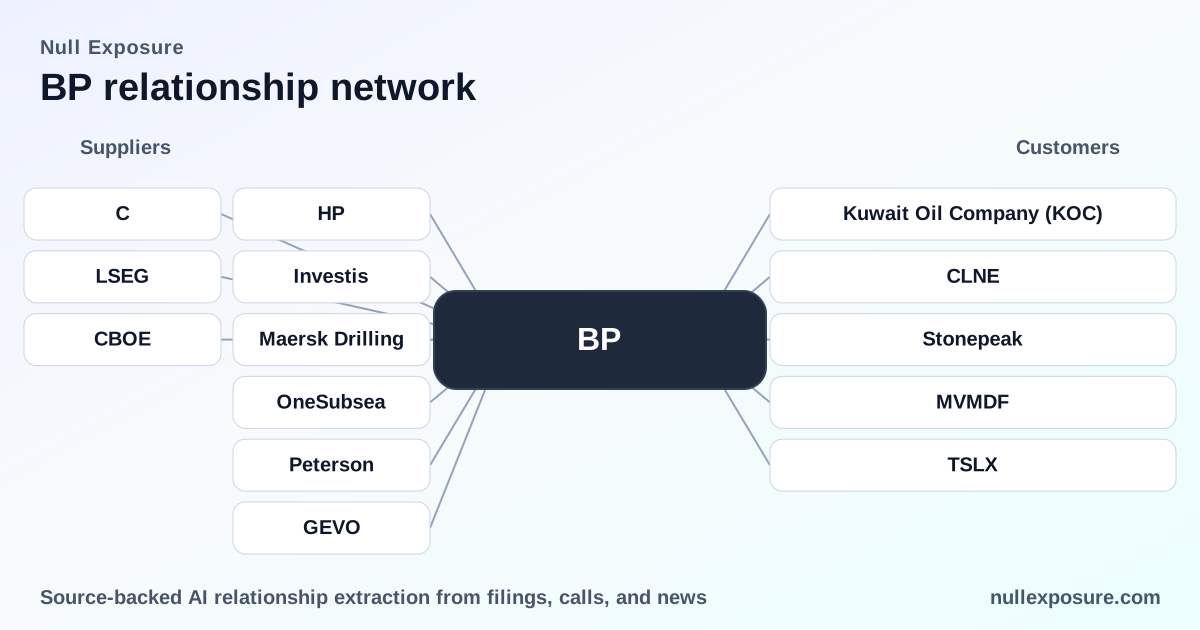
BP’s supplier footprint: operational contractors, market partners, and transition suppliers that move the needle
BP is a global integrated energy company that monetizes through upstream production, downstream refining and marketing, commodity trading, and strategic joint ventures; its supplier relationships therefore span drilling contractors, subsea and logistics firms, renewable feedstock providers, and capital markets infrastructure. With roughly $187.6 billion in trailing revenue and a market capitalization near $110 billion (FY2025–FY2026 figures), BP’s economics are driven by scale in commodity flows and the reliability of third-party contractors for field development and delivery. For investors, supplier signals are a direct read on operational continuity and the trajectory of BP’s energy-transition sourcing. Learn more at https://nullexposure.com/.
The investor lens: why these suppliers matter right now
BP’s supplier set reveals a mixed contracting posture: long-term joint ventures and project operatorship on one hand, and award-based service contracts on the other. That mix produces two actionable investor facts: (1) critical services—drilling, subsea installation, and logistics—are outsourced to large-cap specialists, which concentrates execution risk in a small pool of specialized contractors; (2) BP is also buying renewable inputs and engaging market infrastructure partners, which signals parallel investment in transition supply chains alongside legacy hydrocarbon activity. These characteristics reduce capex burden while increasing the need for robust supplier management and contract oversight.
BP’s capital-return activity and trading/market-data arrangements are equally material for equity investors: public reports show active buybacks and the use of market-data vendors for investor communications. Those items affect liquidity, shares outstanding, and how the market prices BP’s operational performance versus capital allocation. If you want a deeper, sourced scan of these supplier relationships, visit https://nullexposure.com/ for a vendor-level view.
What the supplier list tells you about concentration, criticality and maturity
- Concentration: Supplier roles are concentrated by function—drilling and subsea are handled by a handful of specialist contractors—so operational outages at a contractor level can meaningfully impact field schedules.
- Criticality: Subsea and drilling contractors are high-criticality providers for production ramps; logistics subcontractors are mission-critical for installation windows.
- Maturity and transition exposure: BP uses established oil & gas service providers for legacy projects while sourcing renewable natural gas and partnering with market infrastructure providers, showing parallel maturity tracks within the supply base.
These are company-level signals derived from public supplier disclosures and press activity, not constraints tied to any single supplier.
Detailed supplier ties uncovered in public reporting
Helmerich & Payne — Caspian drilling contract renewal
BP awarded a contract renewal in the Caspian Sea to a Helmerich & Payne joint venture, confirming continued reliance on specialized drilling contractors for offshore projects (press coverage March 9, 2026). Source: The Globe and Mail press release coverage (https://www.theglobeandmail.com/investing/markets/stocks/BP/pressreleases/441687/bp-plc-bp-gets-a-hold-from-dbs/ and https://www.theglobeandmail.com/investing/markets/stocks/BP/pressreleases/405498/berenberg-bank-remains-a-buy-on-bp-plc-bp/).
Investis — market-data delivery for investor communications
BP’s investor pages and quarterly reporting reference market data delivered by Investis (market data delayed by 20 minutes), reflecting one of BP’s market-data and communications suppliers for investor-facing content (Q4 2025 materials). Source: BP press material and investor pages on bp.com (https://www.bp.com/en/global/corporate/news-and-insights/press-releases/fourth-quarter-2025-results.html and https://www.bp.com/en/global/corporate/investors/results-reporting-and-presentations/quarterly-results-and-webcast.html).
Maersk Drilling — awarded Matapal wells contract (histor)
Maersk Drilling won a multi-well contract to drill three wells for the Matapal project operated by BP Trinidad and Tobago (BPTT), demonstrating BP’s use of specialist offshore drilling services for Caribbean gas development (project history reported in 2019, cited in 2026 aggregation). Source: NS Energy Business project summary (https://www.nsenergybusiness.com/projects/matapal-gas-project/).
OneSubsea — key subsea contractor on Matapal
OneSubsea was engaged as the primary subsea contractor for the Matapal project, indicating BP’s reliance on integrated subsea suppliers for critical subsea production infrastructure. Source: NS Energy Business project summary (https://www.nsenergybusiness.com/projects/matapal-gas-project/).
Peterson — logistics subcontractor for subsea works
Peterson was subcontracted by OneSubsea to provide logistics and heavy-lift services for Matapal subsea structures, illustrating the layered subcontracting model BP uses for installation logistics. Source: NS Energy Business project summary (https://www.nsenergybusiness.com/projects/matapal-gas-project/).
Gevo Inc. — renewable natural gas supply agreement (U.S.)
BP contracted to obtain renewable natural gas produced by Gevo’s northwest Iowa project for sale into California markets, showing BP’s commercial procurement of biogas/RNG to meet lower-carbon fuel demand. Source: Rigzone reporting on the supply agreement (https://www.rigzone.com/news/wire/bp_buys_natgas_supplies_derived_from_cow_manure-10-aug-2021-166145-article/).
Citigroup Global Markets Limited — execution agent on share purchases
Public filings and reporting show repeated purchases executed by Citigroup Global Markets Limited as part of share buyback activity intended to move shares into treasury, illustrating the role of investment banks in BP’s capital-return mechanics (reported in FY2026 filings aggregation). Source: StockTitan SEC filing aggregation referencing buyback execution (https://www.stocktitan.net/sec-filings/BP/page-4.html).
London Stock Exchange — venue for buyback execution
BP executed share buybacks on the London Stock Exchange (3,053,288 ordinary shares reported in January 2026), indicating the LSE’s role as a primary execution venue for BP’s capital-return program. Source: TradingView reporting of the buyback (https://www.tradingview.com/news/tradingview:f6088ed4255b1:0-key-facts-bp-trades-50-000-tons-of-gasoline-stock-falls-1-amid-tariffs/).
Cboe (UK) — alternative buyback execution venue
BP also executed share purchases on Cboe (UK) as part of the same buyback activity, showing the use of multiple execution venues to complete treasury purchases. Source: TradingView reporting of the buyback (https://www.tradingview.com/news/tradingview:f6088ed4255b1:0-key-facts-bp-trades-50-000-tons-of-gasoline-stock-falls-1-amid-tariffs/).
Investment implications and risk checklist
- Operational risk: A small group of specialist contractors handles the most critical field activities; schedule slips or contractor disputes will translate quickly into production and cashflow impacts.
- Transition optionality: BP’s procurement of renewable natural gas from Gevo signals active sourcing in lower-carbon fuels, which supports future margin diversification.
- Capital allocation visibility: Repeated buyback executions executed by major brokers and exchanges reduce shares outstanding and are a visible lever management is using to manage per-share metrics.
- Counterparty diversification: The supplier list spans tier-1 drilling and subsea contractors, local logistics firms, renewable feedstock providers, and capital markets partners—diversified by function but concentrated by critical services.
For further supplier-level intelligence and to see how these relationships map onto contract terms and concentration risk, visit our research hub at https://nullexposure.com/.
Bottom line for operators and investors
BP’s supplier footprint is a mix of high-criticality service providers for legacy hydrocarbon projects and select new-economy suppliers for renewable inputs, combined with conventional capital-market vendors that support buybacks and investor communications. Investors should treat supplier performance and contract continuity as a first-order input to production and cashflow forecasting, and monitor renewable-supply contracts for signals about BP’s transition execution. For a deeper supplier-risk evaluation and real-time tracking, go to https://nullexposure.com/.