Blueport Acquisition Ltd Rights (BPACR): Supplier footprint and governance signals investors need
Blueport Acquisition Ltd Rights (ticker BPACR) is a SPAC instrument — a warrant/rights vehicle that gives investors exposure to a management-led search-and-combine strategy focused on technology-driven consumer product companies. The economic proposition is straightforward: Blueport funds sponsor and administrative structures are in place to identify a target, complete a business combination, and convert warrants/rights into long-term equity value for public holders; until a business combination closes, the company carries a minimal operating cost base and outsources essential administrative functions. Revenue is not generated today; value is realized through a successful merger or exercise event.
For a deeper, structured supplier and counterparty analysis for SPACs and other special-purpose issuers, visit the NullExposure research hub: https://nullexposure.com/
What a lightweight supplier list signals about Blueport's operating model
Blueport’s public filings and the supplier items disclosed indicate a lean operating model built around outsourced administrative services rather than internal operating divisions. That posture produces three practical characteristics for investors:
- Contracting posture — transactional and short-term: The disclosed arrangement is a month-to-month consulting engagement for CFO services, consistent with SPACs preserving flexibility and minimizing fixed payroll commitments.
- Concentration — high single-vendor dependence: When critical functions such as CFO responsibilities are outsourced to a single consulting firm, that creates concentration risk even when absolute dollars are small.
- Criticality and maturity — essential services on a low-cost footing: CFO services are operationally critical to regulatory and transactional execution; Blueport’s arrangement cuts overhead but places essential execution in a small external provider, consistent with a pre-combination, early-stage SPAC.
These traits define the supplier risk profile investors must underwrite when valuing a rights/warrant instrument like BPACR. For investor-level queries and supplier coverage of related SPACs, NullExposure maintains consolidated supplier intelligence at https://nullexposure.com/
Relationship inventory: who Blueport pays and why
Below I cover every supplier relationship disclosed in the public results for BPACR.
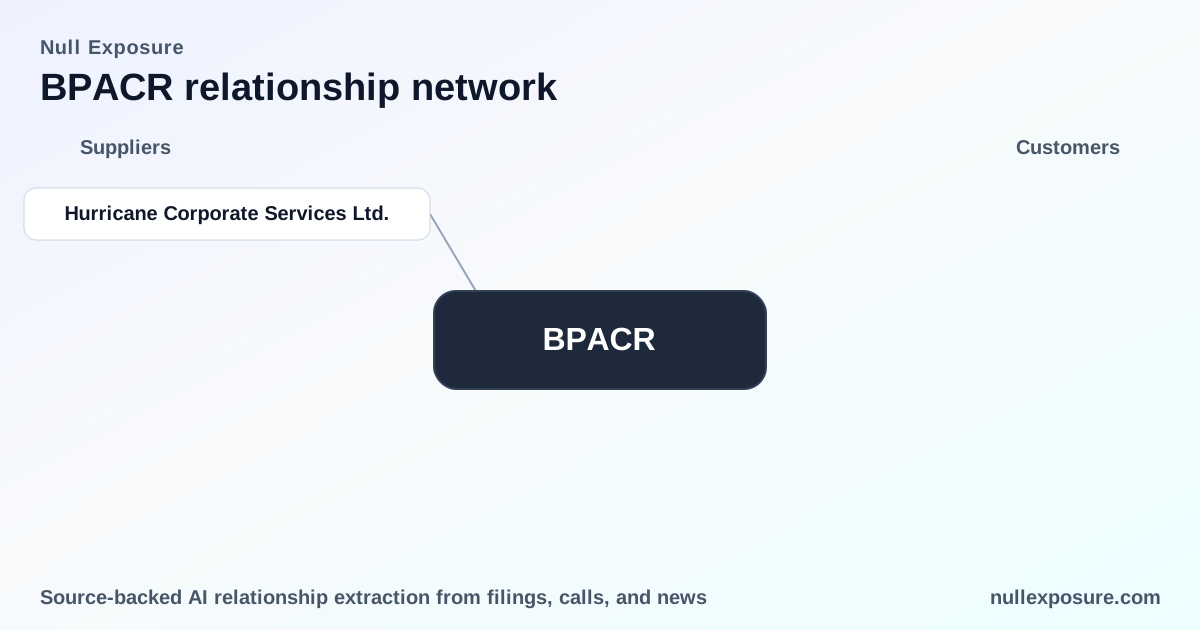
- Hurricane Corporate Services Ltd. — Blueport entered a consulting agreement with Hurricane Corporate Services Ltd., a firm controlled by Chief Financial Officer Kulwant Sandher, for CFO services at $3,000 per month plus reimbursed expenses, documented as of November 11, 2025. The arrangement is a related-party consulting contract providing outsourced financial leadership at a modest fixed monthly fee. Source: an 8‑K reproduced on StockTitan reporting the November 11, 2025 consulting agreement (filed FY2026) — https://www.stocktitan.net/sec-filings/BPAC/8-k-blueport-acquisition-ltd-reports-material-event-b7d97417cdc7.html
Governance and risk implications investors must price in
Blueport’s disclosed supplier relationship is small in dollar terms but carries outsized governance significance. A related-party consulting agreement for the CFO function immediately raises oversight and conflict-of-interest questions that institutional investors should evaluate before allocating capital to a rights/warrant instrument.
Key governance and risk points:
- Related-party transaction: The CFO controls the consulting firm that is contracted for essential finance functions; this elevates the need for independent board oversight and clear disclosure of terms and approvals.
- Concentration risk despite low cost: The CFO function is mission-critical to SEC filings, SPAC combination execution, and investor communications; reliance on a single consultant concentrates operational dependency.
- Disclosure maturity: Blueport’s public disclosures identify this arrangement explicitly; that clarity is a positive signal for transparency, but investors should track subsequent filings for any expansion of related-party services or fees.
Constraints and company-level signals
The supplier review returned no explicit contractual constraints or vendor-level restrictions. That absence is itself a company-level signal: Blueport currently discloses no external supplier constraints that would materially limit execution of its SPAC mandate. In practical terms, this aligns with the SPAC lifecycle stage — pre-combination entities typically maintain minimal supplier commitments and preserve flexibility to execute a business combination.
Monitoring checklist for investors and operators
Investors evaluating BPACR should focus on a short list of operational and governance triggers that change the risk profile quickly:
- Track subsequent 8‑K and proxy filings for any expansion of related-party services, changes in consulting fees, or new supplier engagements.
- Review independent board composition and approvals associated with related-party contracts to assess governance rigor.
- Monitor SPAC timeline and capital events (vote schedules, extensions, redemption levels) that drive whether lightweight supplier arrangements remain adequate or require scaling.
- Watch for other disclosure of supplier concentration as the search progresses and transactional complexity increases.
These items are immediate, actionable due diligence lines for investors sizing exposure to BPACR warrants. If you want systematic coverage of supplier relationships across SPACs, see our platform at https://nullexposure.com/
Bottom line — what this means for BPACR holders
Blueport’s supplier footprint is intentionally compact: one disclosed related-party consulting agreement handling the CFO role at a modest monthly fee. That structure supports low operational burn but introduces governance and concentration considerations that are disproportionate to the dollar value. For rights/warrant investors, the dominant valuation driver remains the success of the business combination; supplier signals refine the governance premium or discount you apply to that core outcome.
For a consolidated supplier-risk view and timely alerts tied to SEC filings and governance events, visit NullExposure and subscribe to tailored monitoring: https://nullexposure.com/
Key takeaways: lean cost base, related‑party CFO contract, concentration of an essential function — price governance accordingly.