Popular Inc (BPOP) — supplier relationships and what they mean for investors
Popular, Inc. is a regional bank that earns money from deposit spreads, fee income on retail and commercial banking services, mortgage origination and servicing, and payment-processing channels. Operationally the company outsources key transaction processing and security functions while funding itself with a mix of stable customer deposits and short-term secured borrowings; that hybrid results in high vendor dependence for infrastructure and concentrated funding levers that directly affect credit and operational risk. For investors, the core thesis is simple: Popular’s economic returns are driven by deposit franchise strength and fee-bearing payment channels, but vendor concentration and cybersecurity exposure are primary non-credit risks to monitor.
Explore deeper supplier intelligence at https://nullexposure.com/.
Why suppliers matter to Popular’s investment case
Popular’s business model monetizes a broad retail and commercial footprint in Puerto Rico and the U.S. mainland via lending margins and transaction fees. That model depends on outsourced operational plumbing — transaction processors, infrastructure and cybersecurity partners — and on access to both public‑sector and private liquidity markets. The 2024 10‑K frames these relationships as not peripheral but operationally critical, highlighting both the upside of scale and the downside of third‑party failure. Investors should prioritize counterparty continuity and cyber-resilience when assessing Popular’s risk-adjusted valuation.
Direct supplier relationships you need on the radar
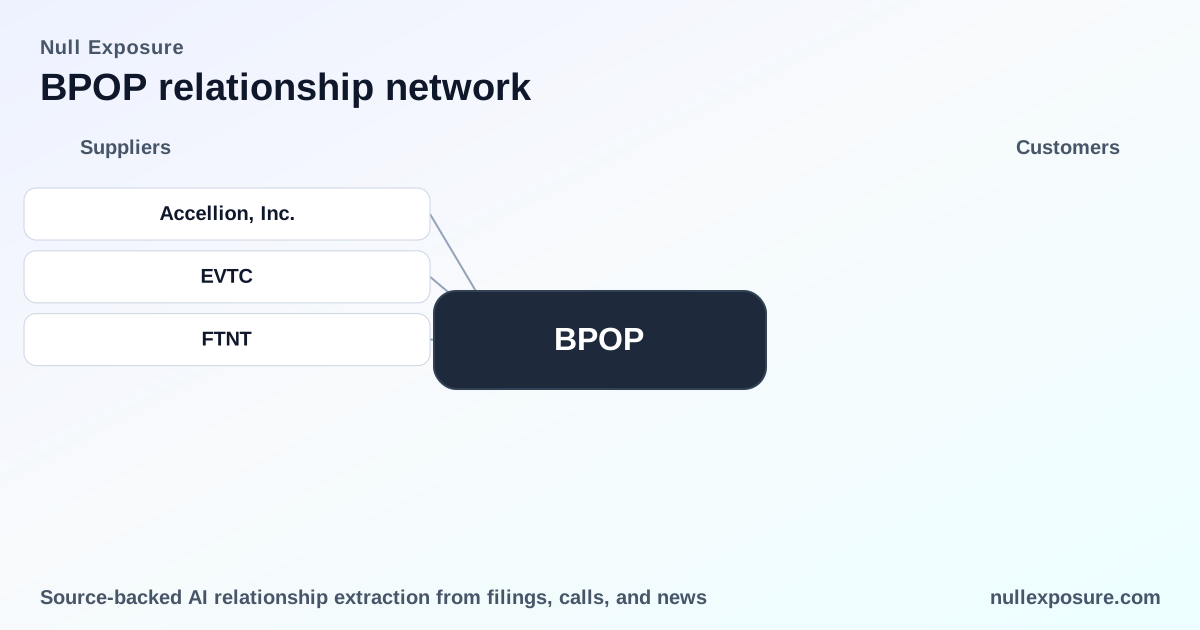
Accellion, Inc.
Popular’s public filings recount the 2021 security breach of Accellion’s File Transfer Appliance tool and cite it as a past vendor incident that affected their risk posture. According to Popular’s 2024 Form 10‑K, the Accellion compromise is referenced as part of the company’s vendor cybersecurity history, underscoring the bank’s sensitivity to third‑party file‑transfer and legacy tooling risks.
Evertec (operationally indispensable)
Popular’s 2024 Form 10‑K identifies Evertec as “the most important of these third‑party service providers,” noting that the bank depends on Evertec for core financial transaction processing and for identification and remediation of certain cybersecurity vulnerabilities. This is a strategic, active service‑provider relationship with direct operational criticality and materiality to Popular’s ability to run payments and customer channels (Popular 2024 10‑K).
Evertec (strategic channel transaction and transformation)
A March 2026 news report about leadership changes at Popular references a transaction to acquire key customer‑facing channels from Evertec and credits management with expanding the auto business and modernizing delivery channels—actions that position Evertec-related assets at the center of Popular’s customer experience strategy. That public commentary frames Evertec not only as an outsourced supplier but as a strategic counterparty tied to distribution and digital modernization (newsismybusiness.com, March 2026).
Fortinet
Popular’s 2024 Form 10‑K also calls out a 2024 incident where threat actors exploited a zero‑day in Fortinet enterprise management server software as used by Evertec, linking vendor‑side vulnerabilities to Popular’s vendor chain. The disclosure highlights the transmitted cyber‑risk that Popular inherits when its critical vendors operate on third‑party security stacks (Popular 2024 10‑K).
What the constraints tell investors about Popular’s operating model
Popular’s supplier constraints, drawn from the company’s filings, paint a coherent operating profile:
-
Contracting posture: Popular balances long‑term exclusivity commitments (evidence of extended exclusivity through 2035 and ATH network commitments through 2030) with ubiquitous short‑term funding practices (repurchase agreements that are generally overnight). This split creates durability in customer channels while leaving liquidity exposed to short‑term market stress.
-
Concentration and criticality: Public filings emphasize heavy reliance on deposits (customer, brokered and public funds represented ~89–90% of funding at year‑end 2024) and explicitly call out Evertec as the most important third‑party service provider, establishing both funding concentration and vendor concentration as primary systemic risks.
-
Relationship posture and maturity: Vendor relationships are described as active and service‑provider oriented, not experimental: Popular engages external partners for core transaction processing and cybersecurity remediation rather than niche services, indicating mature, mission‑critical outsourcing.
-
Geography and funding scope: Popular operates across Puerto Rico, the U.S. mainland and selected territories, but its funding strategy is global — the company sources secured funding from a diverse, worldwide counterparty set when appropriate, while retaining sizable Puerto Rico public sector deposits domestically.
-
Spend scale and liquidity levers: Filings show single line items such as $225 million in FHLB advances and access to the Federal Reserve discount window (unused balances noted), signaling meaningful short‑term borrowing capacity and >$100m spend bands on infrastructure and liquidity.
Together, these constraints show a bank that locks down distribution through long-term commercial terms while financing growth and daily needs with short-duration liquidity — an operational mix that amplifies the importance of vendor continuity and funding flexibility.
Investment implications — risk and monitoring checklist
- Vendor concentration is an active, material risk. Evertec’s designation as the most important service provider means a single vendor operational failure could materially disrupt transaction processing and customer channels. Monitor vendor remediation plans, SLAs, and transition options.
- Cybersecurity is a cross‑vendor vector. Prior references to the Accellion breach and Fortinet zero‑day in the vendor chain highlight systemic exposure; investors should watch third‑party penetration testing results and incident response governance.
- Funding is hybrid and potentially procyclical. High deposit share supports margins in stable environments, while reliance on short‑term secured funding creates liquidity sensitivity in stress events; track brokered‑deposit behavior and access to Fed facilities.
- Contractual duration hedges distribution risk but raises lock‑in. Long‑term exclusivities secure channels but reduce flexibility if a vendor underperforms; investors should evaluate contractual exit clauses, indemnities and service credits.
Explore supplier‑level risk scoring and ongoing monitoring at https://nullexposure.com/ — we curate the vendor signals that matter for balance‑sheet‑level analysis.
Final takeaways and recommended next steps for investors
Popular is a well‑capitalized regional bank with a strong deposit franchise and attractive returns on equity, but its operating model makes it sensitive to vendor continuity and cybersecurity failures. The clearest single relationship risk is Evertec, which is functionally critical and tied to Popular’s ability to process transactions and remediate security issues; Fortinet and Accellion disclosures demonstrate how third‑party vulnerabilities can transmit to Popular. From an investor perspective, the company-level constraints — long‑term channel commitments versus short‑term funding practices, government deposit concentration, and >$100m liquidity lines — are the structural levers that determine downside in stress scenarios.
If you are evaluating Popular for a buy, hold, or operational due diligence position, prioritize vendor resilience metrics, contractual protections, and liquidity contingency plans in your next round of questions. For structured supplier intelligence and continuous monitoring tailored to financial portfolios, visit https://nullexposure.com/.