Bluerock Private Real Estate Fund (BPRE): How the fund leverages a public listing to monetize private real estate
Bluerock Private Real Estate Fund (BPRE) operates as a closed-end real estate investment vehicle that packages private real estate cash flows for public investors and monetizes through asset-level income distributions and manager fee capture while providing liquidity via an exchange listing. Investors access private real estate yield plus liquidity; Bluerock captures management and performance fees and benefits from listing-level market access and distribution visibility. For more supplier-relationship intelligence on funds and their public partners, visit https://nullexposure.com/.
Market context and business model in plain terms
- BPRE is structured as a closed-end fund that holds income-generating real estate and distributes cash to shareholders on a monthly schedule; listing on a major exchange converts otherwise illiquid private positions into tradable shares.
- Primary revenue drivers are net operating income from the real estate portfolio passed through to shareholders, and management/incentive fees retained by the sponsor. Listing and distribution cadence create predictable touchpoints with capital markets and retail/intermediary channels.
- The fund’s public listing changes operating posture: contracting and counterparty relationships shift toward exchange rules, broker-dealer distribution channels, and disclosure obligations, increasing the importance of exchange counterparties and market makers for liquidity.
Read more about supplier relationships and market access at https://nullexposure.com/ to evaluate counterparties and contractual posture.
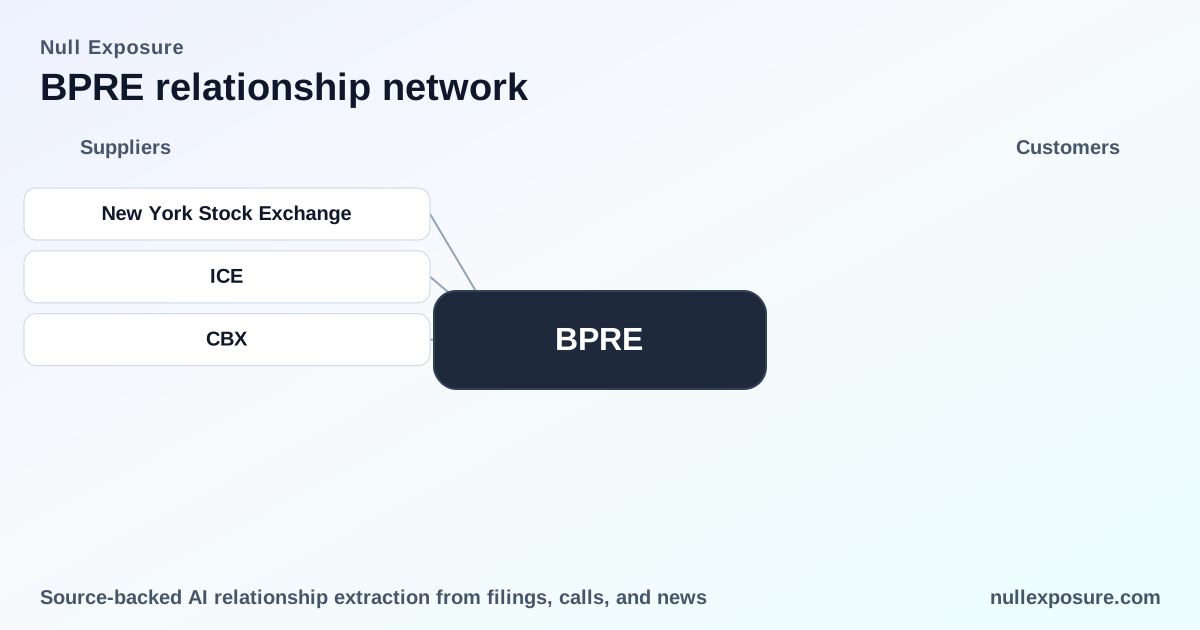
What a list on the NYSE changes for a real estate fund Listing on the New York Stock Exchange makes several operating characteristics explicit. Concentration of critical counterparties increases — the exchange becomes a central supplier for trading and liquidity mechanics; market makers and broker-dealers act as secondary suppliers. Contracting posture tilts toward standardized exchange rules and ongoing disclosure, reducing bespoke bilateral contracting but increasing regulatory and market-compliance obligations. Maturity of the relationship is immediate and continuous: the exchange relationship is active from IPO/listing and persists as long as shares trade.
Documented relationship coverage (each result from public reporting)
PR Newswire — Monthly distribution announcements (March 2026)
Bluerock issued a PR Newswire release announcing the fund’s monthly distribution for March 2026, reinforcing the fund’s operating focus on regular cash distributions to shareholders as part of its monetization strategy. Source: PR Newswire press release, March 2026 — https://www.prnewswire.com/news-releases/bluerock-private-real-estate-fund-announces-monthly-distribution-for-march-2026-302703378.html
PR Newswire — Increased distributions for March and April (February 2026 release)
A PR Newswire statement in February 2026 declared February distributions and announced increased distributions for March and April, signaling active cash-flow management and distribution policy adjustments that affect investor yield expectations and secondary-market demand. Source: PR Newswire press release, February 2026 — https://www.prnewswire.com/news-releases/bluerock-private-real-estate-fund-announces-february-2026-distribution-and-declares-increased-distributions-for-march-and-april-2026-302681003.html
PR Newswire — Monthly distribution for January 2026
The fund’s January 2026 distribution was announced via PR Newswire, underscoring the monthly payout cadence that is central to the fund’s retail appeal and to the exchange-listed product positioning. Source: PR Newswire press release, January 2026 — https://www.prnewswire.com/news-releases/bluerock-private-real-estate-fund-announces-monthly-distribution-for-january-2026-302663630.html
Morningstar coverage — listing rationale and investor liquidity (FY2025)
Morningstar reported on Bluerock’s decision to list a closed-end vehicle on the NYSE as a long-term liquidity solution, noting that the listing provides shareholders an on-ramp to sell shares rather than rely on private fund redemption processes. This coverage frames the exchange relationship as a strategic supplier of liquidity for legacy private funds transitioning to public vehicles. Source: Morningstar commentary, FY2025 — https://www.morningstar.com/funds/bluerocks-listing-fund-of-private-funds-squeezes-investors
InvestmentNews — market-entry pricing and NAV questions (FY2025)
InvestmentNews covered the fund’s forthcoming NYSE listing and flagged concerns about NAV valuation and price discovery on the debut trading day, highlighting that exchange listing exposes the fund to immediate market pricing risk and the critical role of exchange liquidity providers. Source: InvestmentNews, FY2025 — https://www.investmentnews.com/independent-broker-dealers/bluerock-real-estate-fund-to-list-next-week-but-at-what-price/263474
Operating-model constraints and supplier posture There are no supplier-specific contractual constraints provided in the reviewed information; that absence is itself informative: the public reporting focuses on exchange-linked activity (listings and distributions) rather than bespoke supplier contracts. At the company level, this yields several practical signals:
- Contracting posture: Standardized and exchange-centric rather than highly customized bilateral supplier agreements. The NYSE relationship is governed by listing rules and ongoing disclosure obligations rather than confidential supply contracts.
- Concentration: Exchange and market liquidity intermediaries are critical, centralized counterparties for trading and distribution mechanics.
- Criticality: Exchange access and the integrity of monthly distributions are mission-critical to investor confidence and secondary-market value; any disruption to trading mechanics or distribution capability is high impact.
- Maturity: The NYSE and listing-support relationships are continuous and foundational from listing forward; distribution cadence creates frequent operational touchpoints.
Key takeaways for investors and operators
- Listing equals liquidity but introduces market-price volatility. The NYSE connection provides tradability but exposes NAV-sensitive funds to immediate public pricing and market scrutiny (InvestmentNews, FY2025).
- Distributions are central to investor product positioning. Repeated PR Newswire announcements across January–March 2026 confirm a deliberate monthly distribution program that influences yield expectations and retail demand.
- Exchange and market-intermediary relationships are the primary supplier risk vector. Operational resilience of trading infrastructure and market-making support is essential to preserve liquidity and fair price discovery.
Actionable next steps
- For counterparty diligence on exchange and liquidity providers, consult our supplier intelligence toolkit and market-impact briefs at https://nullexposure.com/.
- If you evaluate fund-level counterparties or distribution partners, combine exchange disclosure with third-party market commentary to triangulate pricing and operational risk; our research portal can accelerate that process: https://nullexposure.com/.
Conclusion Bluerock Private Real Estate Fund has pivoted private real estate cash flows into a public, exchange-listed product where monetization flows from asset income and manager fees while liquidity is supplied through the NYSE ecosystem. Investors and operators should treat the exchange as the fund’s primary supplier relationship and monitor distribution cadence and market-making support as the main operational dependencies. For deeper supplier analyses and tailored counterparty assessments, visit https://nullexposure.com/.