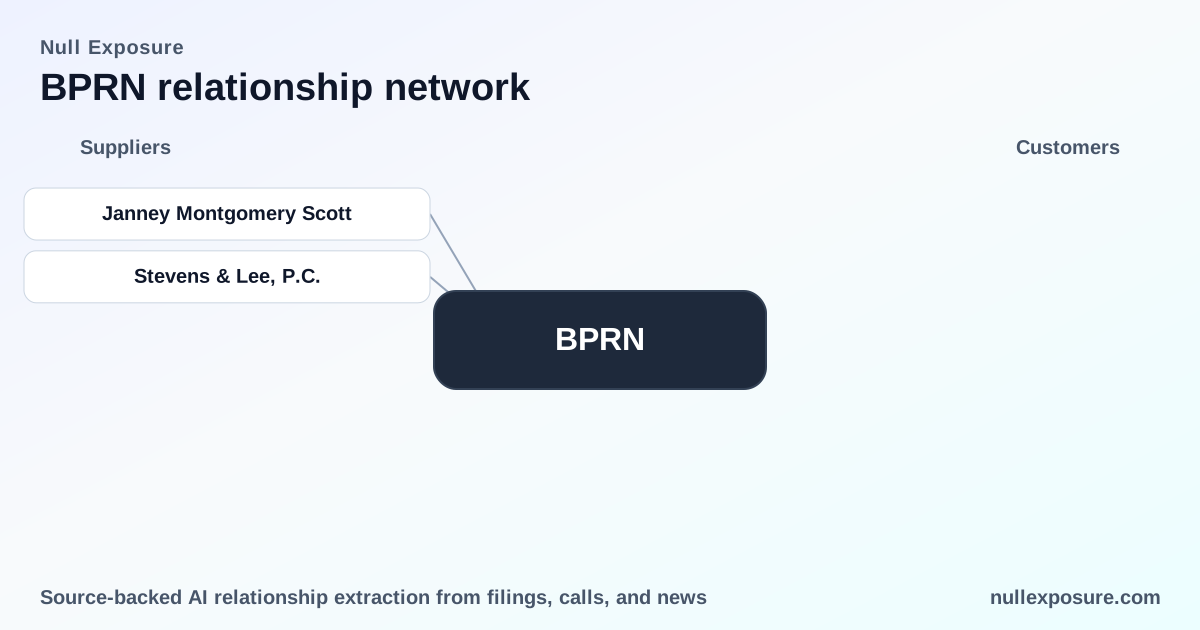
Bank of Princeton (BPRN) — supplier relationships and what they mean for investors
The Bank of Princeton is a regional commercial bank that monetizes primarily through net interest income (loan spreads on a deposit base), fee income, and selective M&A-driven growth. Its balance sheet economics are tied to deposit stability, loan origination margins, and access to secured wholesale funding; strategic advisors and outside counsel are deployed when the bank pursues acquisitions or restructures operations. For an investor evaluating counterparty and supplier exposure, the near-term picture is one of active deal activity supported by traditional financial advisors and law firms, combined with a funding profile that mixes short-term borrowings and longer-term operating lease commitments. Explore more analysis and relationship mapping at https://nullexposure.com/.
Quick read: what the disclosed suppliers are doing for BPRN
Hitting the headlines in March 2026, The Bank of Princeton disclosed two visible supplier relationships tied to a corporate transaction:
Janney Montgomery Scott — financial advisor on the Noah Bank deal
Janney Montgomery Scott served as financial advisor to The Bank of Princeton in its announced acquisition of Noah Bank, supporting transaction structuring and execution. A CityBiz article covering the acquisition noted Janney’s role in the deal announcement (CityBiz, March 9, 2026: https://www.citybiz.co/article/337186/the-bank-of-princeton-to-acquire-noah-bank/).
Stevens & Lee, P.C. — external legal counsel to the bank
Stevens & Lee, P.C. is acting as legal counsel to The Bank of Princeton in connection with the same acquisition, providing documentation and regulatory support for the transaction. The firm’s engagement was reported in the same CityBiz article on March 9, 2026 (CityBiz, March 9, 2026: https://www.citybiz.co/article/337186/the-bank-of-princeton-to-acquire-noah-bank/).
What the supplier mix signals about operating posture
The presence of a national investment bank as advisor and a regional corporate law firm as counsel is consistent with a small regional bank executing a governance‑approved acquisition. These relationships are transaction-focused, indicating episodic external spend tied to M&A rather than ongoing large-scale outsourcing. At the company level, several constraints pulled from corporate disclosures clarify broader operating characteristics:
- Contracting posture: The bank uses both short-term secured funding (FHLB-NY overnight and short-term advances) and longer-dated non-cancelable operating leases for branches and operations. That mix shows a strategy of flexible liquidity supplemented by fixed real-estate commitments.
- Liquidity capacity: The bank reported a very large maximum borrowing capacity with the FHLB-NY — $614.8 million maximum with $554.8 million available as of December 31, 2024 — which positions the bank to access meaningful secured liquidity relative to its size.
- Short-term facility availability: Company disclosures also note $10.0 million of available short-term borrowing capacity with ACBB intended for liquidity generally for periods not more than 14 days.
- Supplier role and maturity: The bank classifies certain third-party relationships as service providers tied to long‑term leases, indicating multi-year operational dependencies for branches and its operations center.
These constraints read collectively as a bank that balances short-term funding flexibility with long-term fixed-cost commitments. Investors should treat these as company-level characteristics, not as attributes of any single supplier.
Operational implications for investors and operators
The supplier disclosures and contract signals produce concrete implications for governance, risk, and capital planning:
- Funding optionality is a strength. The large FHLB capacity is a meaningful liquidity buffer versus peers of similar scale; this reduces immediate refinancing risk but creates a reliance on secured borrowing markets.
- Transaction-related vendor spend is concentrated and episodic. Using Janney and Stevens & Lee for the Noah Bank deal is normal for a regional bank pursuing acquisition-driven growth; expect advisor and legal fees to spike during deal windows.
- Fixed-cost footprint is persistent. Non-cancelable leases for branches and the operations center impose steady operating leverage that will not adjust quickly if loan demand or margins compress.
- Counterparty criticality is moderate. Financial advisors and law firms are critical for execution of M&A but are replaceable; the greater operational concentration risk sits with funding counterparties and real-estate lessors.
Key takeaways for portfolio managers and operators:
- Monitor utilization of FHLB capacity against loan growth and deposit trends.
- Budget for episodic advisor and legal fees when modeling acquisition scenarios.
- Stress-test earnings against sustained margin compression given non-cancelable lease obligations.
If you want a concise map of supplier exposure and contract posture for BPRN, visit https://nullexposure.com/ for our relationship intelligence and alerts.
Deal partners to watch and next steps for due diligence
The immediate items to track with respect to the named suppliers and the bank’s operating profile:
- For Janney Montgomery Scott: confirm the scope of advisory engagement and fee schedule disclosed in the transaction proxy or press release to quantify near-term cash outflow (CityBiz, March 9, 2026).
- For Stevens & Lee, P.C.: review the legal opinion scope and potential contingent liabilities tied to the acquisition (CityBiz, March 9, 2026).
- For funding counterparties and leases: reconcile the bank’s FHLB availability and short-term ACBB capacity against loan-to-deposit and liquidity coverage scenarios in event of stress.
These steps align counterparties to balance-sheet sensitivity and show where supplier relationships convert into financial exposure rather than merely operational support.
Bottom line and investor action items
The Bank of Princeton is executing an acquisition strategy supported by established financial and legal advisors while operating with a hybrid liquidity posture: significant secured borrowing capacity and short-term credit lines alongside fixed branch leases. For investors, the primary risks are execution risk on the acquisition, fee volatility tied to transactional spend, and the bank’s sensitivity to funding markets if secured borrowing becomes constrained.
- Watch transaction disclosures for detailed fee schedules and any contingent indemnities.
- Monitor utilization of FHLB capacity and short-term lines against deposit trends.
For a centralized place to track supplier relationships, contract types, and counterparty risk for BPRN and peer banks, visit our homepage at https://nullexposure.com/ — we publish relationship-level summaries and alerts that align with the due-diligence steps above.
Investors and operators assessing BPRN should place its supplier relationships in the broader context of balance-sheet funding flexibility and fixed operational commitments; both dimensions will determine whether acquisition-driven growth converts into durable value or transient earnings pressure. For ongoing coverage and supplier intelligence, return to https://nullexposure.com/.