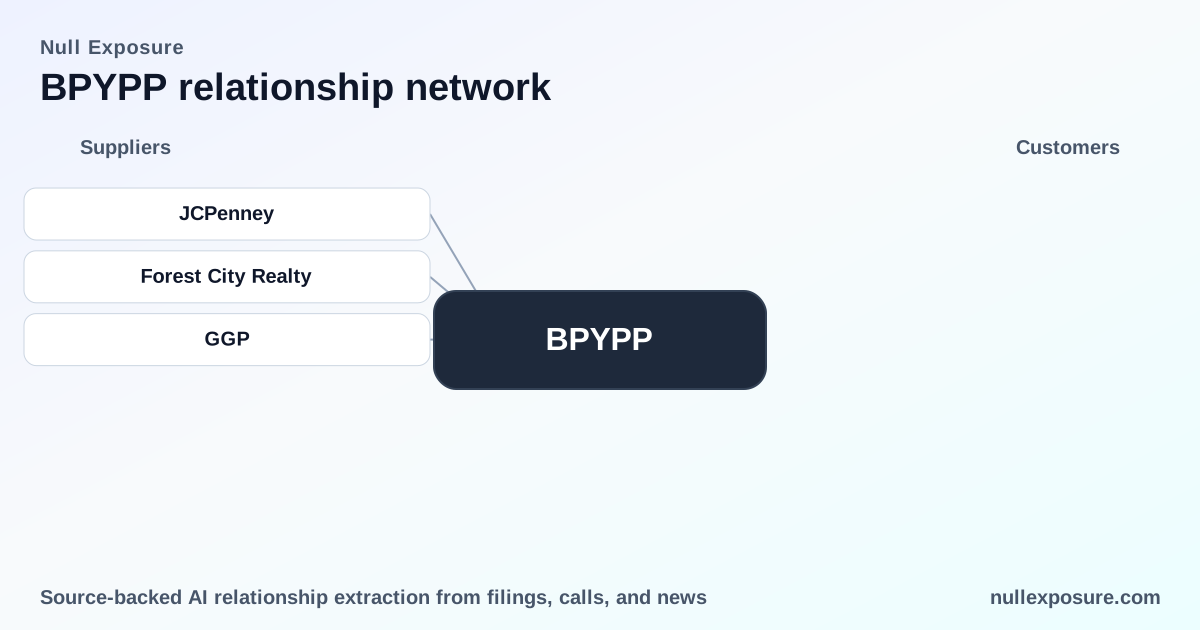
Brookfield Property Partners (BPYPP) — supplier relationships and what they mean for investors
Brookfield Property Partners operates and monetizes a global real estate platform by owning, managing and repositioning commercial properties and by packaging real estate exposures into publicly traded vehicles, including Brookfield Property REIT Inc. The company generates cash flow through leasing and property management, opportunistic asset sales, and capital-market issuance; its scale — roughly $88 billion in total assets — allows it to act as both landlord and strategic acquirer across retail, office and multifamily channels. For investors and operators assessing supplier relationships, BPYPP functions as a counterparty whose purchasing and leasing posture is shaped by asset-level economics, active portfolio optimization, and frequent capital-market overlays.
Learn more about supplier exposure analysis at https://nullexposure.com/.
Why supplier and tenant relationships matter for BPYPP investors
BPYPP is a capital-intensive owner-operator where tenant performance directly translates to cash flow and valuation. When Brookfield acts as landlord to national retail chains, its counterparty risk is simultaneously a sourcing risk for suppliers that service those tenants (construction contractors, mall operators, security/maintenance vendors). The firm's willingness to acquire, restructure or sell assets gives it an active contracting posture rather than a passive landlord profile. This operational posture increases both negotiating leverage and execution risk for counterparties.
From a business-model perspective, key characteristics investors should use to frame supplier risk:
- Contracting posture: Active acquirer and consolidator; negotiates from scale and transaction capability rather than simply long-term leases.
- Concentration: Large asset base across sectors reduces single-tenant dependence but creates regional clusters where tenant distress matters disproportionately.
- Criticality: Relationships with national retail tenants and large mall operators are highly critical to cash flow in retail-heavy assets.
- Maturity: A mature, institutional platform that can monetize through sales or REIT structuring, increasing the likelihood of portfolio-level reshuffles.
These are company-level signals that shape how BPYPP treats suppliers, procurement, and counterparties.
The relationship roster: what public mentions reveal
Below are the supplier/tenant relationships returned in the review, each with a concise investor-oriented description and a source reference.
JCPenney
Brookfield Property Partners and Simon Property Group jointly acquired JCPenney after the retailer’s distress, positioning Brookfield as both landlord and direct stakeholder in the chain’s restructuring and store network decisions. This creates direct commercial exposure for Brookfield to JCPenney’s operational performance and to suppliers serving those stores. According to a NorthJersey report on Willowbrook Mall (Feb 13, 2024), the retailer was acquired by its two largest landlords, Brookfield and Simon. (NorthJersey, Feb 2024)
Forest City Realty
Forest City Realty’s assets were part of a broader mall portfolio that Brookfield absorbed through transactions in 2018 and subsequently evaluated for sale; this historical acquisition underpins Brookfield’s retail footprint and ongoing divestment activity. Bisnow reported that Brookfield Property REIT planned to sell some U.S. mall assets accumulated when it acquired GGP and Forest City Realty. (Bisnow, reporting on FY2020)
GGP (inferred symbol: GGP)
Brookfield’s acquisition of GGP in 2018 materially expanded its U.S. mall holdings and remains a structural reason the firm is actively managing and, in places, disposing of mall assets; that legacy acquisition shapes tenant mixes and supplier contracts across multiple markets. Bisnow recounted that Brookfield bought GGP and Forest City Realty in 2018 for more than $20 billion combined and began a program of targeted asset sales. (Bisnow, reporting on FY2020)
What these relationships imply for operators and suppliers
The mentions collectively underscore three operational realities for anyone transacting with BPYPP:
- Counterparty centrality: National retail tenants such as JCPenney are not merely tenants but strategic levers; Brookfield’s ownership stakes in retailers elevate supplier exposure to tenant restructurings.
- Portfolio dynamism: The company actively sells and repositions assets, so long-term service contracts can be interrupted or renegotiated during disposals or JV formations.
- Scale governance: Brookfield’s scale enables it to standardize procurement and push for supplier consolidation, increasing bargaining power for the landlord and pressure on supplier margins.
These dynamics are consistent with the company’s financial profile: EBITDA of $3.102 billion and trailing revenue of $7.147 billion, with a market capitalization near $9.98 billion. Investors should note mixed profitability signals — operating margin ~9.5% but a negative net profit margin and modest ROE — which frame how aggressively management will manage costs and supplier agreements.
Explore supplier risk scoring and counterparty mapping tools at https://nullexposure.com/ to convert these operational signals into procurement action.
Practical takeaways for procurement teams and investors
- For suppliers: Anticipate renegotiation windows during asset sales and portfolio optimizations; prioritize contracts that include transferability and early-termination economics.
- For operators in malls: Tenant concentration matters — monitor Brookfield’s disposition plans in local markets, which can rapidly change the anchor mix and footfall assumptions.
- For investors: Use Brookfield’s active transactional posture to identify both downside (tenant restructurings, asset sales) and upside (value realization through disposals) in exposure modeling.
Final assessment and next steps
Brookfield Property Partners operates as a hands-on owner-operator with a scale-driven contracting posture, portfolio-level flexibility, and a retail footprint shaped by large acquisitions (GGP, Forest City) and strategic retail relationships (JCPenney). These characteristics create both negotiating leverage and execution risk for suppliers and require active monitoring from investors evaluating counterparty exposures.
For a practical supplier-credit or vendor-risk review tailored to Brookfield holdings and related tenants, visit https://nullexposure.com/ and request a focused exposure report.