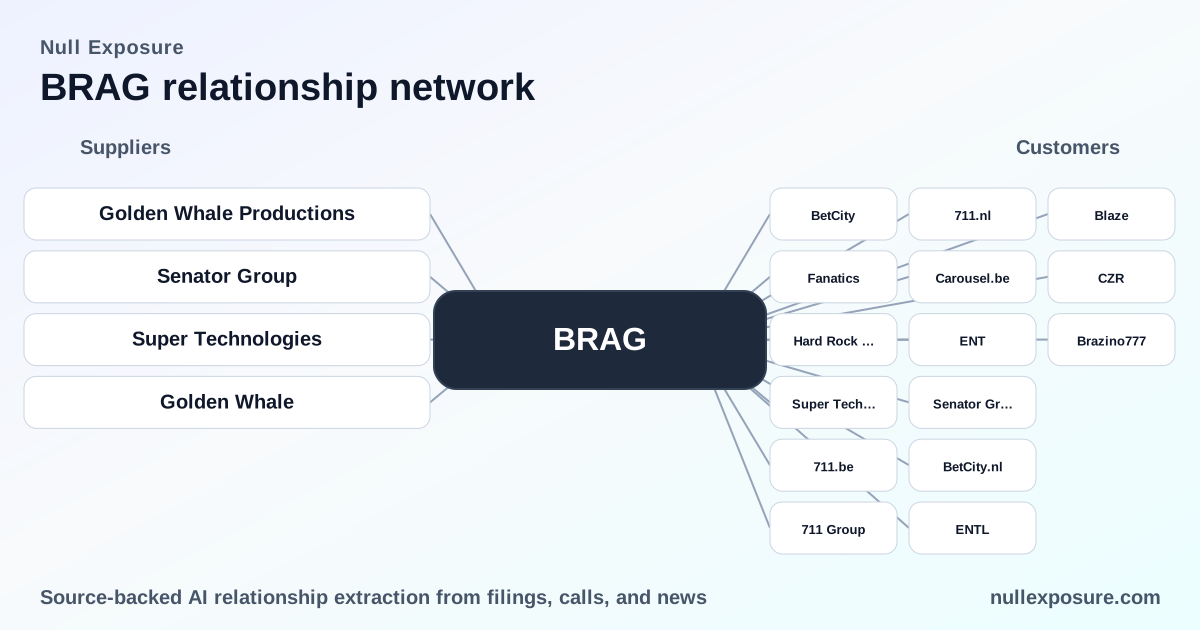
Bragg Gaming Group (BRAG) — Supplier Relationships and What They Mean for Investors
Bragg Gaming Group operates as a B2B online gaming supplier that sells content, platform services and player-account tooling to operators and platforms; it monetizes through content licensing, turnkey platform deals and revenue-share arrangements tied to operator volumes. Investors should view supplier ties as levers on product capability and go-to-market velocity: content and AI partnerships directly influence player retention and operator ARPU, while turnkey and delivery relationships determine how quickly Bragg can scale into new regulated markets.
Explore supplier risk profiles
How Bragg makes money and why suppliers matter
Bragg’s commercial model blends content licensing with platform services. The company reported Revenue TTM of $105.5M and Gross Profit TTM of $58.4M while remaining unprofitable at the operating level (Diluted EPS TTM -$0.33). These figures underline a business that generates meaningful top-line but needs stronger operating leverage. Supplier relationships are not optional add‑ons — they are strategic inputs that affect three investor-critical vectors:
- Product competitiveness: AI, analytics and content partners shape player engagement and lifetime value.
- Commercial reach: Turnkey and preferred-delivery arrangements accelerate operator onboarding and market entry.
- Cost and margin dynamics: Outsourced services can compress opex in the near term but create dependency and potential concentration risk if a supplier is critical.
Taken together, these dynamics indicate a contracting posture that combines platform licensing with strategic partnerships and a company at a mid-stage commercialization maturity: capable of recurring revenue but still consolidating profitability and market share.
The supplier relationships you need to track
Golden Whale Productions — AI / machine‑learning partner
Bragg signed a strategic partnership with Golden Whale Productions to integrate advanced machine-learning and proprietary AI models (called Foundation) into Bragg’s Player Account Management (PAM) platform to enhance predictive intelligence and player engagement. According to a foreign‑issuer report filed in March 2026 and several industry news outlets, this arrangement is positioned as a core element of Bragg’s roadmap to become AI-driven by 2027. Source: company filing and press coverage (March 2026) — https://www.stocktitan.net/sec-filings/BRAG/6-k-bragg-gaming-group-inc-current-report-foreign-issuer-0ef235c3f691.html; https://intellectia.ai/news/stock/kent-young-launches-predigy-aidriven-gaming-applications-set-to-disrupt-industry
Golden Whale — reporting variant that signals the same AI commitment
Multiple news feeds refer to the partner simply as Golden Whale, reinforcing that the AI alliance is being widely publicized across market channels and amplified in industry press. These reports reiterate the same point: integration of predictive AI into the PAM stack to drive engagement and retention. Source: headline coverage and market summaries (March 2026) — https://intellectia.ai/en/stock/BRAG/news
Senator Group — extended turnkey solution agreement
Bragg extended a turnkey solution deal with Senator Group, reflecting continued demand for Bragg’s end‑to‑end platform capabilities where operator clients prefer hosted, managed solutions rather than pure content feeds. This extension signals that Bragg is reinforcing commercial ties in markets where turnkey delivery accelerates operator adoption. Source: press report (Feb 2026) — https://www.stocktitan.net/news/BRAG/bragg-strengthens-executive-team-for-enhanced-content-strategy-north-c2vax3ruwq1e.html
Super Technologies — preferred content delivery partner
Bragg was selected as Super Technologies’ preferred content delivery partner to support the latter’s expansion plans, a relationship that emphasizes content distribution and white‑label delivery rather than back‑end platform services. This type of preferential supplier status typically converts into higher volume content placements and can improve utilization of Bragg’s content catalog. Source: press report (Feb 2026) — https://www.stocktitan.net/news/BRAG/bragg-strengthens-executive-team-for-enhanced-content-strategy-north-c2vax3ruwq1e.html
What these relationships imply for risk and upside
These supplier ties are directional signals about how Bragg is prioritizing product and commercial investments. Key takeaways:
- Upside driver — AI-enabled PAM: The Golden Whale alliance is a revenue-accretion lever if predictive personalization meaningfully lifts player retention and operator ARPU. This is a strategic shift from pure content licensing toward value-added platform services.
- Commercial acceleration — turnkey and preferred delivery: Extensions with Senator Group and a preferred status with Super Technologies reduce friction for operator adoption and shorten sales cycles, supporting near-term top-line growth.
- Concentration and dependency risk: While partnerships expand capability, they also introduce dependency risk if a single partner provides mission‑critical functionality. Current public disclosures do not quantify exclusivity or revenue share, so monitor contract terms in future filings.
- Maturity signal: Partnerships that emphasize turnkey solutions suggest Bragg is moving up the value chain toward managed services — a path that can improve margins long-term if executed cleanly.
Track supplier exposures and contract terms to validate how these relationships convert to recurring economics.
Operational constraints and company-level signals
The source collection did not present explicit contractual constraints in the public feed, so treat the constraints discussion as a company-level signal rather than a relationship-specific finding. From the relationship roster and company metrics we infer these characteristics:
- Contracting posture: Hybrid — content licensing + turnkey platform deals.
- Concentration: Moderate — a mix of operator clients and channel partners; supplier tie‑ins (AI, delivery partners) concentrate capability but not necessarily revenue.
- Criticality: High for product differentiation — AI and delivery partners materially affect player engagement and GTM speed.
- Maturity: Commercializing but not yet consistently profitable — positive gross margins with negative net profitability suggests need for scale to achieve operating leverage.
These signals warrant active monitoring of sales contracts and any disclosures that quantify exclusivity, implementation timelines, or revenue-sharing mechanics.
Actionable takeaways for investors and operators
- Monitor KPI translation: Evaluate whether the Golden Whale integration produces measurable improvements in retention and ARPU in subsequent quarters; these are the clearest paths from partnership to valuation upside.
- Watch contract disclosures: For turnkey and preferred-delivery relationships (Senator Group, Super Technologies), prioritize visibility into contract length, exclusivity and revenue share to assess risk of dependency.
- Balance optimism with execution risk: Partnerships accelerate capability but also require technical integration and commercial alignment; execution failure would pressure margins and operator confidence.
For a consolidated view of supplier risk and to benchmark Bragg against peers, visit NullExposure home. If you want deeper supplier-level monitoring, start with the supplier profiles on the site and sign up for tailored coverage. Explore how we map supplier concentration and criticality
Bragg’s current strategy — content plus AI-enhanced PAM and turnkey delivery — is coherent with a growth-through-product approach, but the market outcome depends on execution: measurement of engagement lift, contract economics and whether these partnerships scale across regulated markets. For investors, the next two quarters of operational metrics tied to these relationships will be the decisive inputs.