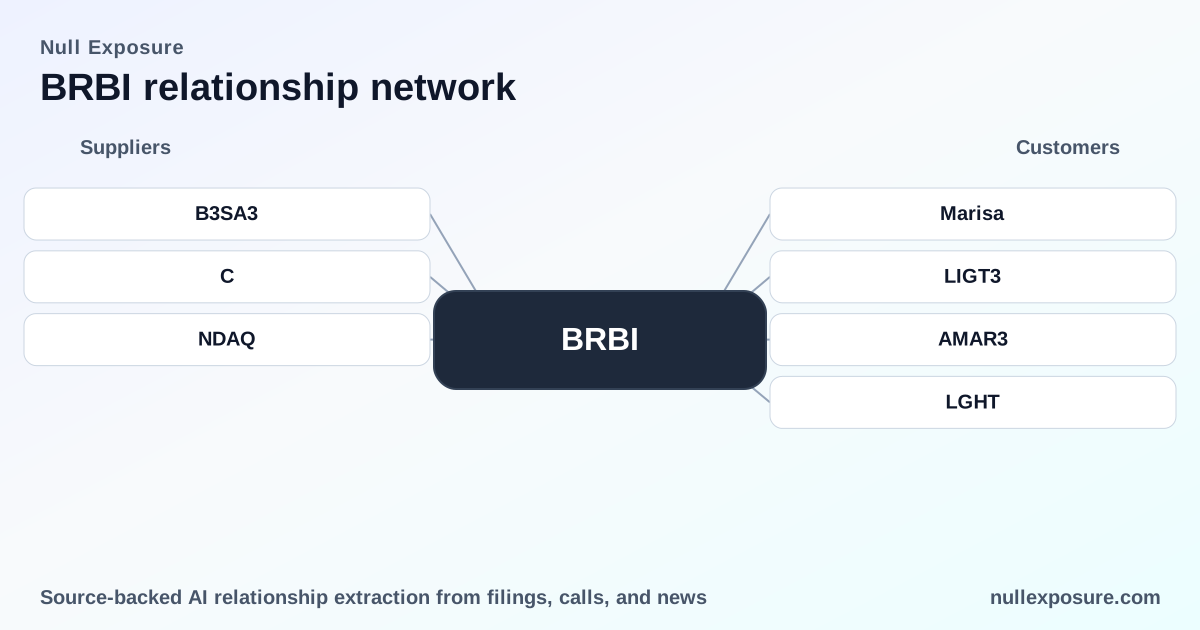
BR Partners (BRBI): Supplier map and what the ADR push means for counterparties
BR Partners S.A. is an independent Brazilian investment bank that monetizes through advisory fees, capital markets underwriting and asset management services, and now through cross‑border equity access after launching an American Depositary Receipt (ADR) program. The firm retains its domestic listing while adding a Nasdaq‑traded ADR vehicle, which changes settlement and custody relationships and expands the pool of U.S. institutional liquidity available to the company. For investors and counterparties, the move reframes BRBI as a client that increasingly relies on global market infrastructure and custodial partners to support its capital markets strategy. Explore more on the firm and related provider signals at https://nullexposure.com/.
How BRBI structures market access and monetization
BR Partners generates revenue through traditional capital markets activities for corporate clients and wealthy families in Brazil. The public information indicates a balance between domestic operations and growing international market presence: the company keeps its B3 listing while adding ADRs on Nasdaq to tap dollar‑based demand, increasing investor reach without replacing its Brazilian share registry. Financials show modest profitability metrics alongside meaningful market cap and institutional ownership that validate the strategic rationale for broadened access.
- Market context: BRBI trades on NASDAQ as an ADR vehicle (ticker BRBI) and maintains its underlying units on B3 in São Paulo.
- Ownership signal: institutional ownership is roughly 49% per the latest public profile, indicating meaningful professional investor engagement.
If you are mapping supplier risk or partnership exposure, the following third‑party relationships are material to settlement, liquidity and market access — learn more at https://nullexposure.com/.
Supplier relationships you need on the desk now
Below I cover every named counterparty in the available relationship records and the implications for operations and counterparties.
B3 — continued domestic listing while expanding internationally
BR Partners will continue to be listed on Brazil’s B3 exchange and is launching ADRs to be traded in dollars on U.S. markets, preserving the local trading venue while expanding investor access. This dual‑listing posture preserves local market visibility and liquidity channels in São Paulo. (Reported by FinanceNews, July 2025; also covered by ADVFN, Sept 2025.)
Sources: FinanceNews July 2025 coverage and ADVFN reporting in September 2025 describing the split listing approach and retention of the B3 listing.
Citibank — depositary institution for the ADR program
Citibank is the depositary institution backing BR Partners’ ADRs, meaning Citibank will hold the underlying units and issue ADR certificates to U.S. investors, supporting custody and dividend flows for the ADR structure. This establishes a direct operational dependence on a global custodian for cross‑border settlement and investor servicing. (Noted in ADVFN, Sept 2025.)
Source: ADVFN article (September 2025) reporting Citibank as the depositary bank for the ADR program.
Nasdaq — U.S. trading venue for Level II ADRs
BR Partners initiated trading of a Level II ADR program on Nasdaq (ticker NASDAQ:BRBI) beginning 17 September 2025, placing the company within U.S. equity market trading rules and investor visibility on a major exchange. Listing on Nasdaq signals adherence to U.S. ADR reporting and trading mechanisms that dictate market‑making and disclosure expectations. (Reported by ADVFN, Sept 2025.)
Source: ADVFN reporting (September 2025) that the firm began trading ADRs on Nasdaq starting 17 September 2025.
What these relationships imply for counterparties and operators
- Contracting posture: BR Partners is adopting a hybrid outsourcing posture for market access — keeping core Brazilian listing functions in‑country while outsourcing U.S. custody and investor access to established global infrastructure. This indicates standard industry contracting where exchanges and global custodians are critical third parties.
- Concentration and criticality: The use of a single global depositary (Citibank) centralizes a critical function — ADR custody and investor servicing — which concentrates operational risk into one counterparty for cross‑border equity flows. Exchanges (B3 and Nasdaq) represent non‑substitutable clearing and trading endpoints for their respective investor bases.
- Maturity of relationships: Listing on regulated venues and appointing a major depositary bank denote a mature, institutionalized approach to capital markets operations rather than ad‑hoc arrangements. Expect standard master‑service agreements and established operational playbooks to govern trading, custody, and reporting.
- Counterparty monitoring focus: For operations teams, prioritize monitoring of the depositary and exchange status, reconciliation flows between B3 and Citibank, and any regulatory disclosure obligations tied to the Nasdaq ADR listing.
Risk profile and operational watchlist
- Operational dependency: The depositary arrangement with Citibank is a single point of failure for ADR issuance, dividend processing and depository receipts servicing; contingency planning for depositary disruptions is prudent.
- Regulatory and reporting risk: Nasdaq Level II ADRs entail additional disclosure and compliance obligations that expand regulatory surface area and legal counsel engagement.
- Liquidity dynamics: Dual listing can fragment liquidity between B3 and Nasdaq; trading desks and market‑makers will shape actual access to capital in dollars versus reais.
Monitor filings and exchange notices for any changes to depositary terms or ADR mechanics; the original media reports and company filings around September 2025 are the starting point.
Practical takeaways for investors and supplier managers
- BRBI’s cross‑border move upgrades its dependency on global custodial services and exchange infrastructure, making those suppliers strategically important.
- Counterparty concentration in depositary services is a material operational risk; procurement and legal teams should review service levels and contingency language.
- Institutional ownership and Nasdaq listing improve access to U.S. liquidity but require disciplined compliance and investor relations operations.
For a deeper mapping of counterparties and infrastructure exposures tied to BRBI and comparable firms, visit https://nullexposure.com/ and use the supplier relationship tools to prioritize monitoring and contractual control.
Conclusion — next steps for due diligence
The ADR launch reframes BR Partners from a domestically focused boutique into a company operating with explicit global market dependencies. For investors and operators, the critical follow‑ups are: validate depositary agreements, confirm reconciliation processes between B3 and the ADR ledger, and ensure regulatory reporting alignment with U.S. expectations. These steps convert headline strategy into measurable operational controls.
Take action today: review the Reuters/ADVFN/FinanceNews coverage cited above and coordinate counterparty diligence with custody and legal teams — more resources and relationship analytics are available at https://nullexposure.com/.