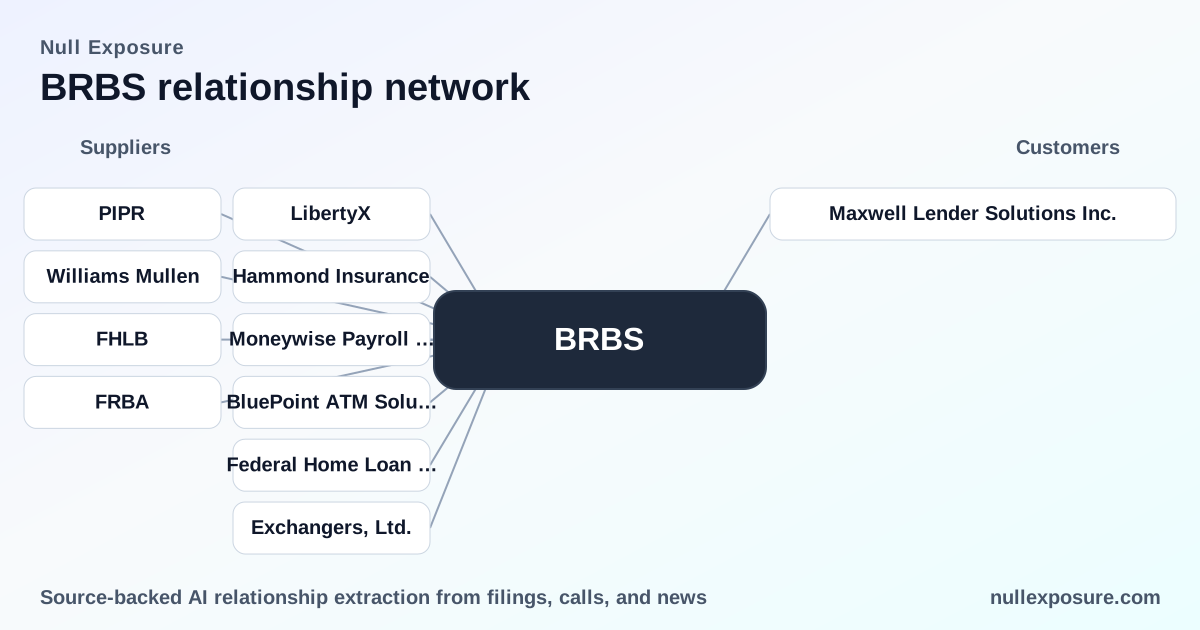
Blue Ridge Bankshares (BRBS): Supplier relationships that shape a regional bank’s risk and revenue profile
Blue Ridge Bankshares operates as the holding company for Blue Ridge Bank, providing commercial and consumer banking and ancillary services that generate fee income and interest margin. The company monetizes through core lending and deposit-taking, supplemented by non‑interest services such as payroll, insurance, qualified intermediary services, placement banking and correspondent liquidity lines; balance sheet funding and capital transactions also involve third‑party partners. For investors evaluating supplier concentration and counterparty risk, BRBS’s supplier map combines funding relationships, outsourced service providers, and strategic tuck‑ins that influence liquidity, compliance and fee diversification. Learn more at https://nullexposure.com/.
How these suppliers fit into BRBS’s operating model
BRBS runs a classic regional banking model with two practical traits driven by its suppliers: (1) funding and capital are materially dependent on institutional counterparties (FHLB advances, wholesale time deposits, subordinated debt and private placements), and (2) certain operational capabilities are outsourced, reducing in‑house expense but increasing vendor operational and cyber risk. The firm’s supplier posture mixes long‑term capital contracts with short‑term liquidity arrangements and legal/placement advisors for capital raises.
- Contracting posture: The company uses a blend of long‑dated secured advances (Federal Home Loan Bank) and immediately available short‑term correspondent facilities.
- Concentration: Funding is concentrated across a few counterparties for wholesale funding and capital transactions, raising counterparty and roll‑over risk if markets tighten.
- Criticality: Third‑party providers supply mission‑critical services (CECL modeling, payroll, insurance distribution and ATM/bitcoin software), which are operationally important even if not large revenue contributors.
- Maturity: Funding maturities include multi‑year fixed rate advances that provide predictability balanced against overnight lines for tactical liquidity.
A deeper supplier roster follows. If you need a consolidated counterparty risk briefing for portfolio decisions, start here: https://nullexposure.com/.
Relationship map — what each counterparty does for BRBS
LibertyX
Blue Ridge Bank partnered with LibertyX to provide bitcoin ATM software as part of an initiative to expand customer access to cryptocurrency services, positioning the bank to capture transactional fees tied to ATM deployments. This relationship was reported in a StockTitan article covering FY2021 activity.
BluePoint ATM Solutions
BluePoint ATM Solutions served as the national ATM operator in the same bitcoin ATM program, supplying physical ATM deployment and operations in partnership with LibertyX and Blue Ridge Bank. The StockTitan report on FY2021 detailed the three‑party arrangement.
Hammond Insurance
Blue Ridge Bank offers insurance services through Hammond Insurance, using the firm to distribute insurance solutions to bank customers and to capture non‑interest income. PR Newswire’s FY2019 merger announcement identified Hammond Insurance as the bank’s insurance channel.
Moneywise Payroll Solutions
Blue Ridge Bank offers small business payroll services via Moneywise Payroll Solutions, adding fee income and cross‑sell opportunities to its commercial banking relationships. This product relationship was disclosed in a PR Newswire release tied to the company’s FY2019 merger materials.
Exchangers, Ltd.
Exchangers, Ltd. provides qualified intermediary services for the bank’s customers, enabling tax‑deferred exchanges and expanding the bank’s product set for commercial clients. PR Newswire’s FY2019 announcement lists Exchangers, Ltd. among the bank’s service partners.
Federal Home Loan Bank of Atlanta (FHLB)
The Federal Home Loan Bank of Atlanta supplies wholesale advances and secured funding to BRBS; PR Newswire’s FY2026 fourth‑quarter filing notes reductions in advances from the FHLB and shows FHLB activity materially impacts interest‑bearing liabilities. The company’s public filings for FY2026 reference advances and their effect on liabilities.
FHLB (as reflected in loan schedules)
BRBS reports fixed‑rate FHLB borrowings with specific tranches and maturities—examples include three $50,000 fixed rate credits dated 3/15/2023, 5/2/2023 and 5/4/2023 with maturities into 2027–2028 and a total FHLB balance of $150,000—documenting the structured, long‑term nature of certain FHLB advances. This detail appears in the company’s funding disclosures (excerpted into the FY2024/FY2025 reporting).
FRB (Federal Reserve Bank) borrowings and interest
BRBS discloses interest expense associated with FHLB and FRB borrowings in its FY2025 results, showing the bank uses both FHLB and FRB borrowings as part of its funding mix and reports the related interest costs. A FY2025 results release distributed via SahmCapital summarized interest on these borrowings.
Piper Sandler & Co.
Piper Sandler acted as the sole placement agent for BRBS’s private placement of common and preferred stock in FY2024, facilitating capital raising and investor distribution. PR Newswire’s FY2024 capital raise announcement identifies Piper Sandler’s role.
Williams Mullen
Williams Mullen served as legal counsel to BRBS in the FY2024 private placement transaction, supplying transactional legal services tied to the company’s capital raise. The FY2024 PR Newswire release names Williams Mullen as counsel.
What these relationships signal for investors
- Funding sensitivity is the dominant risk vector. The presence of multi‑year FHLB advances and disclosed subordinated debt shows BRBS relies on institutional wholesale funding to manage growth and liquidity; the maturity profile reduces immediate roll‑over risk but concentrates exposure to a small set of credit providers. The fixed‑rate FHLB tranches illustrate predictable cash outflows through 2027–2028.
- Operational outsourcing is material and deliberate. Payroll, CECL modelling, ATM/crypto software and insurance distribution are handled by external specialists, which lowers fixed costs and accelerates capability rollout while increasing vendor management and cyber risk. This is a company‑level signal drawn from filings describing third‑party providers and the CECL model vendor.
- Capital markets capability is externalized for large transactions. The bank uses established advisors (Piper Sandler, Williams Mullen) to execute capital raises, indicating limited in‑house investment banking capacity and an operational model that leans on external counsel and placement agents for material equity and preferred issuances.
- Liquidity posture combines short‑term lines and long‑term advances. The firm keeps an unsecured overnight correspondent line ($10.0 million) while also holding longer‑dated secured FHLB advances, producing a balanced but concentrated liquidity profile—short‑term access for day‑to‑day and long‑term for strategic funding.
If you want a concise vendor concentration scorecard or counterparty exposure ladder for BRBS, we provide tailored briefings at https://nullexposure.com/.
Investor implications and recommended next steps
- Monitor the maturity ladder of FHLB advances and subordinated debt ahead of 2027–2028; these are the most consequential funding items for liquidity stress testing.
- Track vendor governance around the CECL model provider, ATM/crypto partners and payroll/insurance channels for operational resilience and regulatory readiness.
- Consider counterparty concentration in any scenario analysis: a small set of funding and placement partners increases sensitivity to market dislocations and reputational events.
For portfolio managers and corporate operators evaluating counterparty exposure, request a focused BRBS supplier risk memo or schedule a briefing at https://nullexposure.com/.