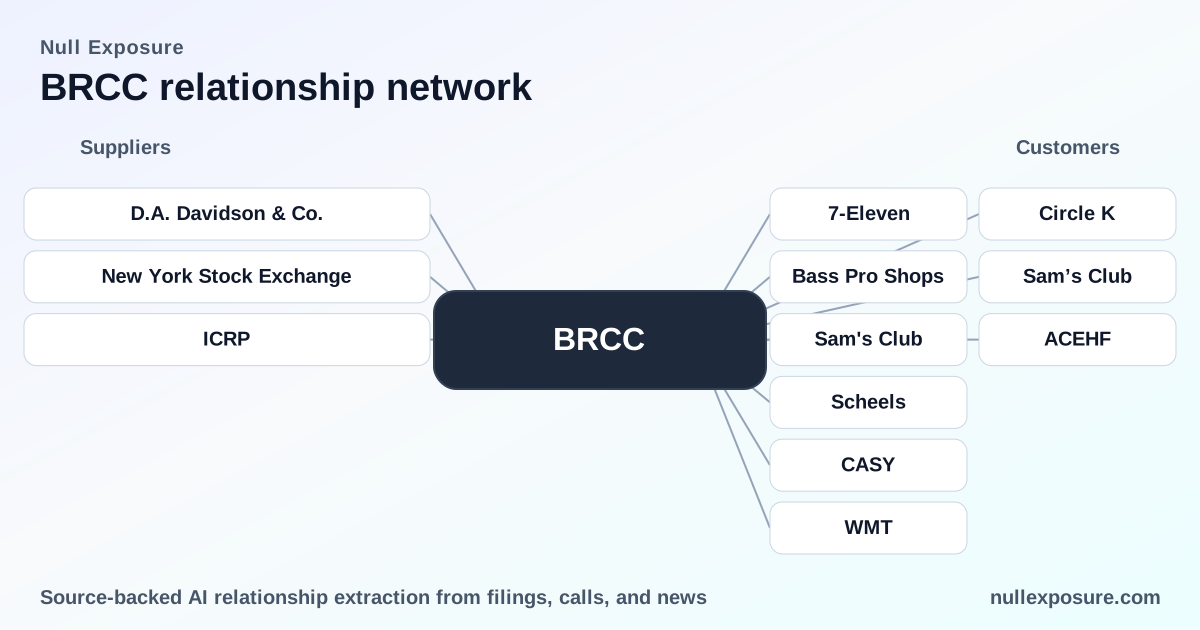
Black Rifle Coffee (BRCC) — supplier relationships and what they mean for investors
BRC Inc. (BRCC) monetizes primarily through direct-to-consumer and retail coffee sales, supplemented by branded merchandise and RTD products; the company outsources substantial portions of roasting and RTD manufacturing while maintaining fixed-price and minimum-purchase commitments for green coffee and third‑party production. Revenue is scale‑driven but supplier commitments and capital markets access are immediate determinants of liquidity and execution risk. For investors and operators, the key question is whether supplier concentration, contract structure, and access to capital markets support profitable growth or amplify downside if retail momentum weakens.
If you want a consolidated view of BRCC’s supplier relationships and risk posture, start here: https://nullexposure.com/
The supplier landscape in plain language
BRCC operates with a hybrid manufacturing model: internal roasting capacity supplemented by co‑manufacturers that handle portions of roast volume and all RTD production. That model reduces fixed capital intensity but creates material third‑party exposure through minimum purchase obligations and take‑or‑pay mechanics. The public record shows active co‑manufacturer engagements and meaningful annual minimum purchase commitments in the tens of millions.
D.A. Davidson & Co. — capital markets partner, not a coffee supplier
D.A. Davidson acted as the sole bookrunner on a $35 million offering of Class A common stock that BRCC priced in July 2025, a transaction reported across syndicated outlets in July 2025. This underwriting role signals active capital markets access and reliance on equity financing to support working capital and execution. (Sources: July 2025 press coverage syndicated on Comunicaffe and Business Wire/FinancialContent.)
New York Stock Exchange — regulator of listing standards, not a vendor
On February 11, 2026 the NYSE notified BRCC that the average closing price of its Class A common stock had fallen below the $1.00 minimum over the prior 30 trading days, placing the company out of compliance with NYSE listing standards. That notice is a market‑structure event that can trigger remediation obligations and heighten refinancing urgency. (Source: press report covering BRCC NYSE non‑compliance notice, February 2026.)
ICR — investor relations and communications partner
BRCC lists ICR as an investor relations contact in its FY2025/FY2026 earnings materials, indicating a retained role for external IR support to manage analyst and institutional communications. External IR relationships influence market perception and can materially affect capital access during periods of stress. (Source: company investor contacts listed in FY2026 press release syndication.)
How the contractual signals shape the operating model
The public disclosures and excerpts on supplier commitments reveal a coherent operating posture that blends flexibility with fixed obligations:
- Contracting posture: mixture of long‑term and order‑based contracts. BRCC maintains long‑term minimum purchase commitments for green coffee and co‑manufacturing arrangements while also using short‑term or purchase‑order‑based co‑manufacturing where appropriate. The combination creates a partial hedge against raw‑material price swings while locking in volume and expenditure.
- Scale of committed spend is material. Aggregate minimum purchase commitments disclosed for 2025–2027 total roughly $88.5 million across those years (calendarized lines: ~$26.1M for 2025; ~$30.0M for 2026; ~$32.4M for 2027), with total multi‑year commitments cited near $118.6M. That positions supplier spend squarely in the $10M–$100M band annually and establishes a baseline fixed cost that must be covered by gross margins and working capital. (Evidence: minimum purchase commitments and aggregated amounts disclosed as of Dec 31, 2024.)
- Supplier roles are operationally critical. BRCC relies on co‑manufacturers for a portion of roast capacity and exclusively for RTD production, which makes these suppliers high‑criticality partners for product availability and quality control.
- Geographic sourcing is diversified but Latin America‑centric. The company sources most green beans from Colombia, Brazil, and Nicaragua and has broadened sourcing across Latin America, Africa, and Asia since 2020—supporting product variety but exposing the company to agricultural, logistics, and FX dynamics in emerging markets.
- Service providers extend beyond manufacturing. Third‑party warehousing and external cybersecurity assessments are part of the supplier mix, indicating operational outsourcing across logistics and controls.
Together these constraints describe a company that trades capital expenditure for supplier commitments and operational flexibility—but with significant fixed purchase obligations that elevate downside if demand softens.
What investors and operators should watch next
- Cash runway and refinancings. The July 2025 $35M equity offering underwritten by D.A. Davidson suggests management has used public markets to fund operations; however, the NYSE non‑compliance notice in February 2026 elevates the risk that future equity raises could be more dilutive or conditional. Monitor liquidity metrics, covenant language on debt (if any), and the pace of share issuance. (See July 2025 underwriting reports and February 2026 NYSE notice coverage.)
- Fulfillment and quality continuity from co‑manufacturers. Because RTD production is exclusively outsourced and roast capacity is shared, any manufacturing disruption would translate quickly into lost sales and elevated per‑unit costs. Look for disclosures around alternate capacity and contingency inventory levels at third‑party warehouses.
- Commodity exposure versus fixed commitments. Fixed‑price green coffee commitments reduce spot volatility but lock BRCC into volume and price floors—this benefits gross margin stability on upside but creates inventory and cash drag if retail sales decelerate.
- Market perception and investor communications. ICR’s role for investor outreach can influence institutional confidence during remediation of exchange non‑compliance or future capital raises; track investor deck messaging and any changes in guidance or capital allocation.
Take action now: review BRCC supplier concentration, committed spend schedule, and recent equity activity at https://nullexposure.com/ for deeper supplier‑risk intelligence.
Practical investor checklist
- Require a current cap table and dilution schedule tied to any recent or planned equity issuances.
- Demand clarity on co‑manufacturer contingency plans and contract termination provisions.
- Validate inventory held at third‑party warehouses against minimum purchase commitments to quantify rollover risk.
For ongoing monitoring and supplier intelligence on BRCC and comparable food & beverage chains, visit https://nullexposure.com/.
Bottom line
BRCC’s operating model deliberately shifts capital intensity into third‑party manufacturing and multi‑year purchase commitments—this reduces fixed asset burden but creates committed cash outflows that must be serviced irrespective of near‑term sales. Capital markets activity—illustrated by the July 2025 equity offering—and the February 2026 NYSE non‑compliance notice are the proximate financial signals investors should prioritize. Operators need to balance supplier diversification, inventory management, and market messaging to preserve liquidity and execution optionality.
If you want supplier‑level exposure mapped into your investment model or diligence workflow, start here: https://nullexposure.com/