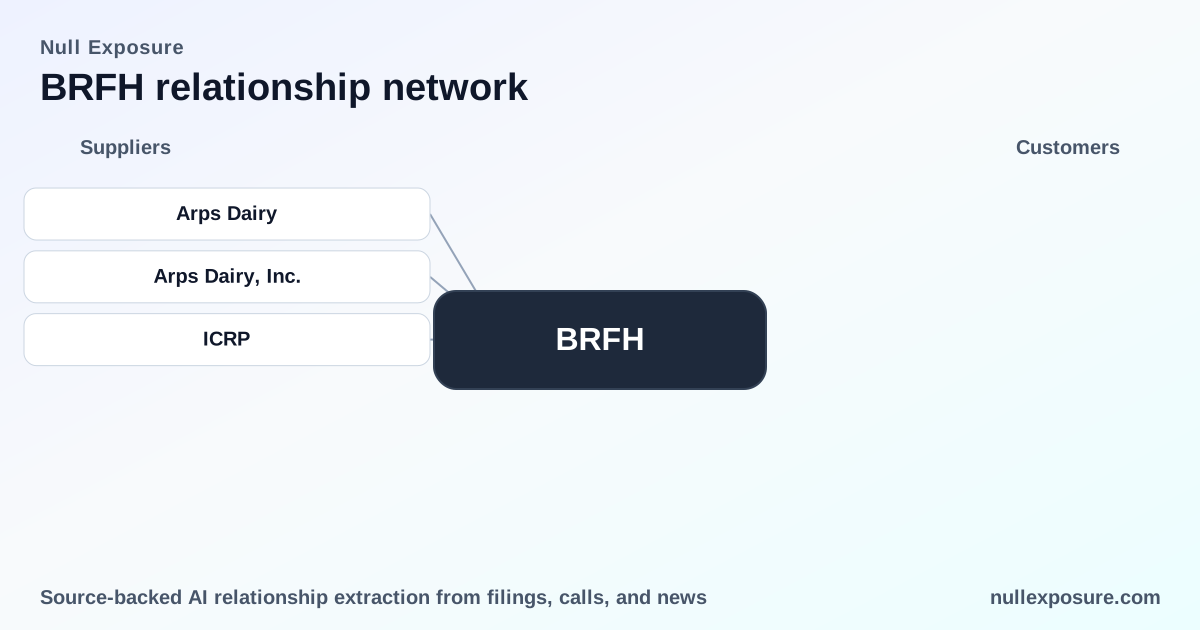
Barfresh (BRFH) supplier map: how the Arps acquisition rewrites the manufacturing playbook
Barfresh monetizes by selling ready-to-mix frozen beverages through retail and institutional channels while historically outsourcing production to contract manufacturers; revenue is driven by SKU distribution and expanding institutional contracts, and the company is now transitioning toward in-house manufacturing through the acquisition of Arps Dairy, which directly changes cost structure, margin optionality, and counterparty exposure.
If you evaluate supplier risk or procurement leverage for BRFH, start with the strategic implications of owning production versus relying on third parties — this is the central commercial inflection for the supplier base. For a deeper supplier-risk briefing, see https://nullexposure.com/.
Why the Arps deal matters to investors: a concise thesis
Barfresh operated as a brand-first beverage supplier dependent on third-party co-packers for production. That contracting posture concentrated operational risk and limited margin upside. The October 2025 completion of Arps Dairy converts Barfresh into an operating company with manufacturing assets, giving direct control over unit economics, production scheduling, and quality control, and enabling pursuit of larger institutional buyers (notably K‑12 foodservice rollouts). This is a structural shift from outsourcing to asset-backed production and will determine supplier relationships going forward.
Explore supplier signals and historical counterparty exposure on the homepage: https://nullexposure.com/.
What changed operationally after the acquisition
The company’s October 2025 acquisition of Arps Dairy supplies Barfresh with an immediate manufacturing footprint — an operational 15,000‑square‑foot processing facility plus a larger 44,000‑square‑foot plant nearing completion — and access to grant funding to support buildout. Barfresh has already commenced production at Arps and is using that capacity to support multi-year institutional wins, including deliveries for K‑12 programs, which require predictable output and traceable supply chains. According to the Q3 2025 earnings call, management framed the transaction as a pivot toward vertical integration that will drive top‑line growth and margin expansion.
Supplier relationships: what’s on the record
Arps Dairy, Inc.
Barfresh completed the acquisition of Arps Dairy in early October 2025, immediately adding a 15,000‑sq‑ft operational processing site and a 44,000‑sq‑ft facility nearing completion, and has already moved product into production at those locations to support larger institutional rollouts. This acquisition was announced and discussed across company filings and press releases in late 2025 and early 2026, including the Q3 2025 earnings call and GlobeNewswire/press release coverage in September–December 2025. (Sources: Barfresh Q3 2025 earnings call; GlobeNewswire Sep 18, 2025; GlobeNewswire Dec 18, 2025; QuiverQuant / March 2026 press aggregation.)
A related disclosure puts transaction economics on the table: public filings and press reports indicate the deal involved repaying approximately $1.6 million of Arps debt and anticipated government support (a grant in the ~$2.3–$2.4 million range) to complete and equip the manufacturing facility, enabling an immediate ramp of production. (Sources: Yahoo Finance recap March 2026; GlobeNewswire Dec 18, 2025; StockTitan March 2026.)
Barfresh has already cited the Arps capacity as a supporting factor in winning and initiating deliveries on a multi‑year, large K‑12 bid and expects the enlarged manufacturing footprint to accelerate institutional expansion. (Source: StockTitan reporting on FY2026 bid activity; GlobeNewswire January 29, 2026 release.)
ICR (Investor Relations partner)
Barfresh lists ICR as its investor relations contact, providing named IR points for market engagement and investor communications. This vendor relationship is documented in investor notices and press materials tied to the company’s FY2025 earnings announcements. (Source: StockTitan reporting quoting investor relations contacts from FY2025 materials.)
Company-level supplier constraints and what they imply for procurement risk
Company disclosures and historical public filings produce several clear operating signals:
-
Contracting posture: Historically, Barfresh relied on contract manufacturers located in the United States to produce all product SKUs, which concentrated production risk outside the company balance sheet. This outsourcing model constrained margin capture and left the company vulnerable to third‑party quality events. (Company filing language describing use of U.S. contract manufacturers.)
-
Concentration and criticality: A prior contract manufacturer supplied approximately 52% of product in 2022; quality complaints from that supplier generated a material operational disruption that forced product withdrawals and destroyed inventory. The filing shows this supplier relationship was critical to continuity of supply. (Company filing Item 7 disclosure on the 2022 Manufacturer incident.)
-
Relationship maturity and stage: At least one prior supply agreement with a contract manufacturer terminated after the quality events, indicating that historically the company’s most important manufacturing relationships could be short‑lived and operationally fragile. This termination was recorded in regulatory disclosures as part of the post‑event remediation. (Company filing describing Manufacturer termination of the Supply Agreement.)
-
Geography: Manufacturing partners have been U.S.‑based, which limits supply chain complexity internationally but concentrates exposure to domestic co‑pack capacity constraints and U.S. regulatory/food‑safety enforcement. (Company disclosure on contract manufacturers operating in the U.S.)
These constraints are company‑level signals extracted from Barfresh filings; they underscore why the Arps acquisition is strategically meaningful — it reduces dependency on critical third parties, shifts the contracting posture toward vertical integration, and addresses prior concentration risk.
Investment implications and risk checklist
-
Positive operational impact: Ownership of Arps provides immediate capacity and control that should improve gross margins and reduce the probability of future supply‑side product quality shocks. The firm can internalize co‑packing revenue and capture manufacturing margin that previously accrued to third parties. (See earnings call and post‑close press releases.)
-
Execution risk remains: Integration of acquired facilities, certification, workforce ramp, and the efficiency of a completed 44,000‑sq‑ft plant determine realized benefits; grant funding helps but does not eliminate execution risk. (See GlobeNewswire updates on grant approval and production progress, Dec 2025–Jan 2026.)
-
Customer concentration and contract enforcement: Institutional customers like K‑12 systems demand strict traceability and volume reliability; successful rollouts will validate the new operating model but failure to scale rapidly could leave Barfresh exposed to lost contract opportunities and fixed asset underutilization.
For a tailored supplier-risk dossier and ongoing monitoring of BRFH counterparties, visit https://nullexposure.com/.
Final read: how to position for the next 12 months
Barfresh’s move from an outsourcing model to owning manufacturing assets is a defining operational pivot that de‑risks prior supplier concentration and creates a path to capture manufacturing margin. Investors should track three operational readouts closely over the next four quarters: production ramp metrics from the Arps facilities, food‑safety/quality incident reports, and the conversion of institutional bid awards into recurring revenue. If those indicators trend positively, the acquisition will be a durable value inflection for BRFH.
For continued supplier intelligence and corporate counterparty mapping on BRFH and peers, go to https://nullexposure.com/.