BrilliA Inc (BRIA): Supplier relationships That Drive Near-Term Revenue and Execution Risk
BrilliA Inc. generates revenue by designing, manufacturing and distributing branded apparel and intimate-wear products through a network of brand licenses and contracted manufacturers; the company monetizes via wholesale and retail channels under recognized labels and by scaling production capacity through outsourced partners. Revenue is driven by licensed brand penetration and the effectiveness of third‑party manufacturing relationships; capital-market activity has been used to fund capacity expansion. For a concise supplier-risk view and to benchmark counterparty concentration, visit https://nullexposure.com/ for more structured supplier intelligence.
How the partner map translates into business value
BrilliA’s commercial model is distribution and licensing-led: the company gains margin by placing products under global and regional brands and keeps fixed-cost exposure low through contracted manufacturing and wholesale arrangements. This hybrid licensing/contract manufacturing approach converts brand equity into revenue while concentrating execution risk on a small set of suppliers and capital providers.
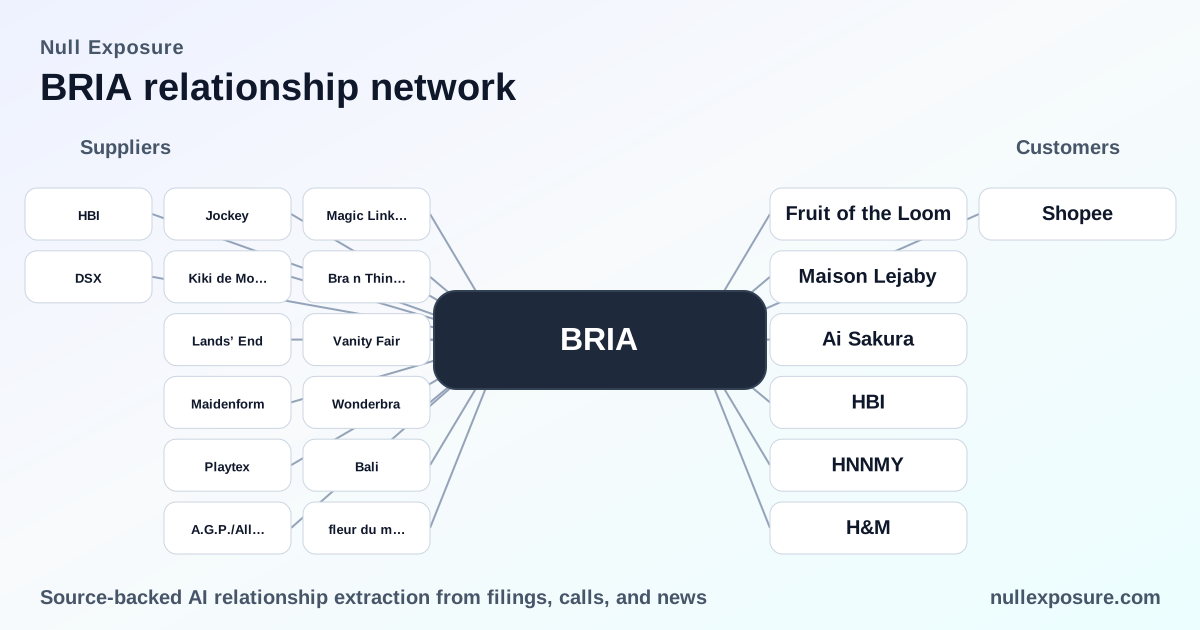
Below I map every partner mention identified in public reporting and explain what each relationship implies for investors.
Magic Link Garment — manufacturing capacity expansion (Cambodia)
BrilliA announced plans to finalize a manufacturing agreement with Magic Link Garment in Cambodia to expand production capacity, signaling active outsourcing of volume production to Southeast Asia (news reported March 9, 2026). Source: StockTitan news item (first seen 2026-03-09).
Bra n Things — brand / product channel inclusion
BrilliA lists Bra n Things among the brands under which it sells products, indicating distribution or licensing relationships across multiple retail or brand channels (FY2024 company profile cited). Source: Simply Wall St company profile (reported March 2026).
Vanity Fair — brand portfolio presence
Vanity Fair appears as one of the labels in the company’s product mix, suggesting BrilliA leverages established lingerie brands to access end markets and retail partners. Source: Simply Wall St company profile (FY2024).
Wonderbra — branded assortment exposure
Wonderbra is included in BrilliA’s product roster, reflecting the company’s strategy of selling under legacy intimate-wear brands to capture consumer recognition and margin. Source: Simply Wall St (FY2024).
Bali — brand licensing or distribution role
Bali is listed among BrilliA’s product brands, reinforcing the company’s positioning as a licensee or supplier to mid‑ and mass‑market lingerie channels. Source: Simply Wall St (FY2024).
fleur du mal — premium brand placement
The presence of fleur du mal in the product list points to selective premium placements within BrilliA’s assortment, diversifying price‑point exposure. Source: Simply Wall St (FY2024).
Jockey — broad brand coverage
Jockey’s inclusion indicates BrilliA sells across multiple sub‑segments (sleepwear, active, basics), widening revenue sources beyond pure fashion intimates. Source: Simply Wall St (FY2024).
Kiki de Montparnasse — high‑end label association
Kiki de Montparnasse on the list shows the company reaches upscale segments as well as mass channels, which can help margin mix during positive retail cycles. Source: Simply Wall St (FY2024).
Lands’ End — channel and category breadth
Lands’ End’s appearance signals distribution into catalog/omnichannel and value-oriented segments, smoothing seasonality risk. Source: Simply Wall St (FY2024).
Maidenform — core intimate-wear brand exposure
Maidenform is part of BrilliA’s branded lineup, supporting the company’s core revenue base in foundational lingerie categories. Source: Simply Wall St (FY2024).
Playtex — established brand licensing
Playtex is identified among products, implying BrilliA uses recognizable legacy brands to secure wholesale and retail placements. Source: Simply Wall St (FY2024).
A.G.P./Alliance Global Partners — capital markets execution partner
A.G.P./Alliance Global Partners served as the sole book‑running manager on a firm‑commitment offering, which indicates reliance on boutique investment banking for equity capital raises and suggests how BrilliA finances manufacturing and growth investments (news noted March 9, 2026). Source: StockTitan news item (first seen 2026-03-09).
Hanes (HBI) — brand-level association
Hanes is named among the product brands, confirming BrilliA’s inventory of mainstream intimate-wear and basics brands that underpin steady wholesale demand. Source: Simply Wall St (FY2024).
DIANA (DSX) — additional brand relationship
DIANA appears on the product roster, further illustrating the company’s strategy of distributing a wide set of licensed labels to cover multiple consumer niches. Source: Simply Wall St (FY2024).
Operating constraints and what they mean for valuation and risk
Investors should frame BrilliA’s supplier landscape through a set of company-level constraints that shape execution risk and upside.
- Contracting posture: BrilliA runs a lean manufacturing model that relies on external factories and brand licenses. This reduces fixed overhead but concentrates operational risk in third‑party manufacturers and logistics. The public reporting of a new manufacturing agreement supports capacity scaling but increases dependence on partner execution.
- Concentration signals: Insider ownership is highly concentrated (about 76% insider ownership) and institutional ownership is effectively negligible, which produces potential governance and liquidity constraints as well as limited sell‑side coverage. Source: company ownership data (latest quarter).
- Criticality and counterparty exposure: Retail brand relationships widen market access, yet the company’s revenue mix indicates critical dependence on a handful of brand channels; failure in manufacturing execution or loss of a license would disproportionately pressure near‑term revenue.
- Maturity and capital posture: BrilliA is a small‑cap issuer with modest profitability (positive margins but limited scale: Revenue TTM ~$64.4M; Profit margin ~4.4%), and it uses capital markets — as evidenced by A.G.P. being sole book‑runner — to fund growth and capacity. This implies sensitivity to financing cycles and the cost of equity issuance. Source: company financials (latest fiscal data).
- Float and market liquidity: A small float (~5.9M shares against 25M outstanding) constrains arbitrage and can amplify price moves on news, increasing trading volatility around supplier announcements. Source: share statistics.
If you want a structured supplier-risk scorecard tied to these constraints, see more at https://nullexposure.com/ — the platform provides standardized counterparty assessments.
Strategic risks, upside levers and investor action points
BrilliA’s supplier relationships create a clear risk/reward profile. Upside comes from successful scale-up of Cambodian manufacturing capacity, improved retail penetration under multiple brands, and better margin mix from premium labels. Downside arises from execution failures at contracted factories, brand-license losses, and constrained access to institutional capital.
Actionable next steps for investors:
- Monitor contract close and operational KPIs from announced manufacturing partners to confirm throughput and cost benefits.
- Track any changes in brand license agreements for evidence of concentration shifts in revenue sources.
- Watch capital markets activity and the choice of underwriters as indicators of financing flexibility and cost.
For a deeper supplier-risk breakdown and watchlist automation, consult https://nullexposure.com/ — it offers analyst-grade supplier trackers that map exactly these variables.
Bottom line
BrilliA operates as a licensing and contract‑manufacturing driven apparel supplier with revenue exposure anchored to well‑known brands and execution risk concentrated in outsourced factories and a small investor base. The recent manufacturing move and the retail brand roster both support growth potential, but investors must price in elevated operational and liquidity risk until capacity expansion proves durable and institutional interest increases. For ongoing monitoring and a concise supplier-risk dashboard tailored to BRIA, visit https://nullexposure.com/.