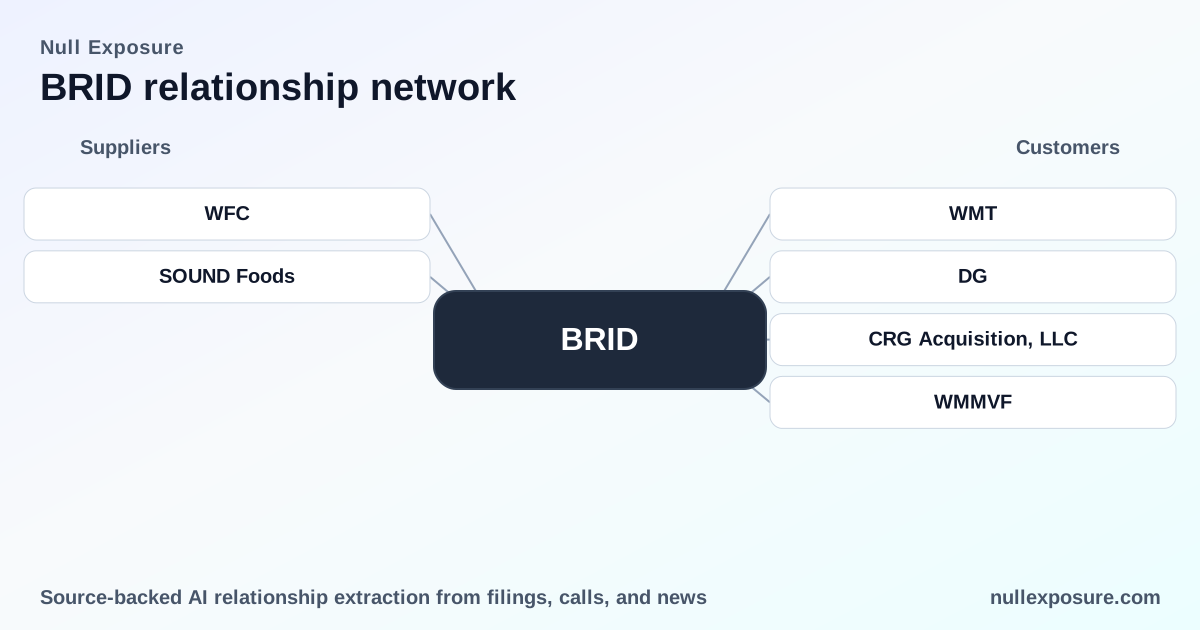
Bridgford Foods (BRID): supply partners, financing ties, and what they mean for operators and investors
Bridgford Foods operates as a branded and private-label manufacturer of frozen, refrigerated and snack products, monetizing through manufacturing margins on packaged foods sold to retail, foodservice and institutional channels. The company purchases bulk commodities, contracts manufacturing capacity and uses short-term financing to manage working capital, with revenue recurring from product sales and margin capture on proprietary SKUs. Investors should treat Bridgford as a small-cap, founder-controlled food manufacturer with commodity purchasing dynamics and active financing relationships that directly influence margin volatility and liquidity. For an independent view of supplier and financing risks, visit https://nullexposure.com/.
How Bridgford runs its supply chain and why it matters to earnings
Bridgford buys large volumes of commodity inputs—flour, pork and beef—and runs production facilities in Statesville, NC and elsewhere to convert those inputs into finished products. The company discloses short-term, fixed-price purchase contracts for bulk flour that typically settle within three months, which creates an operating model where input cost exposure is frequent and repricing happens quickly. That posture reduces long-term counterparty concentration but increases sensitivity to near-term commodity price swings, directly compressing gross margin when costs spike.
- Short-term contracting forces constant procurement activity and working capital churn. It limits lock-in benefits but preserves flexibility to source at prevailing market prices.
- Buyer role and active procurement: Bridgford is primarily a buyer of commodities rather than a long-term supplier partner, which means its negotiating leverage is tied to order size and timing rather than long-term supplier commitments.
- Capital and liquidity dependence: Small market capitalization (~$67.3M) and negative EBITDA in the latest trailing period mean access to credit lines and banking relationships matter for sustaining operations.
These operating signals are company-level characteristics drawn from the firm's disclosures and filings, and they shape both margin profile and supplier negotiation strategy.
What the public record shows about Bridgford’s relationships
Wells Fargo — near-term credit facility supporting working capital
Bridgford amended and restated a credit agreement with Wells Fargo that allows the company to borrow up to $7,500 until July 31, 2026; the facility provides short-term liquidity to fund operations and working capital. According to TradingView coverage of Bridgford’s SEC 10‑K filing for FY2026, the Wells Fargo amendment is a material financing arrangement supporting the company through mid‑2026.
Source: TradingView summary of Bridgford Foods SEC 10‑K (FY2026).
SOUND Foods — production technology partner for tactical nutrition bars
Bridgford plans to incorporate SOUND Foods’ ultrasonic agglomeration technology into its Statesville, NC manufacturing facility to produce tactical nutrition bars for both U.S. military contracts and consumer channels, reflecting an active supplier/technology partnership to expand product capability. A Dallas Innovates report (FY2024 coverage) described the collaboration and the intended application of SOUND’s manufacturing technology at Bridgford’s plant.
Source: Dallas Innovates coverage on Bridgford and SOUND Foods partnership (FY2024).
What these relationships mean strategically and for risk management
The Wells Fargo facility is a financing relationship rather than a supplier tie, and it reduces immediate liquidity risk by providing a committed borrowing line—albeit for a finite term through July 2026. For a small-cap food manufacturer with negative trailing EBITDA, committed bank capacity is a critical enabler of day-to-day operations and a determinant of runway when commodity costs swing.
The SOUND Foods partnership signals a targeted operational investment: integrating ultrasonic agglomeration is a technology-forward move to expand product formats and win institutional contracts (including military supply), which can lift utilization and diversify revenue beyond legacy snack lines. Technology partnerships like this are important for margin expansion only if utilization ramps quickly and contract volumes materialize.
Constraints that shape supplier posture and commercial strategy
Bridgford’s public disclosures show three company-level supply constraints that explain how procurement and supplier relationships operate:
- Short-term, fixed-price contracts for bulk flour (settle within three months) — this creates high-frequency price exposure and forces frequent hedging or dynamic procurement decisions rather than long-term supplier commitments.
- Buyer orientation — Bridgford’s role as a large-volume purchaser of pork, beef and flour places it in a spot market posture; supplier relationships are organized around deliveries and price rather than long-term strategic co-development.
- Active relationship stage — procurement activity is ongoing and operationally critical; suppliers and technology partners must meet immediate production schedules.
Collectively, these constraints explain why Bridgford pairs short-term financing with tactical supplier or technology relationships: short contract tenors elevate the importance of working capital, while technology partners create the potential to stabilize margins through new product lines.
Financial context that matters to counterparties
Bridgford’s trailing revenue sits at approximately $233.8M with negative net income and EBITDA, and insider ownership above 80%. These facts drive three practical consequences for suppliers and lenders:
- High insider ownership (80.7%) and low institutional ownership (~5.55%) signal concentrated control and limited external analyst or institutional oversight, which can slow market discovery and reduce counterparty confidence relative to larger peers.
- Negative EBITDA and negative EPS make access to committed bank facilities and trade credit essential; suppliers should price credit terms accordingly.
- Small public float (1.66M shares of float vs. 9.08M outstanding) reduces liquidity and increases event-driven price volatility, which affects any supplier or investor requiring tradability for exposure management.
Actionable takeaways for investors and operators
- For lenders and credit analysts: Prioritize covenant visibility and monitoring of the Wells Fargo facility expiration and any roll or replacement options beyond July 2026; short-term commodity contracts magnify the importance of near-term liquidity metrics.
- For supply chain managers and potential suppliers: Expect Bridgford to favor flexible, short-tenor supply agreements; negotiate pricing that accounts for rapid order cadence and prioritize payment terms that reflect the company’s small-cap liquidity profile.
- For product and operations teams: The SOUND Foods technology tie demonstrates management’s intent to diversify into military and specialty nutrition contracts—track production ramp metrics and contract awards for revenue-impact signals.
For a concise supplier risk profile and deeper relationship mapping, visit https://nullexposure.com/ and explore our supplier-focused analytics.
Closing judgment and next steps
Bridgford is a nimble, commodity-dependent food manufacturer with active procurement and targeted technology partnerships; its profitability outlook hinges on commodity price control, production ramp from new product technology and continued access to short-term financing. The combination of short-term input contracts and finite bank facilities makes liquidity management the single most immediate operational constraint.
If you evaluate supplier credit lines, manufacturing partnerships, or investment exposure in small-cap packaged foods, review Bridgford’s financing schedule and the commercialization status of its SOUND Foods integration as priority due diligence items. Learn more about supplier relationship analytics and risk signals at https://nullexposure.com/.