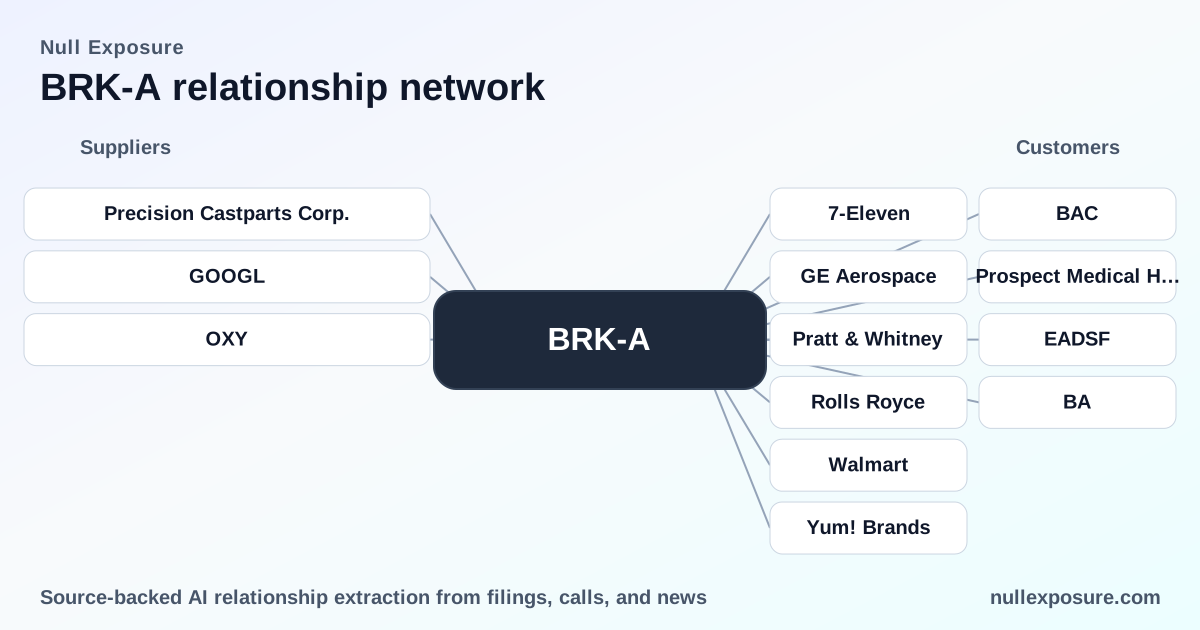
Berkshire Hathaway (BRK-A): supplier footprint and what it means for investors
Berkshire Hathaway operates as a diversified holding company that monetizes through full ownership of operating businesses, insurance float investment, and large strategic equity stakes. The company’s cash generation comes from operating subsidiaries (BNSF, GEICO, Lubrizol, etc.), insurance underwriting profits that create investable float, and disciplined capital allocation into acquisitions and minority investments. For investors evaluating supplier relationships, the relevant signal is how suppliers support critical operating assets and capital deployment rather than a single integrated supply chain. Explore the primary supplier links uncovered for BRK-A at https://nullexposure.com/ to inform underwriting and counterparty risk analysis.
What the supplier set tells an investor about Berkshire’s operating posture
Berkshire’s supplier references reflect a holding-company model with decentralized procurement. Subsidiaries source what they require for operational continuity; Berkshire consolidates financial risk and capital allocation centrally but leaves operational supplier relationships to individual businesses. That leads to several practical characteristics for risk assessment:
- Contracting posture — decentralized and operationally embedded. Subsidiary managers negotiate and manage supplier terms; Berkshire’s corporate center intervenes for strategic transactions (acquisitions, large capital commitments).
- Concentration — broad but strategically concentrated. Berkshire’s supplier exposure is diverse across many industries, but large, high-impact relationships (critical aerospace suppliers, major technology vendors, strategic M&A counterparties) can create outsized operational or capital impacts.
- Criticality — supplier importance scales by subsidiary. A supplier that is critical to an industrial subsidiary (e.g., aerospace components) carries very different risk than a tech services provider used by an insurance unit.
- Maturity and governance — long-tenured, established counterparties. The references found are to established industrial and corporate players, consistent with Berkshire’s preference for mature, reliable counterparties.
No explicit supplier-level contractual constraints were recorded in the available constraints metadata, which is a company-level signal that no material supplier contract covenants or disclosure-triggering constraints were surfaced in this review.
Explore supplier intelligence and the implications for portfolio risk at https://nullexposure.com/.
Supplier relationships documented in filings and the press
Below I cover every supplier-related mention returned in the review. Each entry is treated separately and cited to its original context.
Precision Castparts Corp. (from Berkshire 10‑K, FY2024)
Berkshire’s filings reference Precision Castparts as a manufacturer of complex metal components and investment castings, forgings, and aerostructures for critical aerospace and power applications, indicating its role as a supplier to industrial operations within the group or to businesses within Berkshire’s ecosystem. According to Berkshire Hathaway’s 10‑K for FY2024, Precision Castparts is described in the context of materials and parts that serve critical aerospace and power-and-energy applications (10‑K, FY2024).
Google (coverage in 247wallst, Dec 31, 2025)
Public reporting notes that Berkshire uses Google’s services at GEICO, confirming that large cloud and platform providers have a standing role supporting Berkshire’s insurance operations. A 247wallst article on December 31, 2025 referenced Warren Buffett explaining Berkshire’s use of Google services at GEICO (247wallst, Dec 31, 2025).
Occidental — TS2.tech “market opens” coverage (Dec 26, 2025)
News coverage indicated that Berkshire agreed to purchase Occidental’s chemical business, OxyChem, in an all‑cash $9.7 billion transaction, showing Berkshire’s active role as an acquirer of supplier-facing industrial assets. TS2.tech reported the transaction and its $9.7B cash value when discussing Berkshire’s cash deployment (TS2.tech, Dec 26, 2025).
Occidental — TS2.tech CEO handoff / outlook piece (Dec 26, 2025)
Another TS2.tech item reiterated the definitive agreement for Berkshire to acquire OxyChem for $9.7 billion in cash with expected closing in Q4 2025 subject to approvals, highlighting transaction timing and approval contingencies that are material to integration planning and supplier continuity (TS2.tech, Dec 26, 2025).
Occidental Petroleum coverage in market commentary (most-expensive-stock piece, Oct 2, 2025 reference)
Market commentary noted the October 2, 2025 agreement date and the $9.7 billion cash consideration for the OxyChem acquisition, underscoring that Berkshire’s supplier exposure can expand via acquisition of supplier businesses themselves (market commentary piece referencing Oct 2, 2025).
Key takeaways and risk implications for investors
- Berkshire’s supplier exposure is heterogeneous. Mentions range from precision aerospace suppliers (Precision Castparts) to technology platforms (Google) and acquired industrial suppliers (OxyChem/Occidental). That mix underscores a dual risk universe: operational supplier risk at subsidiary level and strategic counterparties encountered through acquisitions.
- Large acquisitions are a direct supply‑chain play. The OxyChem purchase is an example of Berkshire acquiring supplier capacity outright, moving potential counterparty risk in‑house and shifting the operational risk profile into Berkshire’s consolidated statements.
- Operational criticality differs by business unit. A failure or disruption at a supplier to an industrial Berkshire subsidiary has fundamentally different financial implications than service interruptions at a cloud provider used by an insurance subsidiary; investors must assess the exposure by subsidiary cash flow contribution.
- Contracting is typically non‑standardized. Expect bilateral, legacy contracts managed at the subsidiary level rather than one-size-fits-all corporate procurement terms; this raises due diligence importance when underwriting supplier concentration or counterparty default risk.
Strategic questions for underwriting and operations teams
- Which subsidiaries rely on single-source suppliers for critical inputs, and how large is each subsidiary’s contribution to consolidated operating cash flow?
- For material acquisitions (like OxyChem), what integration plan exists to preserve supplier relationships and margin profiles?
- How does Berkshire monitor third‑party tech and cloud providers for continuity and data security at the insurance operating companies?
For a deeper look at how supplier relationships propagate into balance-sheet and operational risk, review supplier profiles and structured signals at https://nullexposure.com/.
Bottom line
Berkshire’s supplier mentions reflect a conglomerate that manages risk through decentralized operations, selective acquisitions, and long-term relationships with established suppliers. The most material near-term supplier signal is the OxyChem acquisition—a strategic move converting a counterparty relationship into direct ownership and operational responsibility. For investors, the principal work is mapping supplier criticality back to consolidated cash flow and assessing whether Berkshire’s decentralized contracting posture creates idiosyncratic counterparty exposures that warrant closer monitoring.
If you’re evaluating counterparty risk across large portfolios or underwriting acquisition effects on supplier concentration, start with the supplier dossiers at https://nullexposure.com/ for transaction-level context and source tracing.