Berkshire Hathaway (BRK‑B): Supplier relationships and operating constraints investors must price in
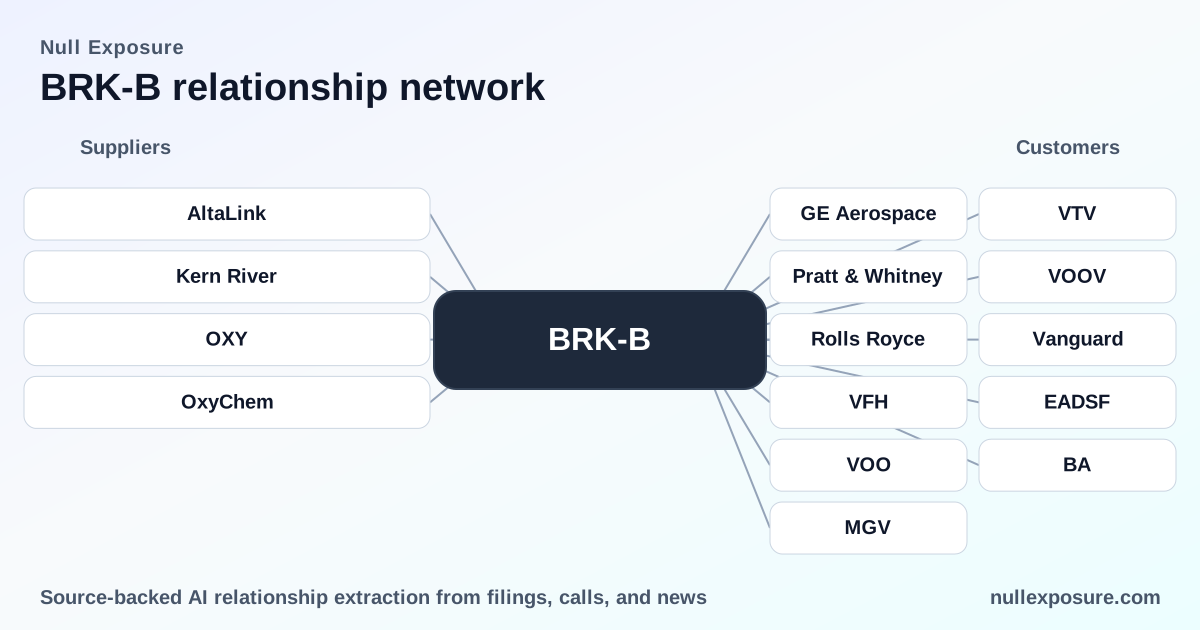
Berkshire Hathaway monetizes a sprawling portfolio of wholly owned operating companies (insurance carriers, freight rail, utilities, manufacturing and services) plus large public equity stakes; cash generation comes from insurance float and operating earnings while capital deployment happens through acquisitions and minority investments. Supplier relationships for Berkshire are not supplier lists — they are extensions of the company’s capital‑intensive operations, from transmission lines and pipelines to material purchases tied to recently announced acquisitions. For investors and operators evaluating BRK‑B supplier exposure, focus on contract tenor, aggregate committed spend, and the role these suppliers play in operating continuity. For more sourcing and supplier intelligence on major firms, visit https://nullexposure.com/.
How the filing and market reports frame supplier exposure
Berkshire’s public disclosures and market reporting combine two types of supplier signals: operational descriptions inside the 2024 Form 10‑K that detail infrastructure and lease commitments, and market reporting of discrete acquisition counterparties. The 10‑K emphasizes long‑dated lease liabilities and quantified multi‑year payment obligations, which reflect a contracting posture that mixes long‑term commitments with some short‑term flexibility. News coverage in early 2026 documents a major transaction for a chemicals business that changes the supplier/service footprint for operating subsidiaries.
AltaLink — transmission infrastructure in Canada
AltaLink operates an electricity transmission system comprising roughly 8,300 miles of transmission lines and about 310 substations, a critical grid asset for energy delivery in Alberta. According to Berkshire Hathaway’s 2024 Form 10‑K disclosure, AltaLink is identified among transmission-related assets cited in the company filing for FY2024.
Source: Berkshire Hathaway 2024 Form 10‑K (FY2024).
Kern River — long pipeline reach across the Rockies to California
Kern River’s system is described as approximately 1,400 miles of natural gas pipeline extending from Wyoming through the Central Rockies into California, indicating exposure to long‑haul energy transportation networks that feed regional markets. This description is called out in Berkshire’s 2024 Form 10‑K filings.
Source: Berkshire Hathaway 2024 Form 10‑K (FY2024).
Occidental — counterparty to a major chemicals deal
Market reporting states Berkshire finalized a $9.7 billion acquisition of OxyChem from Occidental, a transaction that repositions Berkshire as an owner of a large chemicals business and establishes Occidental as the counterparty that sold the asset. Financial coverage of the deal was published on March 9, 2026.
Source: Finviz news coverage, March 9, 2026.
Occidental Petroleum — the parent context for the OxyChem sale
News commentary framed the purchase as Berkshire’s acquisition of Occidental Petroleum’s chemicals subsidiary, noting this $9.7 billion deal was Berkshire’s most significant acquisition since buying Alleghany for $11.6 billion in 2022. That context is important for assessing counterparty scale and integration complexity.
Source: Finviz news coverage, March 9, 2026.
OxyChem — the acquired chemicals subsidiary
OxyChem is the chemicals business acquired for $9.7 billion, and its inclusion in Berkshire’s operating roster will change supplier and feedstock relationships for downstream businesses. Reporting on the transaction makes clear the unit is now within Berkshire’s ownership umbrella as of early 2026.
Source: Finviz news coverage, March 9, 2026.
What the constraints in the filings tell investors about Berkshire’s contracting posture
Berkshire’s supplier‑related constraints are company‑level signals with clear operational implications:
- Long‑term contractual commitment: The 10‑K discloses right‑of‑use assets and lease liabilities with a weighted average remaining term of 7.5 years, indicating material long‑dated leasing commitments across buildings, facilities, and equipment. This demonstrates a contracting posture that locks in counterparties for extended periods and limits near‑term renegotiation risk.
- Short‑term flexibility exists but is modest: The filing also quantifies short‑term lease expense (reported at $171 million for the year), showing room for tactical adjustments where shorter commitments are appropriate.
- Buyer role and scope: Berkshire states it leases property from others and is a buyer across many contracts, primarily for buildings, offices, facilities and equipment—an operational posture typical of a diversified holding company with numerous operating subsidiaries.
- Large committed spend concentration: Management estimates future payments over the next five years approximate $30 billion, including $12 billion in 2025, which signals very large vendor payment obligations and shows supplier relationships are financially significant to Berkshire’s cash flow planning.
These constraints imply high maturity and criticality for many supplier relationships: long tenors and large committed payments point to suppliers that are central to operations (rail, utilities, pipelines), while short‑term leases and diverse subsidiary footprints provide pockets of flexibility.
For more detail on how these contractual profiles map to supplier risk scoring, see our resource hub at https://nullexposure.com/.
Investment implications — what operators and investors should re‑weight
- Operational continuity risk is material but manageable. Long‑term leases and large infrastructure counter‑parties (transmission lines, pipelines) mean that supply interruptions could have outsized effects on operating segments like utilities and energy; however, the maturity of these assets and established counterparty networks reduce operational fragility.
- Capex and cash flow planning must incorporate concentrated near‑term payments. The disclosed $30 billion of future payments over five years, including a $12 billion figure for 2025, is a meaningful liquidity planning input; investors should expect the firm to prioritize free cash flow generation and selective capital deployment accordingly.
- Acquisition activity can alter supplier exposure rapidly. The $9.7 billion OxyChem purchase from Occidental shifts inputs, feedstocks, and supplier contracts into Berkshire’s remit—changes that require active integration management and could create new concentrated supplier relationships or negotiation leverage.
- Diversification across regulated and commercial assets mitigates but does not eliminate vendor concentration. Assets like AltaLink and Kern River are geographically or regulatory‑anchored; their suppliers and counterparties tend toward long‑term contracts and limited competitive substitutes, making those relationships more critical.
Key takeaway: price in larger, long‑dated commitments and the operational implications of recent acquisitions when modeling Berkshire’s segment cash flows and supplier risk exposures.
If you want a deeper breakdown of supplier commitments and contract tenors across Berkshire’s operating companies, check our analysis at https://nullexposure.com/.
Practical recommendations for investors and operators
- Monitor lease‑related disclosures and the schedule of committed payments each quarter to update liquidity and counterparty concentration metrics.
- Track integration milestones and supplier roll‑offs tied to the OxyChem acquisition for signs of cost synergies or vendor consolidation.
- For operational due diligence, prioritize critical suppliers tied to utilities, pipelines and rail where long contracts and regulatory lock‑ins raise the stakes.
For consulting or tailored supplier intelligence on BRK‑B’s vendor footprint, visit https://nullexposure.com/ for services and reports.
Bottom line
Berkshire Hathaway’s supplier landscape is large, capital‑intensive and increasingly shaped by acquisition activity. Long‑term leases and multi‑billion dollar committed payments are central features of its operating model, and the addition of OxyChem materially reconfigures chemical and industrial supplier exposure. Investors should incorporate contract tenor, committed spend and acquisition integration risk into valuations and operational risk assessments.