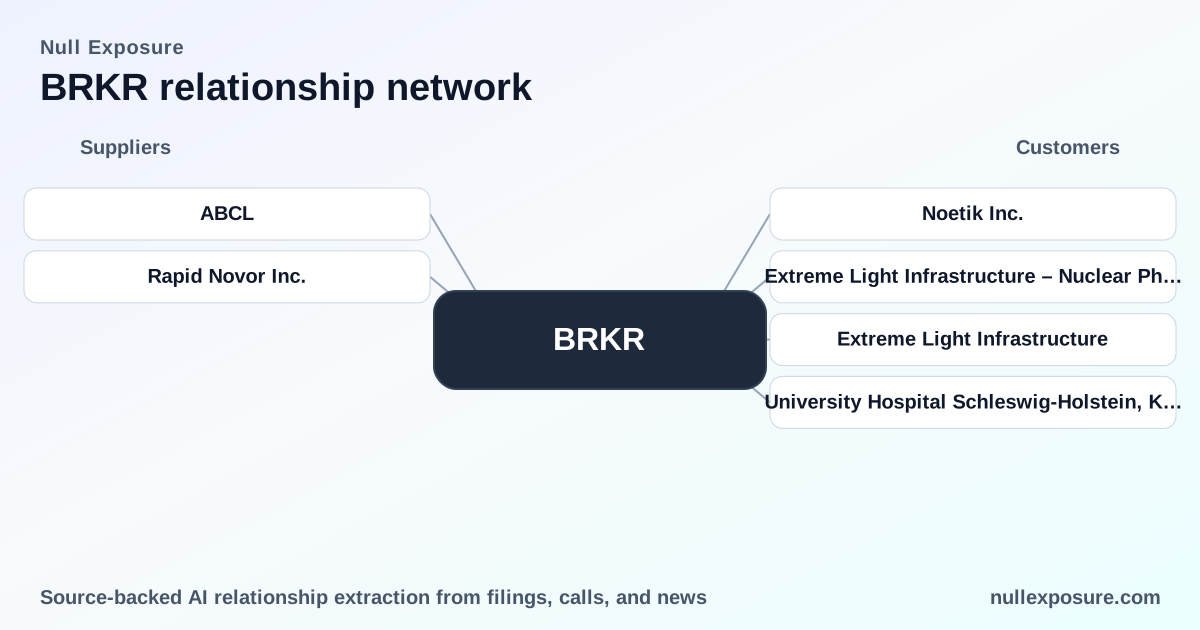
Bruker Corporation (BRKR) — Supplier relationships that move the P&L
Bruker designs, manufactures and sells advanced analytical and diagnostic instruments to life sciences, materials science and clinical markets, and it monetizes through equipment sales, recurring consumables and service/maintenance contracts as well as licensed technology. Supplier and IP relationships therefore directly influence cost of revenue, product roadmaps and royalty flows — making the supplier landscape an active driver of margins and growth optionality for investors and operators.
Explore supplier intelligence and relationship signals in greater depth at https://nullexposure.com/.
Why supplier links matter for a capital allocation view
Bruker’s commercial model mixes capital equipment sales with recurring revenue from consumables, software and services; that mix amplifies supplier risk because upstream inputs and IP licenses feed both unit economics and ongoing revenue streams. Long-term purchasing commitments and licensing fees show the company is both exposed to supplier concentration and engaged in active IP monetization, which affects margin stability and capital intensity.
If you evaluate Bruker as a supplier-dependent industrial life‑science supplier, consider the supplier posture described below and compare with peers on contract length, spend concentration and royalty exposure. For deeper supplier mapping see https://nullexposure.com/.
What the public record shows — direct relationships uncovered
AbCellera Biologics (entry 1)
Bruker and AbCellera resolved global patent litigation with a settlement and patent license agreement under which Bruker will pay AbCellera an upfront US$36 million and ongoing royalties tied to sales of its Beacon Optofluidic platform products for the life of the licensed patents. According to Simply Wall St reporting (March 9, 2026), the settlement was reached on December 18, 2025 and establishes a predictable royalty stream and an immediate cash outflow. (Source: Simply Wall St, March 2026)
AbCellera (entry 2)
A separate Simply Wall St piece covering Bruker reiterated the same settlement terms: US$36 million upfront plus royalty payments on Beacon platform sales for the life of the licensed patents, confirming the transaction has been acknowledged across publisher coverage and will be accounted for in FY2025 disclosures. (Source: Simply Wall St, March 2026)
Rapid Novor Inc. / Novor.AI
Bruker collaborates with Rapid Novor (Novor.AI) to provide large timsTOF mass-spectrometry datasets that enable next‑generation de novo peptide sequencing workflows, trading instrument/data access for algorithmic validation and market adoption support. A StockTitan article (reported March 2026) quoted Novor.AI on the collaboration, highlighting Bruker’s role in supplying the high‑quality data environment that underpins the partner’s AI models. (Source: StockTitan, March 2026)
Company-level constraints and what they imply for operating and investment decisions
The disclosures collected alongside the relationship records produce several clear operating constraints — these are company-level signals, not relationship-specific assignments unless explicitly named in the excerpt.
-
Long-term contracting posture: Bruker reports unconditional purchase commitments totaling $247.2 million across 2025–2029 (2025: $186.2M; 2026: $26.6M; 2027: $11.4M; 2028: $10.0M; 2029: $13.0M). That profile reflects multi‑year supply commitments and a procurement cadence that locks in costs and vendor dependencies over meaningful time horizons. (Company disclosures)
-
Spend concentration and materiality: Management warns that shortages or delivery failures of key components could have a material adverse effect on revenues and margins, which signals high criticality for certain suppliers and limited substitution in the near term. Investors should stress‑test margin sensitivity to supplier disruption when modeling downside scenarios. (Company disclosures)
-
Licensing and royalty economics: The company records licensing fees in cost of product revenue and disclosed licensing fees of $10.1M (2024), $7.5M (2023) and $6.4M (2022), indicating ongoing royalty expense is embedded in gross margins and trending upward. The AbCellera settlement introduces a discrete cash payment plus recurring royalties that will change both cash flow timing and gross margin composition. (Company disclosures; AbCellera reporting)
-
Manufacturing posture (outsourcing): Bruker is actively outsourcing parts of its manufacturing to streamline operations and reduce costs. Outsourcing increases supply chain leverage and requires rigorous vendor control; it also amplifies operational risk if contracted partners are concentrated or constrained. (Company disclosures)
-
Scale of committed spend: The $247.2M of unconditional commitments places Bruker in a >$100M spend band on foreseeable supplier obligations. That level of committed spend is a structural element for procurement negotiations and capex planning. (Company disclosures)
Taken together, these signals describe a company with long-dated supplier commitments, material exposure to component availability, embedded royalty expenses in cost of goods sold, and a mixed internal/outsourced manufacturing strategy — all of which are vital inputs to any valuation or operational improvement plan.
Explore supplier impact scenarios and peer comparisons at https://nullexposure.com/.
Investment implications and an operator checklist
- Earnings composition shift: Expect gross margin dynamics to reflect both the newly reported AbCellera royalty line and existing licensing fees already booked in cost of revenue; model royalty streams explicitly for scenario analysis.
- Supply chain stress test: Build downside cases where critical component shortages increase cost of goods or delay shipments; given the company’s own disclosure of material adverse risk, downside volatility is non‑trivial.
- Contract management priority: Long-term purchase commitments create procurement leverage but also lock-in; investors should monitor renegotiation clauses, inflation pass-through and penalty provisions.
- IP and litigation lens: The AbCellera settlement removes litigation uncertainty but creates a recurring royalty obligation; view this as a trade‑off between legal expense volatility and predictable margin impact.
- Outsourcing governance: As Bruker outsources manufacturing, assess counterparty concentration and geographic risk to evaluate operational continuity.
Bottom line and next steps for analysts
Bruker’s supplier and IP relationships are both a source of market access and a structural cost driver. The $36M AbCellera settlement and the company’s purchase commitments together shift cash flow timing and margin risk into clearer, modelable buckets. Operators should prioritize supplier continuity plans and margin sensitivity runs; investors should update projections to reflect ongoing royalty expense embedded in COGS.
For a consolidated supplier risk view and to benchmark Bruker against peers, visit https://nullexposure.com/.
Take action: review the supplier commitments and royalty assumptions in your model, and consult the full supplier intelligence suite at https://nullexposure.com/ for ongoing monitoring and alerting.