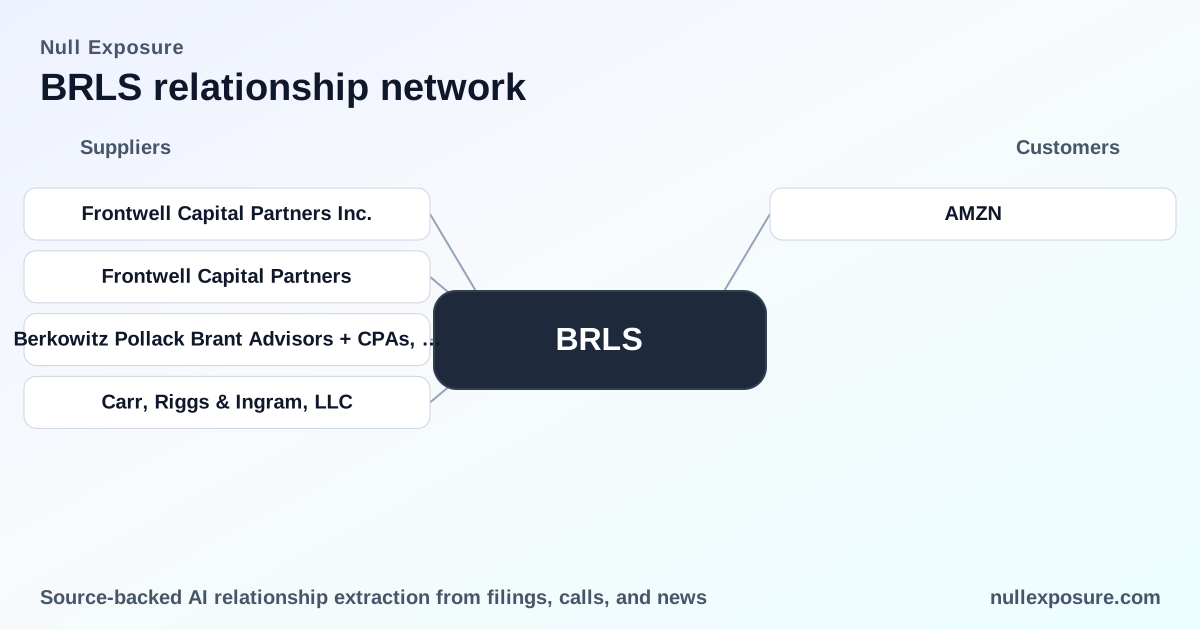
Borealis Foods (BRLS): Supplier relationships and what they signal for investors
Borealis Foods monetizes by producing and selling premium plant-based meat and dairy alternatives through a network of distributors and third‑party logistics providers, collecting revenue at scale from retail and food‑service channels. The company’s cost structure and growth trajectory are tightly linked to supplier concentration, short‑term purchase contracts, and access to external credit, making its supplier and lender relationships direct drivers of near‑term liquidity and margin outcomes. For a focused view of counterparty exposure and operational constraints, review our analysis and recommended next steps at the NullExposure homepage: https://nullexposure.com/.
Why supplier and service relationships matter for BRLS today
Borealis operates with high supplier concentration and a purchasing model that favors purchase‑order (spot) commitments, which compresses bargaining power and elevates input volatility. Simultaneously, the company runs a leveraged working‑capital posture that relies on external credit facilities to manage cash flow; recent lender interactions therefore cross from operational to financial risk. Finally, third‑party logistics is integral to Borealis’ go‑to‑market model, making logistics partners critical service providers rather than peripheral vendors.
The relationships you need on your radar
Below are all relationships flagged in recent filings and reporting. Each entry contains a plain‑English description and the source context.
Frontwell Capital Partners Inc. — refinancing of credit facility (FY2026)
Borealis reported it plans to refinance its existing credit facility with Frontwell Capital Partners Inc., indicating active renegotiation of liquidity terms and an ongoing reliance on Frontwell for short‑term funding. This was disclosed in an 8‑K reported March 9, 2026 via StockTitan summarizing the material event. (Source: company 8‑K, reported 2026‑03‑09 at StockTitan.)
Frontwell Capital Partners — notification of events of default (FY2025)
Frontwell Capital Partners notified Borealis of several events of default under its credit agreement, a direct escalation from covenant monitoring to enforcement that increases the probability of accelerated repayment or restrictive waivers. This notification was disclosed in an 8‑K noted via StockTitan and dated in the FY2025 disclosure stream. (Source: company 8‑K, reported 2026‑03‑09 at StockTitan.)
Berkowitz Pollack Brant Advisors + CPAs, LLP — resignation as auditor (FY2026)
On January 13, 2026, Borealis received notice that Berkowitz Pollack Brant resigned as the company’s independent registered public accounting firm, effective immediately, a development investors treat as a governance and reporting continuity signal. This resignation is documented in the company’s 8‑K filed and summarized on March 9, 2026. (Source: 8‑K disclosure, reported 2026‑03‑09 via StockTitan.)
Carr, Riggs & Ingram, LLC — appointment as new auditor (FY2026)
Two days after BPB’s resignation, on January 15, 2026, Borealis’ Audit Committee approved the appointment of Carr, Riggs & Ingram, LLC (CRI) as the new independent registered public accounting firm, restoring auditing coverage but also initiating an auditor transition period that affects FY2026 reporting comparability. This appointment appears in the same 8‑K filings summarized on March 9, 2026. (Source: 8‑K disclosure, reported 2026‑03‑09 via StockTitan.)
Constraints and what they reveal about operating posture
Borealis’ public filings include explicit operating descriptions that form company‑level constraints:
- The company states “We secure our supplies on a purchase‑order basis.” This indicates a predominantly spot contracting posture, with limited long‑term supply contracts and exposure to input price swings and availability shifts.
- Filings show “Purchases from 10 vendors accounted for approximately 47% and 50% of purchases during the fiscal year December 31, 2024 and 2023, respectively.” This is high vendor concentration and a material dependency that raises negotiating risk and supplier failure impact.
- The company describes logistics arrangements: “Our products are transferred by third‑party logistics providers to distribution centers or are directly shipped to the customer,” identifying third‑party logistics as critical service providers rather than optional vendors.
Taken together, these constraints outline an operating model that is transactional, concentrated, and dependent on external liquidity and logistics partners. Contract maturity is short, counterparty criticality is high, and the procurement posture amplifies margin volatility.
Financial and governance context that amplifies supplier risk
Borealis’ most recent public metrics frame relationship risk in financial terms: Revenue TTM $27.9M and Gross Profit $4.58M, but negative EBITDA of $10.95M and a trailing EPS of -$0.86. Insider ownership is 75.66%, while institutional ownership is effectively negligible at 0.037% — a shareholder base that reduces external market pressure but concentrates control. Market capitalization sits at ~$34.1M. Auditor turnover and lender default notices therefore intersect with a company that is small, cash‑consuming, and dependent on external financing.
Key implications:
- Credit counterparty outcomes drive liquidity: Frontwell’s default notices and refinancing activity convert supplier/lender dialogue into near‑term solvency considerations.
- Supplier concentration elevates operational stoppage risk: Losing a top supplier or a logistics provider creates outsized disruption.
- Auditor change introduces reporting transition risk, which can affect investor confidence during an already delicate refinancing period.
For a deeper look at how these relationship dynamics affect investment scenarios, see our coverage at https://nullexposure.com/.
Tactical takeaways for investors and operators
- Prioritize monitoring of Frontwell interactions: covenant waivers, amended credit terms, or collateral demands will materially alter capital structure.
- Stress‑test supply continuity for the top 10 vendors that account for roughly half of purchases and confirm contingency plans with logistics partners.
- Treat the auditor transition as a near‑term governance checkpoint — management disclosure quality and auditor opinion language in FY2026 will be consequential.
Actionable checklist:
- Request covenant schedules and the proposed refinancing term sheet from management.
- Validate alternate supplier sourcing and inventory buffer plans.
- Track CRI’s audit timeline and any modified disclosures or emphasis‑of‑matter language.
Bottom line and recommended next steps
Borealis operates with high supplier concentration, spot contracts, and meaningful reliance on external credit and logistics partners. The combined signals — Frontwell’s default notice and refinancing discussions, plus auditor turnover — convert supplier and service relationships into primary investment risk factors rather than secondary operational details. Investors and operators should shift from passive monitoring to active engagement: obtain updated credit documentation, verify supplier continuity, and follow the auditor transition closely.
For tailored counterparty exposure research and to download the full relationship dossier, visit NullExposure: https://nullexposure.com/. For immediate briefings and subscription options, go to https://nullexposure.com/ and request the BRLS supplier packet.