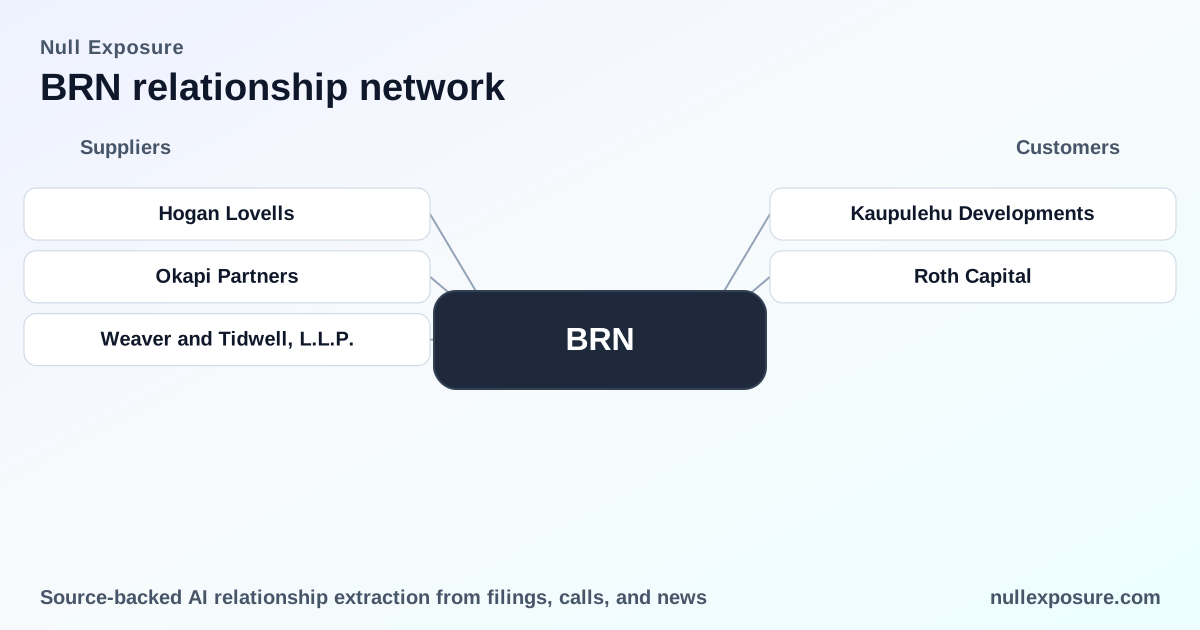
Barnwell Industries (BRN): Supplier relationship map and investor takeaways
Barnwell Industries operates as a small-cap oil and gas producer that acquires, develops, produces and sells oil and natural gas in Canada, monetizing through commodity sales and upstream production. The company's cost base and governance posture are visible through a compact roster of external advisors and service providers; for investors, supplier activity is a direct window into governance friction, recurring fixed obligations, and vendor concentration that affect cash flow and operational resilience. For a faster supplier-risk read on small-cap energy names, visit https://nullexposure.com/.
Why suppliers matter for a capital-constrained E&P
Barnwell is a tightly controlled public company with high insider ownership (66%) and limited institutional ownership (11%), which concentrates decision-making and elevates the role of external advisors when disputes or capital events occur. The supplier list lines up with its operating model: audit and advisory relationships at mid-range spend levels, ad-hoc legal counsel, and proxy solicitation services during contested governance episodes. The company’s commercial profile—negative EBITDA and EPS, modest revenue—creates disproportionate sensitivity to the cost and continuity of these suppliers.
- Contracting posture and maturity: Barnwell reports long-term lease obligations with modest remaining cash outflows (total remaining lease payments disclosed for the near term), indicating predictable, low-level fixed costs but also binding near-term cash commitments.
- Concentration and criticality: A small set of suppliers perform critical functions (audit, legal, proxy solicitation), so vendor performance and continuity matter materially to compliance and governance.
- Spend profile: Audit fees sit in a mid-range band (hundreds of thousands of dollars annually), consistent with a company that outsources statutory compliance and IT functions rather than building large internal teams.
If you want a structured supplier-risk intelligence brief for BRN, start here: https://nullexposure.com/.
The supplier roster investors should track
Hogan Lovells — external legal counsel
Hogan Lovells served as legal counsel to Barnwell in connection with a private placement and related transactions. According to an AccessNewswire release for fiscal 2025, Hogan Lovells acted as Barnwell’s legal advisor for that financing activity, indicating reliance on reputable international counsel for capital transactions. (AccessNewswire, FY2025)
Okapi Partners — proxy solicitor for shareholder votes
Okapi Partners handled proxy solicitation and investor outreach during Barnwell’s 2025 annual meeting process, including instructions for shareholders to contact them regarding WHITE proxy cards. A GlobeNewswire press release dated June 18, 2025 described Okapi’s role in coordinating voting and managing shareholder communications, signaling active and potentially contested governance engagement at Barnwell. (GlobeNewswire, 2025-06-18)
Weaver and Tidwell, L.L.P. — independent auditor and recurring service provider
Weaver and Tidwell, L.L.P. is Barnwell’s independent registered public accounting firm and billed the company $343,795 for audit and related services in fiscal 2025 (and $367,264 in fiscal 2024). Public filings and investor materials for FY2026 discuss the Board’s recommendation to ratify Weaver and Tidwell as auditor and note a reduction in Board size alongside director nominations, underlining the auditor’s central role in statutory reporting and shareholder scrutiny. (Company filings / proxy materials, FY2025–FY2026)
What these relationships mean for risk and upside
- Governance risk is elevated and visible. The involvement of Okapi Partners as proxy solicitor and the Board’s active solicitation for votes in FY2025–FY2026 indicate a contested or highly contested governance environment; that dynamic can drive transaction costs, distract management, and influence strategic choices. (GlobeNewswire, 2025; FY2026 proxy materials)
- Audit continuity is a material operating dependency. Weaver and Tidwell’s audit fees in the mid-hundreds of thousands position them as a critical recurring service provider; any auditor turnover or qualification would materially affect compliance costs and investor confidence. The company explicitly disclosed these fee levels in its FY2025 reporting. (FY2025 filings)
- Legal support for capital transactions is outsourced to top-tier counsel. Retaining Hogan Lovells for financing work signals that Barnwell will lean on established external counsel for complex capital markets work rather than building internal legal capacity—an appropriate posture for a small producer but a cost center when capital raises are frequent. (AccessNewswire, FY2025)
- Fixed obligations are limited but non‑negligible. Barnwell’s lease schedule shows multi-year operating lease payments with a present value of lease liabilities, which creates predictable but binding near-term cash outflows disclosed in the company’s FY2025 reporting. This constrains free cash available for capex or debt service. (FY2025 Form 10-K disclosures)
Constraints and the operating model — what investors should read into the facts
- Contracting posture: The company-run lease schedule demonstrates long-term commitments at modest absolute values, suggesting Barnwell manages facility and office costs conservatively rather than leveraging large lease exposure. This is a company-level signal derived from the FY2025 lease disclosure.
- Service-provider dependency: The firm relies on external professional services—audit, legal and IT consultants—to meet regulatory, capital-raising and cybersecurity needs; Weaver and Tidwell’s disclosed audit fees explicitly classify them as a primary service provider. This creates single-vendor criticality for statutory reporting.
- Spend concentration: Audit fees in the $300k–$400k range place audit spend within the $100k–$1M band, consistent with a small-cap public company profile and confirming mid-level outsourcing spend, particularly for compliance functions. Weaver and Tidwell are explicitly named in those fee disclosures.
- Maturity and scale constraints: Financials show negative EBITDA and EPS, limited market capitalization and modest revenue, which compress negotiating leverage with suppliers and increase sensitivity to any step-up in vendor fees or unexpected service disruptions.
Midway through your diligence, monitor the next proxy cycle and the auditor relationship closely—both are real governance levers for value creation or destruction. For a supplier-focused monitoring playbook, see https://nullexposure.com/.
Practical monitoring checklist for investors
- Track proxy statements and press releases for changes in proxy solicitor activity and notice of adjournments; these are early indicators of governance disputes.
- Monitor Form 10-K/10-Q for any auditor fee changes, audit opinions or auditor turnover notices; auditor continuity is a leading indicator of reporting risk.
- Watch legal-retainer disclosures around capital raises—changes in counsel or fee levels reveal shifts in financing strategy.
- Review lease and other contract schedules in periodic reports for changes to fixed obligations that impact near-term liquidity.
Bottom line and next steps
Barnwell’s supplier footprint is compact but consequential: a single named auditor with mid-level recurring fees, top-tier legal counsel for financings, and an active proxy solicitor during contested governance episodes. For investors, the most immediate risks are governance distraction and audit continuity, both of which can influence valuation more than operational tweaks in a small-cap E&P.
Explore a structured supplier-risk brief for BRN and comparable small-cap energy suppliers at https://nullexposure.com/.