Barinthus Biotherapeutics (BRNS): Supplier relationships you need on your radar
Barinthus Biotherapeutics is a clinical-stage immunology company that develops T-cell–guided therapies for chronic infectious disease, autoimmunity and cancer. The company monetizes by advancing clinical-stage candidates toward regulatory milestones and commercialization while outsourcing much of development and manufacturing to third parties; value is created through licensing, partnerships and eventual product sales or M&A outcomes. For investors and operators, the fundamental driver is Barinthus’s ability to execute clinical programs while managing external supplier risk and multi-year infrastructure commitments. Learn more about supplier risk profiling and supplier intelligence at the Null Exposure homepage: https://nullexposure.com/
Quick operating thesis for suppliers and counterparties
Barinthus is a capital-consuming, clinical-stage biotech with no product revenue and a negative EBITDA profile; it relies on third-party CMOs, CROs and professional advisers to run trials, manufacture drug product and manage M&A/IR activity. This operating posture produces two structural realities: (1) supplier criticality is high—failure or delay at a CMO/CRO will directly impact trial timelines—and (2) contracting is long-dated and geographically split, reflecting dual-site science infrastructure in the U.K. and the U.S. To benchmark counterparties and surface concentration risk, examine legal/financial advisory relationships, ongoing R&D vendors and manufacturing commitments. For a consolidated view of supplier relationships, visit https://nullexposure.com/
Vendor map: who Barinthus is working with now
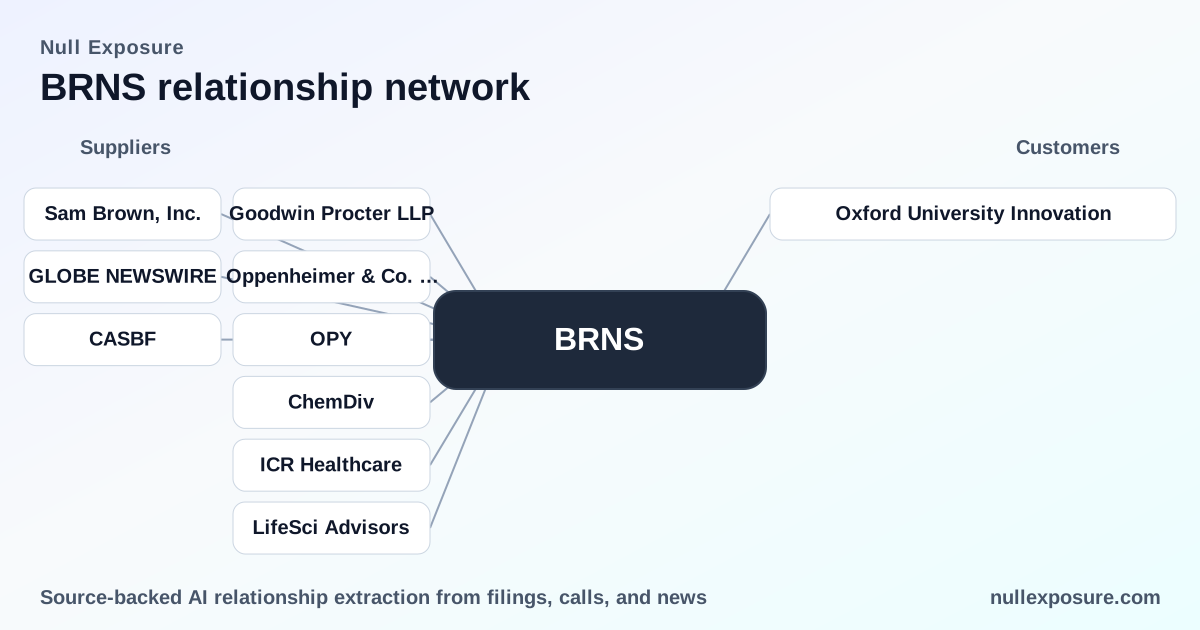
Below are the supplier and advisor relationships surfaced in public releases and filings. Each entry is a plain-English summary with source attribution.
-
Goodwin Procter LLP — Goodwin acted as legal counsel to Barinthus in the all‑stock merger agreement with Clywedog Therapeutics, supporting public M&A and life sciences transactional work for the company in FY2025. According to a Goodwin/Mondaq advisory and GlobeNewswire coverage of the merger announcement (FY2025), Goodwin led the legal advisory role in the deal.
-
Oppenheimer & Co. Inc. — Oppenheimer served as Barinthus’s exclusive financial advisor during the transaction to combine with Clywedog, providing sell‑side/strategic advisory services for the merger process (announced in FY2025). The GlobeNewswire merger release and subsequent QuiverQuant summary identify Oppenheimer as the exclusive financial advisor (FY2025).
-
ChemDiv — ChemDiv continues to provide integrated R&D services—chemistry, computational chemistry and clinical pharmacology support—to the combined Barinthus/Clywedog programs, supporting translational work and medicinal chemistry post-merger. Multiple press pieces including Yahoo Finance and a SahmCapital report note ChemDiv’s continuing role supporting Clywedog work as it transitions into the merged organization (Oct 2025).
-
ICR Healthcare — ICR Healthcare is the retained media/IR contact listed for Barinthus’s Phase 1 VTP‑1000 clinical update, acting as external communications support for clinical announcements and investor-facing messaging. The December 10, 2025 press release carried on Yahoo Finance lists ICR Healthcare personnel as the media contacts for the company (Dec 2025).
-
LifeSci Advisors — LifeSci Advisors functions as investor relations counsel, with named Managing Directors supporting IR outreach and analyst engagement during the company’s FY2025 strategic update. Barinthus’s January 10, 2025 strategic focus and financial update press release includes LifeSci Advisors contact information for investor relations (Jan 2025).
-
Sam Brown, Inc. — Sam Brown is an external public relations firm providing media contact and communications support for Barinthus corporate announcements, as listed in the company’s FY2025 communications materials. The January 2025 press release identifies Sam Brown as a media contact for outreach (Jan 2025).
-
GLOBE NEWSWIRE — GlobeNewswire served as the distribution channel for Barinthus’s Phase 1 clinical update and merger announcements, functioning as the primary press release vehicle to reach investors and the trade press in FY2025. The company used GlobeNewswire to publish both the VTP‑1000 Phase 1 update and the merger announcement (Dec–Sep 2025).
-
CanSino (CASBF) — In its FY2024 Form 10‑K, Barinthus disclosed efforts to enter into a separate supply agreement under which CanSino would manufacture product necessary for clinical trials and commercialization under a project agreement, indicating a potential manufacturing supply relationship. The FY2024 filing explicitly references CanSino in the context of manufacturing commitments and project supply arrangements (FY2024 10‑K).
What the supplier footprint says about Barinthus’s operating model
-
Contracting posture: long-term, fixed-site commitments. Barinthus’s filings document multi-year leases for lab and office space in both the U.K. and U.S., establishing a long-dated infrastructure base and fixed-cost profile. This translates into predictable facility spending and the need to maintain continuous vendor support for lab operations and service continuity.
-
Geographic split increases operational complexity. The company has active infrastructure and clinical operations spanning EMEA (Harwell, Oxfordshire) and North America (Germantown, Maryland), which drives multi-jurisdictional supplier management and regulatory interfaces.
-
Outsourced manufacturing is central and strategic. Company disclosures highlight reliance on third‑party manufacturers, CMOs and CROs to run studies and produce clinical material—making supplier performance a critical path item for timelines and value realization.
-
Active, maturing supplier relationships. Evidence indicates active vendor engagements (ongoing R&D support, retained advisors and press channels), not purely ad hoc arrangements; lease liabilities and right‑of‑use assets in filings point to committed, near-term cash flow obligations tied to infrastructure.
-
Spend profile is material but bounded. Lease maturities and minimum lease payments reported (totaling roughly the mid‑tens of millions aggregated) signal an infrastructure spend band consistent with the company’s scale—company-level capex/opex exposure in the $10m–$100m band for leases and facility-related obligations.
Investment and operational implications
-
Operational risk is supplier risk. Delays at ChemDiv or a failure to finalize manufacturing with CanSino will have direct program timeline and cost implications. Investors should prioritize evidence of contractual terms, SLAs and contingency manufacturing plans.
-
Advisory relationships reduce execution risk for M&A and capital markets work. Legal and financial advisors (Goodwin, Oppenheimer) indicate Barinthus is actively managing corporate transactions and capital access pathways—important for exit timing and dilution expectations.
-
Communications and IR infrastructure are in place. Retained PR/IR firms and use of GlobeNewswire show the company manages investor messaging centrally, which supports market transparency ahead of key clinical readouts.
If you want a structured supplier risk scorecard for Barinthus or a comparative supplier concentration analysis across similar clinical-stage immunology companies, start here: https://nullexposure.com/
Bottom line and next steps
Barinthus executes a highly outsourced clinical model with long-term facility commitments and a small set of strategic vendors that are critical to program timelines. For investors, the priority is validating manufacturing agreements and vendor SLAs; for operators, the priority is contingency planning for third‑party manufacturing and cross‑border regulatory coordination.
For an in-depth supplier diligence package or to commission a counterparty risk brief on Barinthus and its vendors, visit https://nullexposure.com/ and request our supplier intelligence briefing.