Brown & Brown (BRO): Supplier and Partner Relationships That Drive Growth and Risk
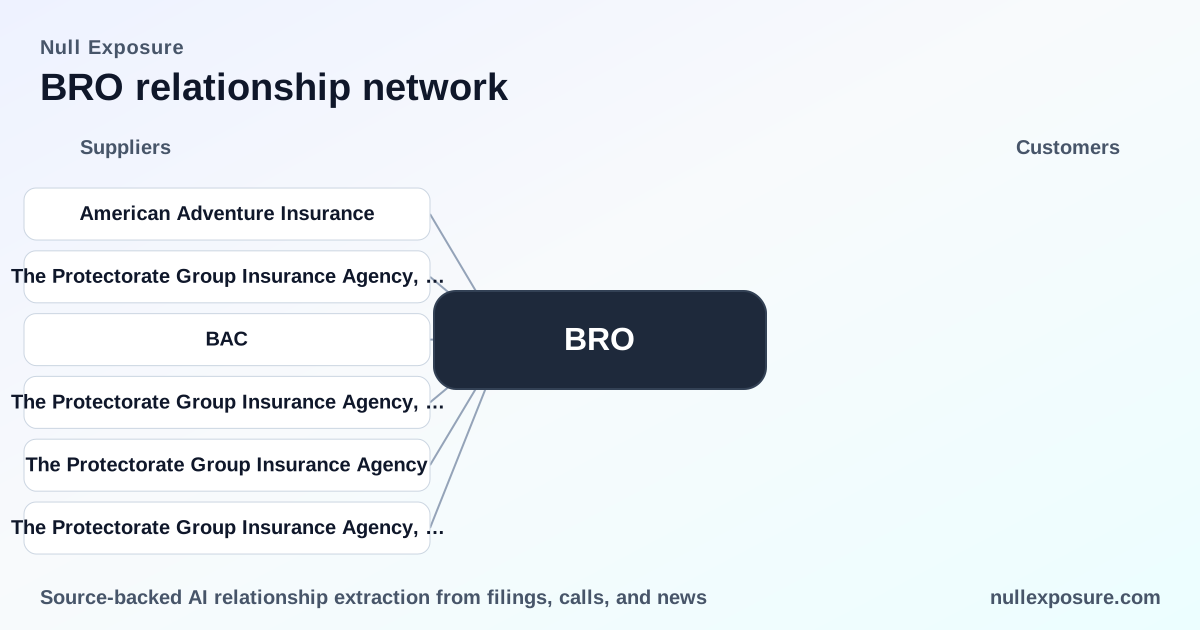
Brown & Brown operates as a high-volume insurance broker and distributor, monetizing through brokerage commissions, fee income from value-added services, targeted acquisitions, and disciplined capital deployment such as accelerated share repurchases. The company expands both organically and by buying specialty agencies to augment distribution and dealer-facing capabilities, while using capital markets partners to return capital and manage the share base. For a consolidated view of supplier relationships and strategic signals, visit https://nullexposure.com/.
How these relationships actually move the needle
Brown & Brown’s business model depends on two live operational levers: acquisitive growth to scale niche distribution channels and capital programs to optimize shareholder value. Acquisitions enlarge fee streams and dealer-facing product suites; bank counterparties execute liquidity and buyback mechanics. Simultaneously, the firm runs a complex third‑party vendor network to support underwriting, administration, and reinsurance procurement.
Recent relationship activity you need to know about
Below I list every relationship instance surfaced in the results and what it means in plain English.
-
Brown & Brown Dealer Services acquired the assets of American Adventure Insurance; the announcement was publicly disclosed on February 17, 2026 via news aggregators and deal notices. This adds dealer-focused capabilities to BBDS’s platform. (See the Quiver Quant release summarizing the deal, FY2026: https://www.quiverquant.com/news/Brown+%26+Brown%2C+Inc.+Acquires+Assets+of+American+Adventure+Insurance+to+Enhance+Dealer+Services)
-
A Finviz news item noted the same transaction: Brown & Brown’s BBDS purchased the assets of American Adventure Insurance effective February 17, 2026, reinforcing the company’s strategy to consolidate dealer insurance channels. (Finviz report, FY2026: https://finviz.com/news/325986/raymond-james-cuts-brown-and-brown-bro-target-by-8)
-
ProgramBusiness reported that Brown & Brown Dealer Services completed the asset acquisition of The Protectorate Group Insurance Agency, doing business as American Adventure Insurance, signaling BBDS’s targeted roll-up of dealer-focused agencies to expand distribution and product innovation. (ProgramBusiness, FY2026: https://programbusiness.com/news/brown-brown-dealer-services-acquires-assets-of-american-adventure-insurance/)
-
Pulse2 covered the announcement that Brown & Brown’s dealer services division acquired The Protectorate Group Insurance Agency assets, emphasizing integration of the American Adventure team into BBDS’s dealer solutions. (Pulse2, FY2026: https://pulse2.com/brown-brown-acquires-american-adventure-insurance-assets/)
-
GlobeNewswire (published via Manila Times) ran Brown & Brown’s press release noting the American Adventure team will expand BBDS capabilities and add dealer solutions nationwide—presentation consistent with a bolt-on acquisition play. (GlobeNewswire / ManilaTimes, Feb 17, 2026: https://www.manilatimes.net/2026/02/17/tmt-newswire/globenewswire/brown-brown-inc-acquires-the-assets-of-the-protectorate-group-insurance-agency-inc-doing-business-as-american-adventure-insurance/2279308)
-
A Bitget news item repeated the same acquisition news on February 17, 2026, confirming the transaction and Brown & Brown’s use of BBDS as the operating vehicle for dealer‑focused asset integrations. (Bitget News, FY2026: https://www.bitget.com/news/detail/12560605228714)
-
Brown & Brown entered into a $250 million Accelerated Share Repurchase (ASR) with Bank of America, a capital-allocation action reported in market commentary that confirms the company’s use of major banking counterparties to execute buybacks and manage outstanding shares. (MarketScreener / Mizuho note referencing the ASR with Bank of America, FY2026: https://www.marketscreener.com/news/mizuho-upgrades-brown-brown-to-outperform-from-neutral-adjusts-price-target-to-85-from-84-ce7e5cded08cf326)
Operational constraints and what they signal for investors
Brown & Brown’s disclosures surface several firm-level constraints that translate directly into operating model characteristics:
-
Global supplier footprint: The company acknowledges that some providers are located outside the U.S., creating exposure to geopolitical and cross‑border operational risk. This signal indicates an internationally distributed vendor base that increases complexity and continuity risk.
-
Buyer role for reinsurance: Brown & Brown explicitly purchases reinsurance to limit exposure. This confirms a buyer contracting posture relative to reinsurance markets, implying recurring counterparty settlements and sensitivity to reinsurer capacity and pricing cycles.
-
Reliance on third‑party service providers: The business depends on vendors for technology, information security, funds transfers, and administration. That reliance defines high operational criticality and vendor concentration risks where a small set of service providers could materially affect operations.
-
Active relationship stage: The company describes ongoing reliance on a large number of vendors and third parties for critical functions, suggesting mature, active supplier relationships rather than nascent pilots—contracts and SLAs are likely embedded in day‑to‑day operations.
Together, these constraints imply a supplier posture that is operationally critical, broadly distributed, and reliant on established third‑party relationships—factors that investors must weigh alongside financial metrics.
Investment implications and risk-reward tradeoffs
Brown & Brown’s asset purchases for its Dealer Services unit are fundamentally growth-accretive: bolt-on acquisitions expand distribution, raise fee income, and strengthen niche market positions. The American Adventure integration is a clear, execution-oriented move to own more dealer channels. At the same time, the $250 million ASR executed with Bank of America signals an active use of capital to support EPS and share price dynamics.
Risk considerations for an investor audience:
- Vendor and cross-border exposure introduce operational tail risk that can affect underwriting and administration if key providers underperform or face disruption.
- Reinsurance purchasing posture creates dependence on market pricing and counterparty strength, which matters in adverse loss years.
- M&A integration execution is a recurring performance lever—success requires consistent operational integration of acquired agencies into BBDS and the broader firm.
If you track supplier concentration, integration cadence, and capital deployment rhythm, you will see the levers that drive Brown & Brown’s margins and return metrics. For more on supplier signals and how they affect valuation models, visit https://nullexposure.com/.
What investors should do now
- Monitor integration cadence and incremental revenue from BBDS acquisitions; these prove the ROI of the deal pipeline.
- Watch reinsurance markets and counterparty ratings to anticipate changes in cost of risk transfer.
- Track ASR and buyback cadence as a near-term EPS amplifier and key indicator of management’s capital priorities.
For deeper supplier profiling and to assess third‑party risk across portfolios, explore our research hub at https://nullexposure.com/.
Bottom line
Brown & Brown executes a dual playbook: targeted acquisitions to expand specialty distribution and measured capital programs to optimize shareholder returns. Operational reliance on a distributed vendor base and the company’s buyer role in reinsurance are central constraints that define both opportunity and risk. Investors should prioritize monitoring integration success, vendor continuity, and reinsurance market dynamics when evaluating BRO as a supplier-driven franchise.