BRT Realty Trust: supplier relationships, capital posture, and what lenders tell investors
BRT Realty Trust operates as a focused multifamily REIT that acquires, owns and manages apartment communities and monetizes through rental income, property-level fee arrangements, and joint-venture economics. Its operating model relies on outsourced property management, mortgage financing and selective joint-venture partnerships to execute a value‑add strategy that lifts cash flow and asset values. For investors evaluating supplier counterparties, the critical lens is on credit relationships that shape liquidity and covenant exposure, outsourced managers that control property-level performance, and a concentrated capital structure that amplifies supplier importance. Learn more about how we surface these relationships at https://nullexposure.com/.
The supplier posture that defines BRT's risk surface
BRT runs a hybrid model: asset ownership with outsourced operations and externally sourced financing. That creates three structural supplier features investors should track:
- Long-term, fixed-rate mortgage commitments that lock in cash‑flow obligations and limit financing flexibility.
- Outsourced property management and back‑office services that are operationally critical and compensated on a revenue share basis.
- Concentrated lending relationships where amendments to facilities materially affect near-term liquidity.
These are not abstract: BRT reported a mortgage on Woodland Trails that matures in September 2031, interest‑only until maturity at 5.22%, illustrating a long-term debt posture that ties up cash flow for years. Separately, the company discloses approximately $443.1 million of mortgage principal outstanding on carve-out guaranteed properties at year‑end 2024, signaling substantial secured debt against the operating portfolio. These features make supplier negotiations—particularly with lenders and property managers—highly consequential for dividends and refinancing windows.
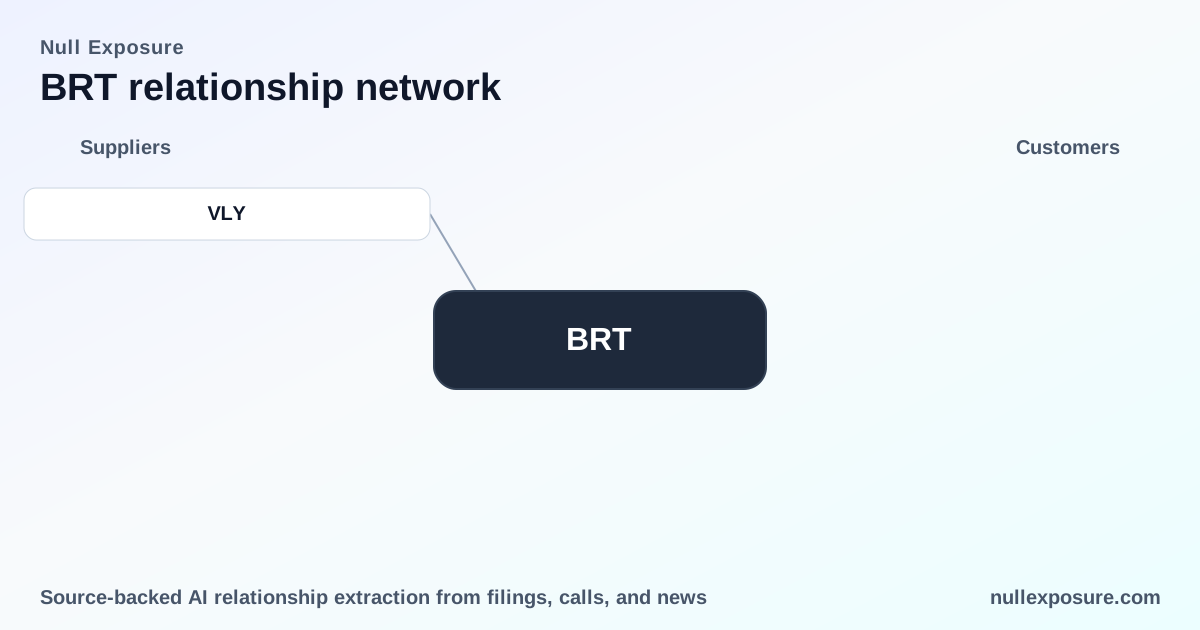
Valley National Bank — the single explicit relationship in the results
According to a March 9, 2026 news report, BRT amended its credit facility with Valley National Bank, reducing the borrowing capacity from $60 million to $40 million and extending the facility maturity to September 2027 (https://qz.com/brt-apartments-corp-md-brt-reports-earnings-1851769527). The amendment also revised certain financial and other covenants. This is a direct lender relationship that both constrains available liquidity and shifts covenant timing; the extension to 2027 buys runway while the reduced capacity tightens the company’s short-term borrowing flexibility.
What the Valley National Bank amendment means for investors
The VNB amendment is a practical example of how lender negotiations translate into operational constraints:
- Reduced headroom: Availability cut to $40 million lowers immediate liquidity cushions for capex or leasing shortfalls.
- Maturity relief but covenant sensitivity: Extending maturity reduces near-term refinance pressure but leaves the company exposed to amended covenants that can trigger defaults or additional restrictions.
Investors should treat Valley National Bank as a material financing counterparty: the relationship is transactional (credit provider) and operationally critical. The news item is the explicit relationship captured in the results and is the most recent supplier action that changes BRT’s capital options (news report, March 2026).
The operational supplier network behind the balance sheet
Outside the single recorded lender relationship, BRT’s filings and disclosures describe the routine service-provider ecosystem that runs the portfolio:
- Property management firms oversee day‑to‑day operations, with management fees disclosed in the 2%–4% of property revenues range; four of seven joint-venture properties are managed by a JV partner or its affiliates, tying property performance to third‑party incentives.
- Certain executive, administrative, legal and accounting functions are provided through part‑time personnel and affiliate arrangements, which reduces fixed SG&A but creates dependency on external capabilities.
These arrangements make operational suppliers both cost levers and potential single points of failure: if a revenue-based manager underperforms, the impact drops straight to NOI and debt service coverage. According to company disclosures, management fees and affiliated service arrangements are a standing part of the operating model.
Capital structure and constraint signals that shape supplier bargaining power
Treat the following as company-level operating signals rather than relationship-specific facts:
- Long maturity profile on mortgages (example: Woodland Trails financing to Sept 2031) indicates that BRT accepts multi-year locked-in interest costs rather than rolling short-term exposure.
- High secured debt scale (~$443.1 million) positions lenders as influential suppliers; financing counterparties have structural leverage in covenant negotiations and refinancing outcomes.
- Material spend concentration toward mortgage and financing obligations reduces flexibility to absorb higher management fees or service cost inflation without compressing distributions.
These constraints make BRT a credit-sensitive operator: lenders dictate refinancing cadence while outsourced managers influence the top line—both determine free cash flow available to shareholders.
Financial context that underpins supplier risk
BRT’s most recent financial snapshot reinforces why supplier terms matter. Revenue for the trailing twelve months is roughly $96.9 million with EBITDA around $37.2 million, while book value per share sits at $9.41 and the company reports a negative diluted EPS of -$0.51. Market capitalization is approximately $270.3 million, and valuation multiples show an EV/EBITDA of 18.6, implying limited margin for adverse financing moves. When financing headroom is reduced—as with the VNB amendment—operational suppliers and lenders become primary determinants of near-term performance.
For readers who want a deeper extraction of counterparty exposure and covenant timelines, visit https://nullexposure.com/ to review the full supplier mapping and event timeline.
Investor implications and what to monitor next
Active investors and operators should prioritize the following:
- Monitor borrower covenants and any covenant-testing dates tied to the VNB amendment; covenant breaches will materially affect liquidity.
- Track refinancing windows for major mortgages (notably the Woodland Trails maturity in 2031) to assess repricing risk and lender concentration.
- Review property manager performance metrics because fees are revenue‑linked and underperformance flows directly to the bottom line.
Key takeaway: BRT’s supplier risk is dominated by financing counterparties and outsourced managers; changes in credit facilities (like the Valley National Bank amendment) immediately alter cash-flow flexibility and should guide any valuation or operational scenario analysis.
For an investor-ready supplier dossier and ongoing monitoring of BRT counterparties, go to https://nullexposure.com/ and subscribe for alerts.
In summary, BRT’s business model relies on long-term mortgage financing and outsourced operational partners; the Valley National Bank amendment is the most salient supplier action in the public record and materially affects near-term liquidity and covenant exposure. Investors should treat lender and manager relationships as core value drivers and monitor covenant milestones and refinancing timelines closely.