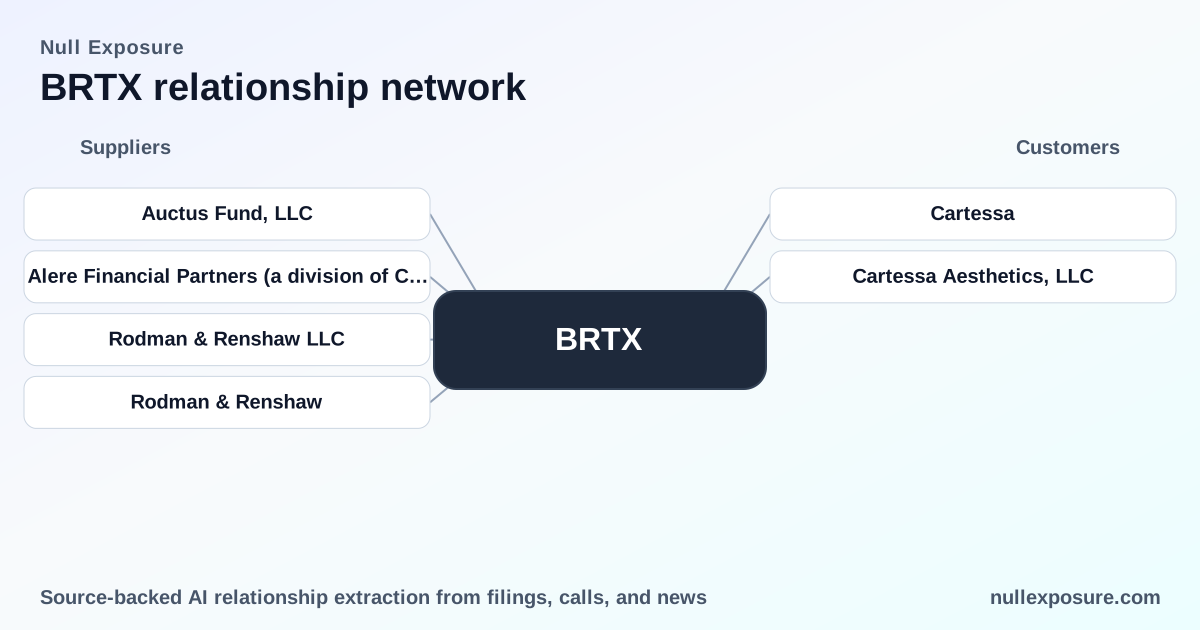
BRTX Supplier Map: placement agents, a CRO dependency, and what investors need to price in
BioRestorative Therapies (NASDAQ: BRTX) is a small-cap regenerative medicine developer that earns negligible product revenue today and funds operations through capital markets activity and strategic financings. The company advances adult stem‑cell protocols toward clinical endpoints and monetizes via future product commercialization or licensing—but in the current operating cycle the material cash flows are coming from registered and public offerings arranged by placement agents, and clinical execution is outsourced to contract research organizations. For investors, the supplier book is therefore a combination of capital markets counterparties (placement agents), a named CRO for Phase 2 work, and routine clinical‑grade vendors for media and reagents. Learn more at https://nullexposure.com/.
Clear relationships: who BRTX is contracting with right now
-
Auctus Fund, LLC — equity investor via preferred stock exchange. The company disclosed that on November 8, 2021 it issued 1,543,158 shares of Series A Preferred Stock to Auctus Fund, LLC in exchange for an equal number of shares of outstanding Series A, creating a legacy shareholder and capital partner position. This detail is recorded in BRTX’s 2024 Form 10‑K filing (FY2024).
-
Alere Financial Partners (division of Cova Capital Partners, LLC) — exclusive placement agent for a 2025 registered direct offering. Alere Financial Partners served as the exclusive placement agent for a $1.085 million registered direct offering priced above market in October 2025, positioning them as a capital markets supplier used to shore up near‑term liquidity. The company announced this via a GlobeNewswire release in October 2025.
-
Rodman & Renshaw LLC / Rodman & Renshaw — exclusive placement agent for 2026 public offerings and placement agent compensation terms. Rodman acted as exclusive placement agent for a $5.0 million public offering priced and announced in February 2026 and related communications through early March 2026; public filings and press releases state Rodman received a 7% cash fee on gross proceeds, reimbursement of expenses (up to $100,000), and five‑year placement agent warrants for 350,000 shares at a $0.4375 exercise price. See the company’s February 2026 press release and the related 8‑K and market news coverage in February–March 2026.
What the constraints tell investors about operating posture and supplier risk
The company disclosures reveal three actionable operating signals that shape supplier risk and contracting posture.
-
Clinical development is outsourced under a named CRO agreement. BRTX entered a Master Service Agreement and a CRO agreement with Professional Research Consulting Inc., operating as PRC Clinical, to run its Phase 2 trial and related site agreements, patient enrollment and procedures. This is a direct company disclosure (10‑K language) and signals an outsourced clinical execution model where timetables and quality hinge on a single CRO relationship.
-
BRTX is a buyer of clinical‑grade inputs supplied by third parties. Company statements confirm that certain media, reagents, devices and systems used in clinical and potential commercial production are obtained from unaffiliated third parties, indicating routine vendor dependency for manufactured inputs rather than in‑house vertical integration.
-
Supplier spend and fixed commitments are modest but nontrivial. The filing notes a lease with an annual base rental of $173,060, which places real estate/operational fixed costs in the $100k–$1m band and aligns with the company’s constrained operating scale. That spend band is sufficient to create exit costs and continuity sensitivity if suppliers or lessors change terms.
Collectively these constraints indicate a company operating at early maturity with high external dependency: trial progress depends on outsourced clinical services, financing relies on intermediaries that take dilutive fees, and operational overhead is small but meaningful relative to the firm’s revenue base (Revenue TTM $383,400; Market Cap ≈ $6.2M).
Why placement agents and the CRO relationship matter for valuation
-
Placement agent economics are expensive and dilutive. The 7% cash fee, expense reimbursements and the issuance of placement agent warrants to Rodman materially increase the effective cost of short‑term capital. For a thinly capitalized issuer, these underwriting-like terms transfer cash and equity value to the agent while preserving runway, but they also compress shareholder value and create future overhang via warrants. Source: company 8‑K and press releases, February–March 2026.
-
CRO dependence converts operational risk into counterparty risk. With PRC Clinical running Phase 2 under an MSA, clinical milestone timing and data integrity are directly affected by a single external vendor; any delay, quality control issue, or termination would create outsized program risk. This is explicit in the company’s disclosures on its Phase 2 arrangements (10‑K).
-
Capital partners reflect past and future financing behavior. The Auctus preferred stock exchange and successive registered and public offerings placed by Alere and Rodman show a pattern: BRTX leans on third‑party capital placement to fund clinical work rather than generating free cash flow, implying continued interaction with placement agents and investors that extract fees or seek preferred/convertible economics. Source: company 10‑K (Auctus) and GlobeNewswire/press coverage (Alere, Rodman).
Explore a supplier‑level risk dashboard and investor insights at https://nullexposure.com/.
Operational concentration, maturity and counterparty power — a concise read
-
Concentration and liquidity: BRTX has a small public float and low institutional ownership (insiders ≈ 14.3%; institutions ≈ 5.4%), which gives early strategic or placement counterparties disproportionate bargaining power in financing rounds. Source: company summary metrics.
-
Maturity: The company’s negative EBITDA and minimal revenue confirm it is in the clinical‑stage development phase; supplier relationships are therefore mission‑critical rather than transactional.
-
Criticality: Suppliers for clinical‑grade inputs and the named CRO are critical to program timelines; placement agents are critical to survival. Each supplier category has a different risk profile—operational continuity for CROs and vendors; dilution and overhang for placement agents.
What investors should monitor next
- Monitor SEC filings (8‑Ks, Form 10‑Q) and press releases for additional placement agent terms, warrant issuances, and any changes to the PRC Clinical engagement or new CRO agreements. Watch for exercise or re‑pricing events on placement agent warrants.
- Track clinical milestone cadence from the Phase 2 program run by PRC Clinical and any vendor supply disruptions for media and reagents. Clinical delays materially change required capital and the timing of further financings.
- Reassess counterparty exposure if placement agent relationships widen or if new strategic investors (like Auctus) deepen positions.
If you need a tailored supplier risk briefing or monitoring feed for BRTX counterparties, start here: https://nullexposure.com/.
Bottom line: price counterparty risk into the stock
BioRestorative is an early‑stage biotech where capital markets counterparties and outsourced clinical partners define near‑term viability. Placement agents reduce immediate liquidity strain but at clear cash and dilutive costs; the named CRO relationship concentrates operational risk for the Phase 2 program. For investors evaluating BRTX supplier relationships, the thesis is straightforward: value recovery depends on clinical success and the company’s ability to access less‑expensive capital—each mediated by the supplier landscape described above. For a deeper supplier map and alerts on new placements or contractual changes, visit https://nullexposure.com/.