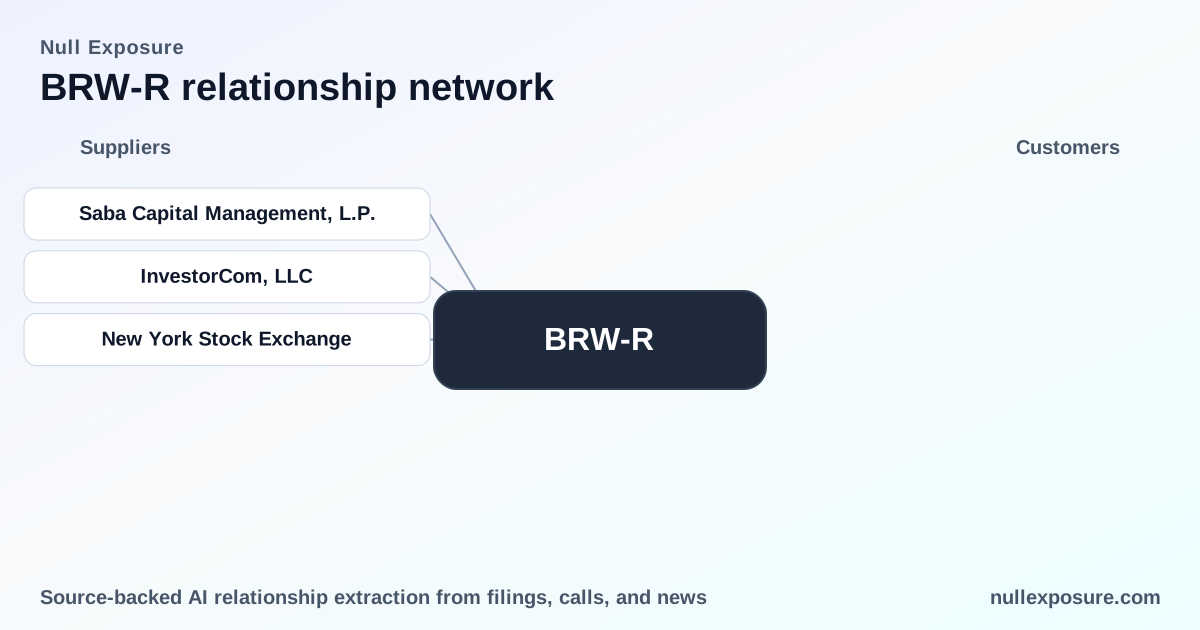
BRW-R: Who the Fund Pays, Who Runs It, and What That Means for Investors
Saba Capital Income & Opportunities Fund (NYSE: BRW) is a closed-end investment vehicle that monetizes through investment income and management fee capture: it holds a portfolio of debt and equity securities and distributes income to shareholders while the adviser earns fees for portfolio management. The fund supplements capital through market actions such as a rights offering in 2025 designed to expand deployable assets and preserve flexibility to pursue income opportunities. For investors and counterparties evaluating supplier exposure, the fund’s operating model centers on a single, external investment manager, an external investor relations/agent, and its NYSE listing — each relationship drives performance, governance transparency, and operational continuity.
Explore supplier intelligence and relationship risk at Null Exposure.
How BRW-R runs and where the economics live
BRW-R’s business is straightforward: a closed-end fund generates cash through interest, dividends, and trading gains, then pays distributions to shareholders while the adviser collects management and performance-linked fees. The fund’s economics depend on asset performance and the adviser’s ability to source higher-yielding opportunities without impairing NAV. Capital raising events — like the October 2025 rights offering — are explicit levers management uses to scale the asset base and manage per-share metrics.
Key company-level operating signals:
- Outsourced active management: Investment decisions and portfolio execution are delegated to an external adviser, concentrating decision-making and operational risk at the manager level.
- Supplier concentration: Essential functions (investment management and investor communications) rely on single named providers rather than a diversified roster, producing single-point dependency for those services.
- Market-facing criticality: The NYSE listing is a material access point to liquidity and valuation; maintaining that listing is central to investor exit and price discovery.
- Capital flexibility is tactical: Rights offerings demonstrate the fund’s willingness to change capital structure to pursue opportunities or address liquidity and scale.
These signals frame how you underwrite counterparty continuity, fee alignment, and dilution risk when assessing BRW-R exposure.
Supplier map — who does business with BRW-R and why it matters
Saba Capital Management, L.P. — the fund’s investment adviser and strategic engine
Saba Capital Management serves as BRW-R’s investment adviser and runs the portfolio with the stated objective of producing a high level of current income with secondary capital appreciation, a role confirmed repeatedly in the fund’s 2025 disclosures. According to multiple press releases announcing the 2025 rights offering, the Board and the Adviser determined the offering was in shareholders’ interests to scale assets and capture future opportunities (BizWire/markets.financialcontent.com, Sept. 24, 2025; Oct. 29, 2025).
Source: BizWire distribution via markets.financialcontent.com (Sept. 24, 2025; Oct. 29, 2025) and historical fund descriptions (StockTitan).
InvestorCom, LLC — the information agent that connects the fund to shareholders
InvestorCom, LLC is listed as the fund’s information agent for the 2025 rights offering, responsible for shareholder communications and distribution of prospectus supplements and offering materials; contact details were provided in the fund’s offering notice. This makes InvestorCom the operational conduit for disclosure execution and shareholder servicing during the offering period (BizWire/markets.financialcontent.com, Sept. 24, 2025).
Source: Offer notice distributed via markets.financialcontent.com (Sept. 24, 2025).
New York Stock Exchange — the market venue that underpins liquidity and valuation
BRW is a registered closed-end management investment company listed on the New York Stock Exchange, and the Board set the record date for the rights issuance consistent with NYSE listing protocols. The NYSE listing is the primary market through which shareholders access liquidity and the fund’s public pricing is determined (BizWire/markets.financialcontent.com, Sept. 24, 2025).
Source: Fund announcement referencing NYSE listing via markets.financialcontent.com (Sept. 24, 2025).
Operational constraints and supplier risk profile investors must price
There are no explicit constraints supplied in the public relationship payload, so the following are company-level operating characteristics that determine counterparty risk and should be priced into due diligence:
- Contracting posture: BRW-R relies on an external adviser relationship rather than internal portfolio teams, concentrating strategic control with Saba Capital and making the fund’s performance tightly coupled to that manager’s decisions and continuity.
- Concentration risk: Single-provider relationships for critical functions (management and investor communications) create single points of failure; operational disruptions at those providers would have immediate visibility for shareholders.
- Criticality: The adviser relationship and the NYSE listing are high-criticality links — losing the adviser or facing a listing suspension would materially disrupt NAV management and liquidity.
- Maturity and governance: The fund operates with established public-market governance (Board-approved offerings, formal information agents), reflecting institutional processes for capital actions and shareholder notice.
These characteristics translate to concentrated counterparty exposure and governance levers that investors should monitor closely.
What this means for investor decisions and monitoring
Active investors and operators should prioritize three practical actions:
- Evaluate adviser track record and continuity: review Saba Capital’s historical performance across interest-rate cycles and its retention plan for key portfolio managers and execution staff. Manager continuity is the primary operational risk.
- Track offering mechanics and shareholder impact: the October 2025 rights offering materially affects capital structure and per-share dilution dynamics; monitor take-up rates and the final results disclosure for implications on NAV per share. Rights offerings change the leverage and reinvestment profile of the fund.
- Confirm communications and compliance pathways: ensure InvestorCom (or successor agents) maintains timely dissemination of prospectuses and that NYSE filing and listing status remain in good order to preserve liquidity for exits. Operational transparency drives market confidence.
For a structured supplier-risk review and ongoing monitoring, visit Null Exposure to see how counterparties and disclosure events map to investment risk.
Closing assessment and action points
BRW-R’s model is manager-led and market-distributed: asset returns and fee earnings flow from Saba Capital’s portfolio activities while the NYSE listing and a single information agent handle market access and shareholder communications. The 2025 rights offering signals active capital management to scale assets — a strategic choice that changes the investor risk-reward profile in the near term. The highest-value diligence is assessing adviser competency, continuity, and their track record in income generation under current market conditions.
If you manage exposure to BRW-R or similar funds, create a short watchlist of adviser KPIs, offering outcomes, and listing governance to execute timely counterparty decisions. Learn more about supplier-driven investment risk at Null Exposure.