BRW-R-W: What investors should know about the fund’s supplier relationships and operating posture
Saba Capital Income & Opportunities Fund (ticker BRW) is a closed-end management investment company listed on the New York Stock Exchange that operates by pooling capital into an investment portfolio and monetizing through investment income distributed to investors while the external manager collects management and incentive fees. The fund’s listed status and external management structure define its supplier footprint: exchange services for market access and an external asset manager responsible for portfolio and capital decisions. For investors and operators evaluating counterparty exposures, these two supplier relationships drive liquidity, governance and operational dependency. Visit https://nullexposure.com/ for deeper supplier intelligence and relationship scoring.
Two suppliers that anchor BRW-R-W’s operating model
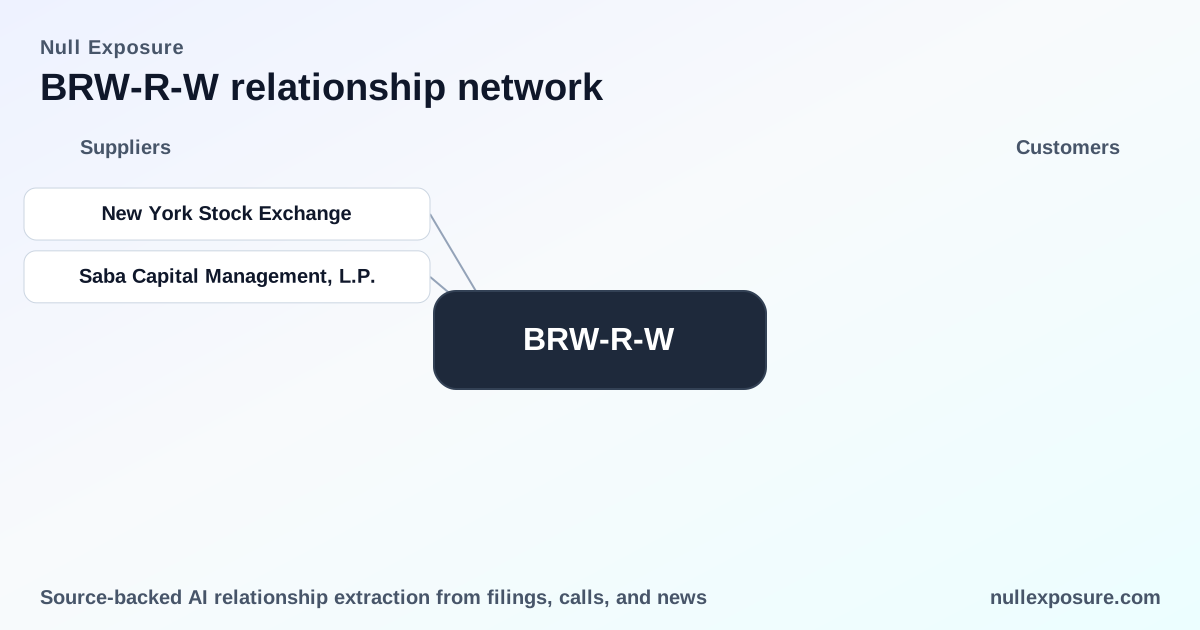
The supplier footprint for BRW-R-W is concise but consequential: the New York Stock Exchange (exchange services) and Saba Capital Management, L.P. (external manager). Each relationship is operationally material in different ways — one governs market access and liquidity, the other controls investment decision-making and fee economics.
New York Stock Exchange — market venue and listing services
The Fund is listed on the New York Stock Exchange, and a corporate announcement referenced the Fund’s transferable rights offer when discussing shareholder actions. According to a finance.yahoo.com press release covering FY2025 activity (first seen March 9, 2026), the Fund “is a registered closed-end management investment company listed on the New York Stock Exchange” and disclosed the final results of a transferable rights offer that expired on October 28, 2025. Key takeaway: NYSE listing provides primary liquidity and regulatory profile for BRW shares, making exchange access a critical supplier function.
Saba Capital Management, L.P. — external manager and adviser
The same public release states the Fund “is managed by Saba Capital Management, L.P.” (finance.yahoo.com, FY2025, March 2026). Key takeaway: Saba Capital is the operational brain of the fund — portfolio construction, risk-taking and fee capture all flow through this manager relationship, creating a concentrated operational dependence.
What these relationships reveal about BRW-R-W’s operating model
The supplier map is compact, and that compactness is the defining feature of BRW-R-W’s operating posture.
- Contracting posture: The fund follows a standard closed-end governance and contracting model — an exchange listing contract for market infrastructure and an external management agreement for investment oversight. These are formal, long-established commercial arrangements rather than ad hoc vendor relationships.
- Concentration: With only two core external suppliers surfaced, concentration risk is material: Saba Capital delivers the active management that generates returns and fees; the NYSE supplies the liquidity mechanisms and public-market governance. Investors should treat managerial continuity and listing status as top-line dependency vectors.
- Criticality: Both suppliers are mission-critical: without listing access the fund’s tradability and price discovery deteriorate; without Saba’s management the fund would require immediate replacement of investment governance. The rights offer referenced in the FY2025 announcement signals active capital management under existing governance (finance.yahoo.com, FY2025).
- Maturity and formality: These are mature supplier relationships — a regulated exchange listing and an institutional investment management contract — so operational expectations, disclosure requirements and enforcement mechanisms are robust.
There are no constraint excerpts provided in the available records to alter these conclusions; absence of constraint flags is itself a company-level signal that the analysis must rely on observable supplier roles and public filings.
Visit https://nullexposure.com/ to compare these supplier signals against peer funds and manager profiles.
Relationship-by-relationship rundown (concise and sourced)
- New York Stock Exchange — The Fund is a registered closed-end management investment company listed on the NYSE and disclosed the final results of a transferable rights offer that expired October 28, 2025, per a finance.yahoo.com release covering FY2025 (first seen March 9, 2026). This confirms NYSE is the Fund’s primary market venue and the platform used for shareholder liquidity and corporate actions.
- Saba Capital Management, L.P. — The same FY2025 finance.yahoo.com announcement states the Fund “is managed by Saba Capital Management, L.P.” (first seen March 9, 2026). That confirms Saba is the delegated investment manager and fee recipient for portfolio management services.
What investors should prioritize next
- Manager continuity and governance: Given the concentrated reliance on Saba Capital for portfolio strategy and execution, verify the management agreement terms, key-person provisions, and any recent amendments or performance-based fee structures disclosed in the fund’s filings.
- Liquidity and market mechanics: The NYSE listing is essential for share-level liquidity; track average daily volume, bid/ask spreads and any trading halts or suspension history to assess execution risk in stressed markets.
- Capital actions and balance sheet posture: The Fund’s transferable rights offer that expired October 28, 2025 indicates an active capital-management stance; review the rights-offer results and subsequent balance-sheet impacts in the Fund’s proxy and shareholder communications.
A marketplace-ready next step: review the full supplier and filing history on the platform to prioritize manager and exchange risk in valuation and stress-testing. For comparative supplier scoring and exposure matrices, go to https://nullexposure.com/.
Final assessment and action items
BRW-R-W’s supplier profile is deliberately simple and therefore easy to monitor: an exchange that provides liquidity and a single external manager that delivers investment returns and fees. That concentration translates to both clarity and vulnerability — clarity because there are few moving parts to track, vulnerability because adverse events affecting either supplier have outsized impact on governance, liquidity and performance.
Action items for investors and operators:
- Confirm manager contract terms and key-person protections in the latest regulatory filings.
- Monitor post-rights-offer capital structure disclosures and market liquidity metrics on the NYSE.
- Build contingency scenarios for manager replacement and delisting risk into portfolio stress tests.
For structured intelligence and ongoing relationship monitoring across manager and exchange exposures, visit https://nullexposure.com/ and integrate supplier signals into your investment playbook.
Bottom line: BRW-R-W’s operational fate is concentrated in two suppliers — the NYSE and Saba Capital — and investors should treat both as high-priority items on diligence and monitoring checklists.