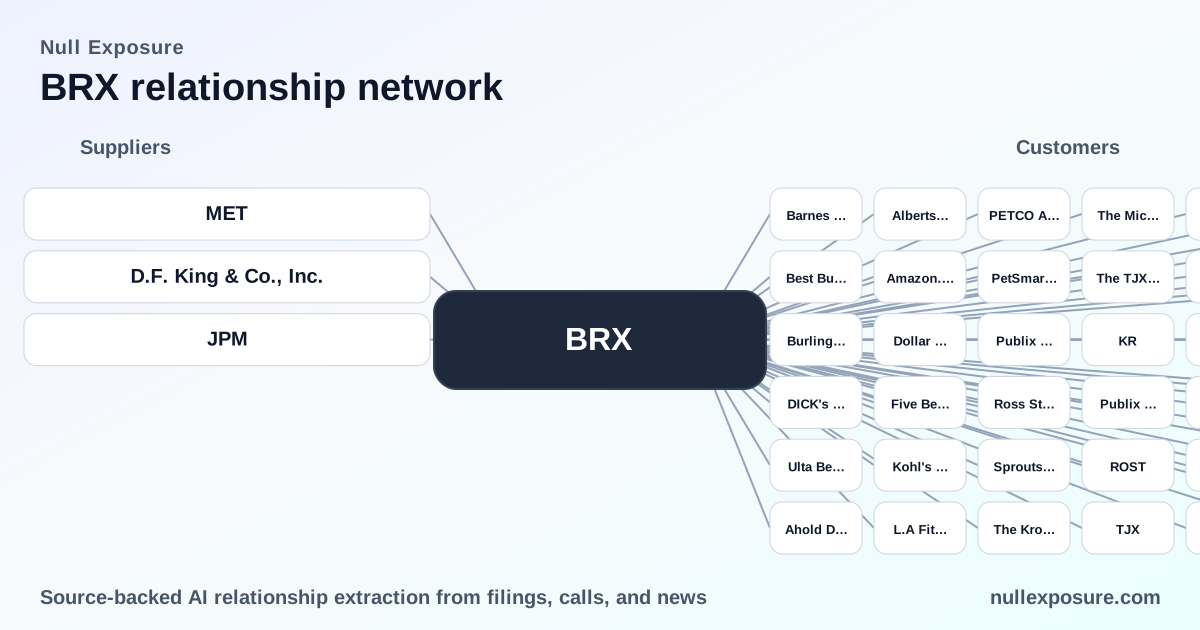
Brixmor Property (BRX) — supplier and counterparty map for investors
Brixmor (NYSE: BRX) operates and monetizes a nationally distributed portfolio of outdoor shopping centers through rental income, targeted acquisitions and dispositions, and active capital recycling; the company's earnings profile is driven by leasing momentum across its retail footprint and periodic property transactions that reweight the portfolio. For investors evaluating BRX supplier and counterparty relationships, the current public signals show transactional deal activity with institutional sellers, engagement with investor-relations and solicitation agents, and traditional capital markets placement through an investment bank—each relationship reinforcing Brixmor’s operating playbook of acquisition-fueled portfolio optimization and steady cash flow generation. Visit the NullExposure homepage for ongoing counterparty intelligence and supplier mapping: https://nullexposure.com/
Quick financial orientation
A few compact metrics to set context:
- Market capitalization: $9.19B; EV/EBITDA: 13.97.
- Profitability: profit margin 28.2%, ROE 12.9%.
- Income signal: dividend yield ~3.95% and EPS of $1.25 (TTM).
These figures underline a stable cash-generating REIT with active portfolio rotation and leverage typical of the listed retail-park sector.
What the recent relationships are — clear, direct, and actionable
MetLife Investment Management — strategic seller to BRX
Brixmor purchased the Chino Spectrum Towne Center from MetLife Investment Management for $138 million, representing a direct asset acquisition that increases BRX’s presence in Southern California retail markets. According to The Real Deal (reported January 16, 2026), this transaction is consistent with BRX’s ongoing capital recycling strategy and selective market deployments in suburban retail nodes.
D.F. King & Co., Inc. — solicitation and shareholder services referenced
D.F. King is referenced as the agent providing details related to an offer that is being managed, indicating BRX’s use of established solicitation and shareholder services for corporate actions or investor communications. StockTitan reported (March 2026) that D.F. King & Co., Inc. is furnishing further details in connection with a managed offer, signaling a formal investor outreach or tender process execution.
J.P. Morgan Securities LLC — capital markets and offer manager
J.P. Morgan Securities LLC is the manager of an offer tied to BRX activities, reflecting BRX’s reliance on a major investment bank for underwriting, placement or structured capital-market transactions. Per the same StockTitan notice (March 2026), J.P. Morgan is managing the offer, which aligns with BRX’s use of top-tier capital markets partners for liquidity and deal execution.
How these relationships shape BRX’s operating model and constraints
Taken together, the relationship set is small but strategically paired: institutional seller (MetLife) for asset acquisition, a shareholder-agent (D.F. King) for corporate communications or tender logistics, and a bank (J.P. Morgan) for capital markets execution. These relationships reveal three company-level operating characteristics:
-
Contracting posture — long-term financing is central. Public disclosures show exposure to interest-rate variability driven by long-term debt used to fund operations and capital expenditures, a structural funding posture consistent with REITs that maintain portfolio leverage to enhance returns. This is a company signal rather than tied to a specific counterparty.
-
Maturity and stability of commitments — active hedging program. BRX reports interest-rate swap agreements on $500 million of variable-rate indebtedness, converting variable exposure to fixed and indicating active treasury management and an “active” relationship stage with its financial counterparties.
-
Asset and land rights — licensor/lessee dynamics. The company regularly enters into ground and office leases as the lessee for both shopping centers and administrative space, signaling a negotiated, long-tenor footprint for property operations rather than a purely short-term vendor model.
These constraints collectively describe a company that operates with structured, long-duration financing, formal investor engagement processes, and deliberate counterparty selection for both asset acquisition and capital placement.
Visit NullExposure for a consolidated view of BRX counterparties and to track new supplier signals: https://nullexposure.com/
Investor implications — risk versus re-rating upside
-
Risk: interest-rate sensitivity and leverage. The combination of long-term debt funding plus $500 million of swapped exposure makes BRX’s earnings and valuation sensitive to overall financing costs and refinancing cycles. Investors should treat interest-rate movements and swap counterparty continuity as material operational risks.
-
Strength: disciplined portfolio rotation and institutional deal flow. The acquisition from MetLife demonstrates BRX’s ability to source institutional sales and redeploy capital, supporting cash flow growth and valuation accretion when executed at attractive yields.
-
Execution dependency: capital markets and communications. Reliance on J.P. Morgan for offer management and D.F. King for investor-facing execution underscores the importance of BRX’s external providers in delivering financing and corporate actions cleanly and efficiently.
Net takeaway: BRX operates a credit-sensitive, acquisition-led REIT model with focused counterparty relationships that support both its capital markets access and asset-refresh strategy.
How to monitor these relationships going forward
- Track transaction pipelines with institutional sellers and announced property acquisitions for signs of valuation direction and portfolio quality shifts.
- Monitor hedging disclosures and swap counterparty notes in 10-Q/10-K filings or earnings releases to gauge funding risk posture.
- Watch investor communications and managed offers for changes in capital strategy that could alter leverage or ownership dilution.
For a deeper, continuously updated counterparty map and alerting on BRX supplier changes, explore the NullExposure platform: https://nullexposure.com/
Bottom line — what operators and investors should do now
Brixmor combines stable rent roll economics and an active acquisition/disposition engine, financed through long-term debt and managed with interest-rate hedges. Investors should weigh the company’s healthy profitability and yield against its funding sensitivity and reliance on a small set of high-impact counterparties for capital and corporate actions. Operators evaluating BRX as a tenant, lender, or partner should factor in the company’s predictable contracting posture and established capital-market relationships when negotiating terms.
For ongoing intelligence on BRX counterparties and supplier relationships, return to NullExposure: https://nullexposure.com/