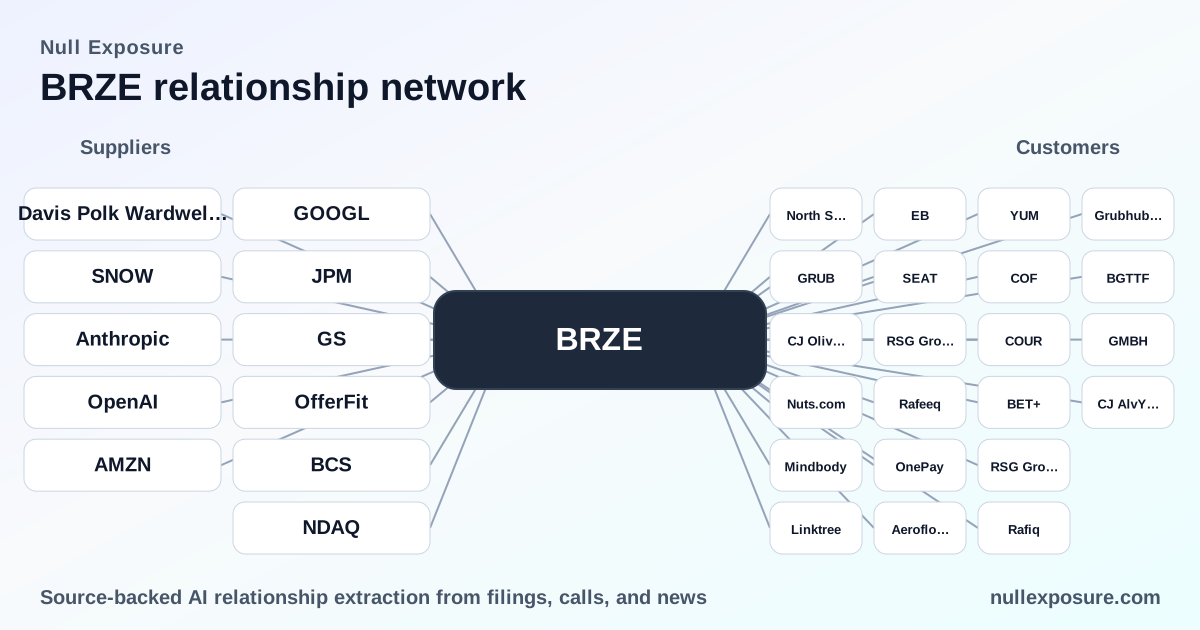
Braze (BRZE): Partner Map and Supplier Relationships that Drive Growth
Braze operates a cloud-native customer engagement platform and monetizes through subscription fees for its software, premium AI add-ons, and ecosystem integrations that deepen enterprise adoption and stickiness. The company sells its platform to marketers and product teams, layers AI-driven decisioning and operator features on top of first‑party data, and leverages marketplace listings and cloud integrations to shorten procurement cycles and expand enterprise footprints. For investors, the commercial model is recurring SaaS revenue amplified by partner-enabled distribution and large-cloud dependence. Learn more about partner risk and signals at https://nullexposure.com/.
Why partners matter for the investment case
Braze’s growth thesis rests on two interlocking themes: product-led monetization of engagement tools and partner-enabled scale for enterprise sales. Marketplace listings, cloud integrations, and AI model partnerships accelerate adoption in large accounts but also concentrate strategic dependency on a small set of infrastructure and go-to-market allies. That concentration is a central lever for upside and a material risk to monitor.
Visit https://nullexposure.com/ for a deeper supplier-risk profile on BRZE.
Key partner and advisor relationships investors should know
Below I cover every partner and advisor mentioned in recent public reporting and commentary, with a concise plain-English takeaway and source reference.
Google / Google Cloud / Google Cloud Marketplace
Braze listed its BrazeAI Decisioning Studio on Google Cloud Marketplace and integrated with Google BigQuery to act directly on first‑party customer data, accelerating procurement and deployment inside Google Cloud environments. This relationship is the single most visible cloud go‑to‑market channel cited in recent coverage. (See Sahm Capital, Jan 9, 2026: https://www.sahmcapital.com/news/content/does-brazes-brze-revenue-beat-reveal-durable-strength-in-its-ai-customer-engagement-strategy-2026-01-09; and StockTitan overview, FY2025: https://www.stocktitan.net/overview/BRZE/.)
Snowflake
Braze integrated with Snowflake’s Cortex AI to enable marketers to query campaign and analytics data with natural language via BrazeAI Operator™, improving data activation for customers that store analytics in Snowflake. This tight analytics integration supports enterprise use cases for insights-to-action. (See StockTitan overview, FY2025: https://www.stocktitan.net/overview/BRZE/.)
Anthropic
Braze supports external LLMs including Anthropic for agent-driven content generation and orchestration, offering customers choice of model providers for specific workloads. That multi-vendor model reduces single‑model lock‑in for buyers. (See StockTitan overview, FY2025: https://www.stocktitan.net/overview/BRZE/.)
OpenAI
Braze can configure agents to use OpenAI models for content and data-enrichment tasks, expanding its AI capabilities and meeting clients that standardize on OpenAI. This gives Braze product flexibility across enterprise AI stacks. (See StockTitan overview, FY2025: https://www.stocktitan.net/overview/BRZE/.)
Amazon Bedrock
Braze lists Amazon Bedrock as an external model option for its agents, positioning the company to serve customers that prefer AWS-native AI services. That linkage supports multi-cloud customer requirements. (See StockTitan overview, FY2025: https://www.stocktitan.net/overview/BRZE/.)
OfferFit
OfferFit is described as a long‑time technology partner whose integration and eventual joining of forces with Braze required operational integration and margin management; analysts flagged integration dilution and channel pricing risk as near‑term considerations. OfferFit brings targeted marketing capabilities that expand Braze’s product set while introducing short-term integration execution risk. (See Braze SEC exhibit and Sahm Capital notes, FY2025–FY2026: https://www.sec.gov/Archives/edgar/data/1676238/000167623825000051/exhibit992-20250327xtransa.htm and https://www.sahmcapital.com/news/content/does-brazes-brze-revenue-beat-reveal-durable-strength-in-its-ai-customer-engagement-strategy-2026-01-09.)
Goldman Sachs (Goldman Sachs Co. LLC)
Goldman Sachs Co. LLC acted as financial advisor to Braze, reflecting the firm’s use of top-tier investment banking for strategic transactions and capital markets work. That relationship is advisory rather than operational but signals institutional financial engagement. (See SEC filing FY2025: https://www.sec.gov/Archives/edgar/data/1676238/000167623825000051/exhibit992-20250327xtransa.htm.)
Davis Polk Wardwell LLP
Davis Polk served as Braze’s legal advisor on material transactions, indicating access to premier corporate legal counsel for deal execution and compliance. (See SEC filing FY2025: https://www.sec.gov/Archives/edgar/data/1676238/000167623825000051/exhibit992-20250327xtransa.htm.)
JPMorgan
JPMorgan was among the bookrunners for Braze’s IPO, a historical capital markets relationship that underpinned Braze’s public listing and initial institutional distribution. (See MarketRealist coverage of the IPO, FY2021: https://marketrealist.com/p/braze-ipo-price/.)
Barclays
Barclays also served as an IPO bookrunner, part of the multi-bank syndicate that brought Braze to public markets and established institutional coverage. (See MarketRealist, FY2021: https://marketrealist.com/p/braze-ipo-price/.)
Nasdaq Exchange
Braze chose the Nasdaq for its public listing, reflecting the company’s alignment with technology sector investors and public-market comparables. The listing venue supports liquidity and visibility with tech-focused funds. (See MarketRealist, FY2021: https://marketrealist.com/p/braze-ipo-price/.)
Operating model constraints and what they signal to investors
Braze’s public disclosures include several company‑level constraints that shape supplier risk and contracting posture:
- Long‑term real estate commitment: Braze leases headquarters space through January 2034, signaling longer-term fixed‑cost commitments and planning horizon—an indicator of corporate maturity and fixed-cost leverage rather than supplier-specific exposure.
- Global footprint: The company leases offices in more than ten cities across North America, Latin America, EMEA and APAC, which signals a geographically distributed operating model and the need for multi‑region supplier arrangements, particularly cloud and compliance vendors.
- Third‑party licensing and service reliance: Braze explicitly licenses third‑party software and relies on external service providers for data storage and processing, demonstrating critical dependency on cloud infrastructure and vendor SLAs rather than complete in‑house control.
- Spend signal: Braze disclosed approximately $3.5 million in aggregate services purchased from Datadog in FY2025, placing at least some monitoring/observability vendor spend in the $1–10M band—useful for estimating supplier bargaining leverage and typical contract sizes.
Together these constraints point to a contracting posture oriented to long-term, distributed supplier relationships with moderate concentration on major cloud and observability partners, and a corporate maturity that supports multi-year commitments.
Investment implications and risk checklist
- Upside: Marketplace listings and AI integrations (Google, Snowflake, model providers) accelerate enterprise adoption and can shorten sales cycles; these are direct growth levers.
- Concentration risk: Heavy reliance on major clouds and third‑party models creates potential switching or pricing risk if partner economics change.
- Integration risk: Acquisitions and technology partnerships such as OfferFit require execution to protect margins.
- Operational risk: Long‑term leases and multi‑region operations increase fixed costs and complexity during downturns.
For a deeper, quantified view of these supplier relationships and their risk weighting, visit https://nullexposure.com/ and request a BRZE supplier brief.
Bottom line
Braze’s partner ecosystem—anchored by Google Cloud marketplace distribution, Snowflake analytics integration, and flexible LLM model options—is a strategic growth engine that also concentrates supply‑chain and cloud dependency. Investors should weigh the platform’s recurring revenue benefits against operational concentration and integration execution risk. For a tailored supplier-risk analysis and to monitor contract-level developments, go to https://nullexposure.com/.