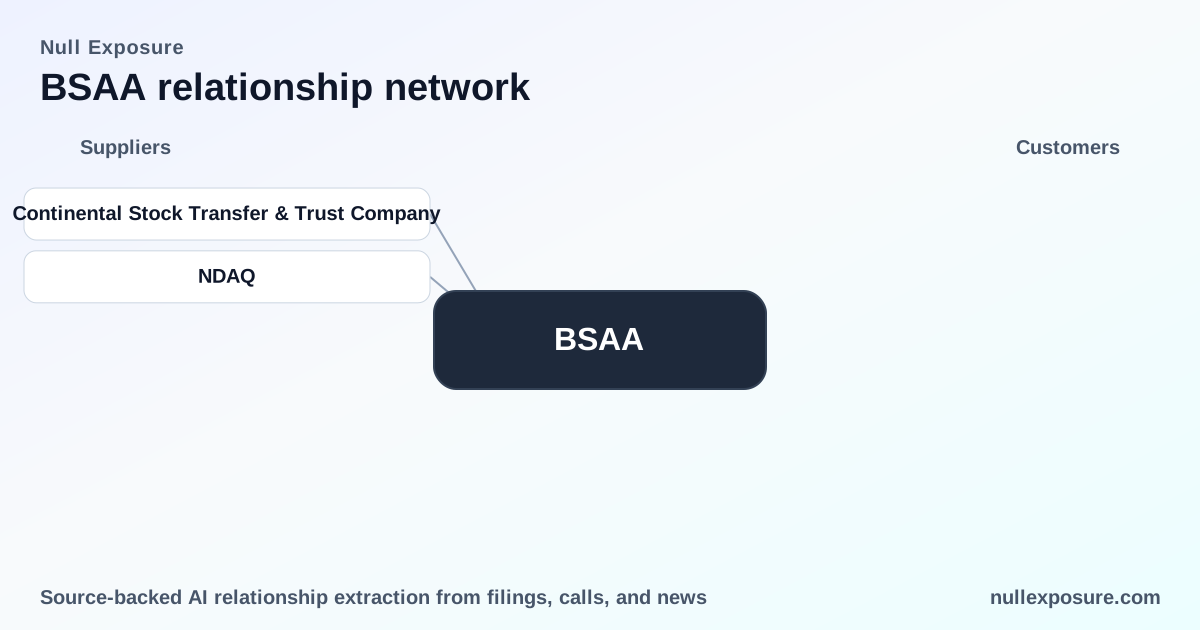
BSAA — Supplier profile and what investors should price into trustee and exchange relationships
BEST SPAC I Acquisition Corp. (BSAA) is a publicly listed special purpose acquisition company that raises capital via IPO units placed into a trust and monetizes by executing a business combination and capturing post-merger equity appreciation for public shareholders and sponsors. The commercial model depends on preserving trust account proceeds, smooth unit conversion and transfer mechanics, and exchange listing liquidity — all of which are provided by third-party suppliers identified below. For investors and operators evaluating counterparty exposure, the supplier set is small and functionally critical.
Read more background and tooling at https://nullexposure.com/.
Two supplier relationships show up in public sources — trustee/transfer agent and the listing exchange
Below I cover the two named counterparties that are on the public record for BSAA, with a concise practical takeaway for each.
Continental Stock Transfer & Trust Company — trust and transfer agent
Continental is identified as the trustee for the Trust Account that holds $55,000,000 of IPO and private placement proceeds and is also named as the firm holders should contact to separate units into Class A shares and rights. According to the company disclosure referenced in FY2025 (first seen 2026-03-09), Continental performs the dual role of trustee and transfer agent for BSAA. This makes Continental a critical operational supplier because trust custody and unit separation are necessary preconditions to any shareholder conversion, redemptions, or business combination mechanics.
Source: StockTitan overview citing company disclosures for FY2025 (first seen 2026-03-09).
Nasdaq (Nasdaq Capital Market) — listing venue and market infrastructure
BSAA’s units, Class A ordinary shares, and rights are listed on the Nasdaq Capital Market, which provides market access, liquidity, and the regulatory framework for public trading. A StockTitan report referencing FY2025 (first seen 2026-03-09) confirms the company’s listing on Nasdaq, establishing the exchange as the primary commercial interface between BSAA and public investors. Exchange compliance and liquidity are therefore central to any valuation event or secondary trading dynamics.
Source: StockTitan overview referencing FY2025 listing information (first seen 2026-03-09).
What the supplier set and constraints tell investors about the operating model
The public evidence yields a compact, high-signal profile of how BSAA runs operationally and where counterparty risk concentrates.
-
Contracting posture: BSAA’s IPO structure follows standard SPAC mechanics — proceeds placed into a trust account with a named trustee and a modest cash underwriting discount paid at closing. The company disclosed a one percent cash underwriting discount ($550,000) on gross IPO proceeds upon closing, and specifically named Continental as trustee for the $55,000,000 Trust Account. This combination signals conventional, transaction-focused contracting with limited bespoke supplier commitments. The trustee and the underwriters capture defined, low-friction fees rather than open-ended operational service contracts.
-
Concentration and criticality: The supplier topology is narrow and concentrated. Continental’s dual trustee/transfer-agent role is operationally critical: any custody, redemption, unit-splitting, or transfer issue would materially impair BSAA’s ability to execute redemptions or effect a business combination. Nasdaq’s role is equally critical for liquidity and regulatory continuity. When a supplier set is this small and functionally narrow, single-vendor operational risk is elevated.
-
Maturity and business stage: BSAA is a classic SPAC shell with no reported revenue (RevenueTTM = 0) and a Trust Account holding IPO proceeds. This is an early-stage public vehicle where suppliers are engaged in transactional, not long-running operational, relationships. The firm-level financials — modest market capitalization (~$75 million) and no operating revenue — reinforce the SPAC-stage operating model: short-term capital preservation and a time-bound mandate to complete a merger.
-
Commercial leverage and bargaining: Naming Continental as trustee and the one-percent underwriting discount suggest standardized, low-cost transactional terms rather than complex, dependency-increasing contracts that lock the company into long-term vendor commitments. That contracting posture reduces recurring supplier expense but increases operational dependence on a small set of vendors for time-sensitive events.
Practical implications for investors and operators
-
Operational risk is concentrated. With Continental performing core custody and transfer functions and Nasdaq supplying market access, operational continuity depends on the uninterrupted functioning of these two suppliers. Counterparty due diligence should prioritize trustee and transfer-agent SLAs, dispute history, and continuity plans.
-
Regulatory and timing risk matter more than price risk. Given the SPAC structure, regulatory compliance at the exchange and the correctness of trust-account handling are immediate determinants of whether capital can be returned to investors or deployed in a business combination.
-
Fee exposure is limited but explicit. The disclosed one-percent underwriting charge ($550,000) represents a defined upfront friction on proceeds; the trust arrangement preserves proceeds for shareholders and reduces reinvestment risk. Fee certainty reduces financial exposure but not operational exposure.
If you are evaluating BSAA’s counterparty exposure for underwriting, operational resilience, or M&A execution risk, prioritize documentation and audit trails for the trustee and transfer-agent activities and confirm Nasdaq listing compliance windows.
Read more supplier intelligence and supplier risk playbooks at https://nullexposure.com/.
Quick risk checklist for underwriting or partner diligence
- Confirm trustee custody mechanics and reconciliation processes for the $55,000,000 Trust Account.
- Validate transfer-agent process and timelines for unit separation and shareholder instructions.
- Review Nasdaq compliance history, listing notifications, and late filing or delisting risk indicators.
- Verify any further underwriter or sponsor side agreements not disclosed in the public excerpts.
Bottom line and next steps
BSAA operates as a transaction-focused SPAC with a compact and critical supplier footprint: Continental for trust/transfer functions and Nasdaq for market access. That supplier configuration reduces recurring cost exposure but concentrates operational risk in a very small set of vendors — a structural factor investors should price into deal timelines and downside scenarios.
For a deeper supplier-level view and continuous monitoring of BSAA counterparties, visit https://nullexposure.com/ and subscribe for alerts.