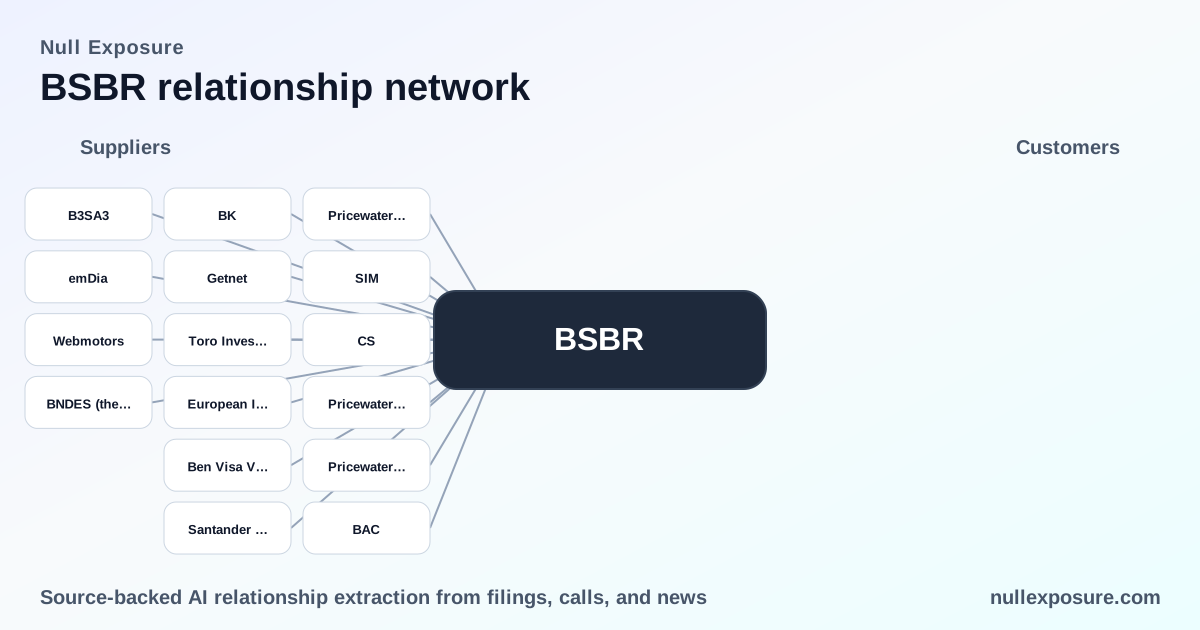
Banco Santander Brasil (BSBR) — supplier and partner map investors need to know
Thesis: Banco Santander Brasil operates as a diversified retail and wholesale bank that monetizes through interest income, fees from payments and asset management, and strategic partnerships across fintech and capital markets; its supplier relationships reveal a deliberate mix of trusted audit and valuation providers, global custody/depositary services for ADRs, development-bank funding, and a broad fintech ecosystem that supports fee growth and customer acquisition. Review these relationships to assess operational concentration, governance quality, and cross-border investor servicing. For a deeper supplier risk view, visit https://nullexposure.com/.
Quick-read: what to watch in BSBR’s supplier universe
BSBR’s public records show repeated engagements with PricewaterhouseCoopers for audits and valuations, ongoing ADR support through The Bank of New York Mellon / BNY Mellon, capital-market underwriting history with global investment banks, development-lender credit lines, and internal fintech affiliates that feed fee-bearing products. This cluster implies high reliance on a small set of professional services for audit/valuation and a parallel strategy of building revenue via fintech investments and external funding sources.
- Concentration and criticality: Multiple FY2025–FY2026 filings appoint PricewaterhouseCoopers variants for auditing and appraisal work, which positions PwC as a critical vendor for financial reporting and corporate reorganizations.
- Cross-border servicing: BNY Mellon’s role as ADR depositary makes it operationally critical for international investors and dividend/ voting flows.
- Funding and credit channels: EIB and BNDES facilities represent material non-market funding relationships that support specific lending programs and ESG/renewable projects.
Explore an investor-grade supplier risk report at https://nullexposure.com/ to quantify these exposures.
The relationship roll call — concise summaries investors use
- PricewaterhouseCoopers Auditores Independentes (FY2026) — The Board approved the Prudential Conglomerate’s financial statements for FY2026 with an unqualified audit report issued by PricewaterhouseCoopers Auditores Independentes, under Audit Committee recommendation (Source: FY2026 current report filed on StockTitan, March 2026).
- Sim (FY2021) — Sim is a Santander Brazil-linked fintech for personal loans that is listed among businesses supporting Santander’s diversified ecosystem and customer origination (Source: Santander press release, FY2021).
- Credit Suisse Group AG (FY2017) — Credit Suisse acted as an underwriter on a units offering for Santander Brasil, reflecting historical use of global investment banks for capital transactions (Source: Qatar Tribune summarizing a FY2017 securities filing).
- PricewaterhouseCoopers (FY2025) — Shareholders ratified PwC as the appraiser for a partial spin-off of Return Capital Gestão de Ativos e Participações S.A., showing PwC’s role in corporate reorganizations (Source: Globe and Mail / company press release, November 28, 2025).
- PricewaterhouseCoopers Auditores Independentes Ltda. (FY2025) — Shareholders ratified the appointment of PwC Auditores Independentes Ltda. to prepare valuation reports, confirming repeated valuation engagements (Source: FY2025 current report on StockTitan).
- Bank of America Corp (FY2017) — Bank of America served as an underwriter in the FY2017 unit offering alongside Santander’s investment banking unit and Credit Suisse, indicating historic distribution relationships (Source: Qatar Tribune citing FY2017 securities filing).
- BNY Mellon (FY2025) — BNY Mellon handles ADR dividend payments and can have ADR-specific timing separate from local markets, underlining its depositary role for BSBR ADRs (Source: analyst/market note published Dec 2025 and company communications, FY2025).
- Getnet (FY2021) — Getnet is cited as a strategic payments business within Santander Brazil’s ecosystem that drives fee income and merchant acquiring scale (Source: Santander press release, FY2021).
- Toro Investimentos (FY2021) — Toro is part of Santander Brazil’s investment product ecosystem, supporting wealth and brokerage customer acquisition (Source: Santander press release, FY2021).
- European Investment Bank (EIB) (FY2023) — The EIB provided a €300 million loan to Banco Santander Brasil in July 2023 targeted at small-scale solar energy investments, evidencing EIB-backed green financing (Source: Santander press release, July 17, 2023).
- PricewaterhouseCoopers Auditores Independentes (FY2025) — PwC was engaged to prepare an appraisal report for Santander Leasing S.A. Arrendamento Mercantil, reinforcing PwC’s recurring technical valuation role (Source: FY2025 current report on StockTitan).
- The Bank of New York Mellon (FY2025) — BNY Mellon will instruct ADS holders in corporate actions, demonstrating its operational role for investor communications and ADR mechanics (Source: FY2025 current report on StockTitan).
- The Bank of New York Mellon (FY2025) — The company confirmed that ADS holders can vote through BNY Mellon on the same agenda items as local shareholders, underscoring depositary governance functionality (Source: FY2025 current report on StockTitan).
- PricewaterhouseCoopers (FY2025) — The general meeting ratified PwC’s hiring for appraisal work and approved merger protocols, again emphasizing PwC’s involvement in BSBR’s reorganization activities (Source: Globe and Mail press release, FY2025).
- PricewaterhouseCoopers Auditores Independentes Ltda. (FY2025) — The ratification to hire PwC Auditores Independentes Ltda. for appraisal reports was formalized at shareholder meetings, further documenting repeated audit/valuation dependency (Source: FY2025 current report on StockTitan).
- Ben Visa Vale (FY2021) — Ben Visa Vale is a corporate-benefits fintech launched in Santander Brazil’s ecosystem, serving payroll and benefits channels that generate fee revenue (Source: Santander press release, FY2021).
- Santander Financiamentos (FY2021) — Santander Financiamentos is identified as a strengthened business line in Santander Brazil’s strategy, contributing to consumer and auto finance portfolios (Source: Santander press release, FY2021).
- B3 S.A. - Brasil, Bolsa, Balcão (FY2025) — B3 is cited in filings as the domestic exchange and central depository used for shareholder notices and voting mechanics, indicating regulatory and operational dependence on B3 infrastructure (Source: FY2025 current report on StockTitan).
- BNY Mellon (FY2025) — Company communications reconfirm that ADR holders listed on the NYSE receive payments through BNY Mellon, reinforcing the depositary’s payment role (Source: Globe and Mail press release, FY2025).
- emDia (FY2021) — emDia is a fintech for debt renegotiation within Santander Brazil’s ecosystem, addressing credit-cycle and customer retention strategies (Source: Santander press release, FY2021).
- Webmotors (FY2021) — Webmotors is part of Santander Brazil’s digital strategy for vehicle-related finance and market presence in auto lending segments (Source: Santander press release, FY2021).
- BNDES (the Brazilian Development Bank) (FY2022) — BNDES supported an emergency lending facility (FGI PEAC) through which Santander Brazil made credit available to micro and small enterprises, indicating partnership on public-sector credit programs (Source: Santander press release, FY2022).
What the relationship map means for investors
- Governance and reporting dependability is high: repeated hires of PricewaterhouseCoopers variants for audits and valuation work across FY2025–FY2026 reflect a consistent, centralized vendor posture for financial reporting and transaction support. This reduces execution risk on reporting but increases counterparty concentration risk in professional services.
- International investor servicing is operationalized: BNY Mellon’s multiple mentions make ADR mechanics a stable and visible line item for investor returns and voting, which is critical for foreign liquidity and ADR price discovery.
- Funding and directed credit channels diversify capital: relationships with EIB and BNDES provide alternative, policy-linked funding sources that support targeted lending (solar, SMEs), reducing pure-market funding dependence for specific programs.
- Commercial strategy via fintech affiliates reduces single-product dependence: Getnet, Toro, Sim, emDia, Ben Visa Vale, Webmotors, and Santander Financiamentos form a fee-generating ecosystem that supports both customer acquisition and cross-sell economics.
If you are assessing supplier concentration, operational criticality, or the governance posture of BSBR, commission a focused supplier-risk profile at https://nullexposure.com/ to quantify exposure and remediation options.
Bottom line and investor action items
Banco Santander Brasil combines traditional banking core capabilities with an ecosystem of fintechs and repeated use of global service providers for audit, depositary, and capital markets functions. Key investor risks include professional-services concentration and operational reliance on ADR depositaries; key strengths are diversified fee channels and development-bank funding. For tailored exposure mapping and monitoring, visit https://nullexposure.com/ and request a supplier risk briefing.