Bassett (BSET): Supply relationships, sourcing posture, and what investors should price
Bassett operates as a vertically integrated furniture manufacturer and retailer that monetizes through direct retail sales, wholesale distribution (including branded and outdoor lines), and a licensee-store model. The company combines five domestic manufacturing facilities with targeted foreign sourcing — principally in Vietnam — and sustains a mix of company-owned and licensee-owned retail locations supported by long-dated real estate leases. For investors and operators, the core thesis is simple: Bassett’s margin and growth profile is driven by domestic manufacturing scale and selective offshore sourcing, with structural fixed costs from real estate and concentrated vendor exposure in APAC. Learn more about supplier relationships and exposure at https://nullexposure.com/.
How Bassett actually sources products — the geographic split that matters
Bassett’s procurement picture is a hybrid of domestic production and targeted overseas buys.
- Domestic manufacturing remains the backbone. Company disclosures show that over 75% of wholesale revenues are derived from products manufactured in the United States, produced at five domestic facilities. This positions Bassett to control cost, quality, and lead times for the majority of its wholesale assortment.
- APAC (Vietnam) supplies core casegoods and leather upholstery. The firm sources much of its formal bedroom and dining furniture and certain leather upholstery from foreign plants, primarily in Vietnam. Purchases from its three largest vendors in Vietnam were reported as 15,108, 11,689 and 15,601 for 2025, 2024 and 2023 respectively, highlighting a meaningful and consistent spend footprint in that market.
- Overall global mix. In 2025 roughly 23% of wholesale products were sourced from various foreign countries, leaving the remainder produced domestically.
According to company filing excerpts, these sourcing details reflect a deliberate mix that protects margins on high-value, domestically produced SKUs while leveraging lower-cost offshore capacity for specific product lines.
What the contracting posture and maturity of the model imply
Bassett’s operational model carries structural characteristics that affect financial and operational risk.
- Long-term real estate commitments create fixed-cost leverage. The company leases land and buildings for company-owned retail stores and some licensee-owned stores; lease terms range from one to 15 years with renewal options of five to 15 years. This produces a predictable occupancy cost but reduces flexibility to rapidly reconfigure store footprints.
- Concentration in APAC is a strategic but concentrated exposure. The three largest Vietnam vendors constitute a material portion of off‑shore procurement spending across recent years, which delivers purchasing leverage but introduces supplier concentration risk.
- Manufacturing maturity and control. Maintaining five domestic manufacturing facilities gives Bassett operational control, faster time-to-market for key assortments, and a buffer against shipping disruptions — a competitive advantage compared with pure import-based peers.
These company-level signals — long-term leases, a dominant domestic manufacturing base, and meaningful Vietnam vendor spend — are the right lens for modeling Bassett’s cash flow sensitivity, capex needs, and supply resilience.
Who Bassett works with: the explicit supplier relationships
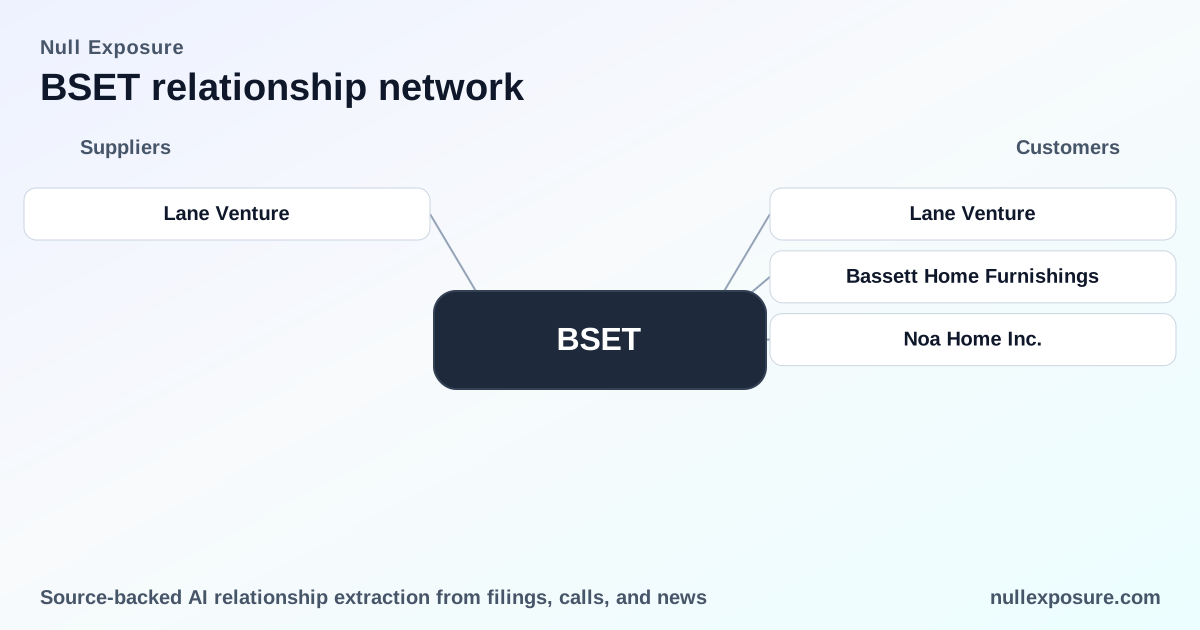
Lane Venture — The wholesale business, including the Lane Venture outdoor brand, services general furniture stores and a growing number of interior design firms, positioning Lane Venture as a distribution channel that complements Bassett’s retail and licensee footprint. Source: GlobeNewswire press release on Bassett’s dividend announcement, January 15, 2026.
(That is the complete set of supplier relationship mentions surfaced in the examined material.)
What this means for investors and operators — risks and upside
Bassett’s supplier posture creates a few concentrated vectors that affect valuation and operations.
- Risk — vendor concentration in Vietnam. Repeated multi-year purchases from the same Vietnam vendors create bargaining power risk and geopolitical/transportation concentration exposure; investors should stress-test margins assuming shipping cost shocks or vendor disruption.
- Opportunity — domestic manufacturing premium. With over three-quarters of wholesale revenue produced in the U.S., Bassett captures shorter lead times and quality control advantages that support price and margin resilience.
- Fixed-cost leverage from leases. Long-term lease schedules create operating leverage that can amplify earnings in expansionary cycles but pressure coverage metrics in downturns; monitor lease renewal cadence and occupancy expense trends.
- Channel diversification via Lane Venture. Wholesale relationships that push product into general furniture stores and interior design firms extend Bassett’s reach beyond its retail network and can smooth demand seasonality.
A practical investor stress test should combine a supplier disruption scenario in Vietnam with an occupancy-cost shock from rising lease expenses. Operators should prioritize vendor diversification, inventory buffers for imported casegoods, and active lease renegotiation where possible.
Explore deeper supplier analytics and due-diligence tools at https://nullexposure.com/ to quantify these exposures.
A short due-diligence checklist for active managers and operators
- Obtain a vendor concentration schedule and confirm the spend share tied to the three largest Vietnam suppliers.
- Review the lease maturity schedule and renewal terms for company-owned and licensee locations to assess early renewal risk and cash flow timing.
- Validate SKUs sourced offshore versus domestically to prioritize which product lines require inventory hedges or dual-sourcing strategies.
- Monitor wholesale channel performance (including Lane Venture) to evaluate growth versus retail and see whether wholesale margins compress or expand over time.
Final read: balance of control and concentrated exposure
Bassett’s operating model is a calculated balance of domestic manufacturing control and concentrated APAC sourcing. The company’s long-term leases and five domestic plants suggest a mature, capital-light retail footprint married to manufacturing scale; the Vietnam vendor spend and a roughly 23% offshore sourcing share create a focused exposure that allocates risk and margin opportunity differently than peers that are predominantly importers.
For investors, the right valuation thesis prices in the margin premium from domestic manufacturing, the growth potential of wholesale relationships like Lane Venture, and the tail risk from vendor concentration and fixed real estate commitments. Operators should treat vendor diversification and lease portfolio management as top priorities to protect margins and flexibility.
If you want a deeper, transaction-ready view of these supplier exposures and how they move company economics, visit https://nullexposure.com/ for analysis and engagement options.
Sources referenced in this commentary include company filing excerpts describing lease and sourcing terms and a GlobeNewswire press release dated January 15, 2026 discussing Bassett’s business lines and wholesale brands.