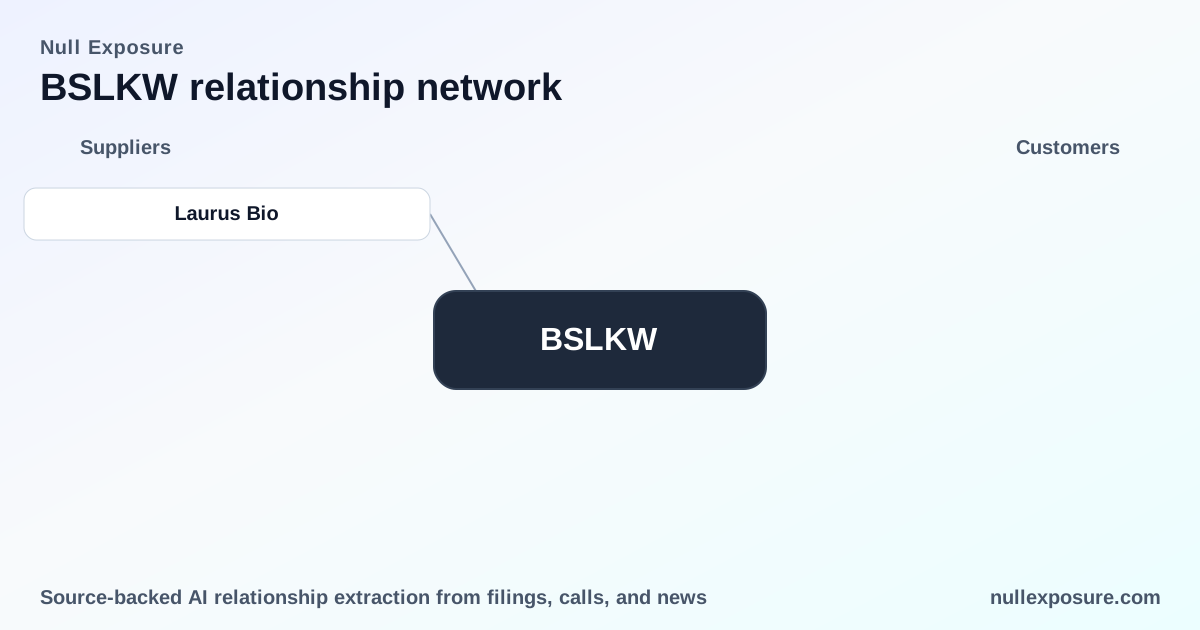
BSLKW supplier briefing: single-source manufacturing creates a levered operational profile
Thesis: BSLKW operates a product-driven biofabrication business centered on its Vegan Silk Technology Platform, outsourcing commercial-scale production to third-party manufacturers and monetizing through a combination of product sales and licensing arrangements with royalty obligations. The company currently concentrates manufacturing with one partner and facility in APAC, funds technical services through upfront payments, and carries modest supplier-related contingent liabilities — an operating model that amplifies execution risk but also yields clear levers for investors and operators to align remediation and upside capture.
Explore deeper supplier intelligence at https://nullexposure.com/.
The single manufacturing partner that defines capacity and risk
Laurus Bio is the company’s sole current manufacturing partner and the only facility producing BSLKW’s Vegan Silk products, making that relationship the operational bottleneck for scale-up and delivery. According to the FY2024 10‑K, “We currently rely on a single manufacturing partner, Laurus Bio, and a single manufacturing facility of Laurus Bio (the Laurus Bio Facility) to produce our products.” (FY2024 10‑K).
- Laurus Bio, Bangalore, India — BSLKW relies exclusively on Laurus Bio’s single facility in Bangalore for production; the services agreement was renewed in October 2024 and the relationship is active. (FY2024 10‑K).
Key takeaway: Laurus Bio is both the production engine and the primary single-point-of-failure for BSLKW’s manufacturing.
How contracting and monetization flow through licensing and service payments
BSLKW’s commercial arrangements combine licensing-style royalty obligations with prepaid technical services and modest capped startup funding. The company’s Technology Development Agreements (TDAs) include royalty payment obligations based on future net sales, payable in cash at defined country rates once a first commercial sale occurs, while the company currently has not accrued any royalty liability because no commercial sale under those TDAs has yet occurred. (FY2024 filing).
- The company recorded $3.4 million of credit remaining to be applied against future technical services under the 2022 TDA as of December 31, 2024 (prior year $4.1 million), and agreed to capped startup payments for a farm test/commissioning phase totaling up to $1.1 million in the aggregate. (FY2024 filing).
Implication: Licensing creates contingent upside and contingent cash outflows (royalties) that are currently prospective, while upfront and prepaid service credits compress near-term working capital volatility but indicate committed spend to external technical partners.
Explore supplier-risk analytics and documentation at https://nullexposure.com/.
Geographic concentration raises APAC operational exposure
BSLKW’s manufacturing concentration in Bangalore, India (APAC) increases the company’s exposure to regional operational disruptions — regulatory actions, severe weather, power interruptions or political events would disproportionately affect production. The FY2024 filing explicitly notes the Laurus Bio Facility’s location and the increased magnitude of disruption risk tied to that geography. (FY2024 10‑K).
Operational constraint: The filing stresses that any shutdown or reduced production at Laurus Bio would significantly disrupt product availability and the company’s ability to meet contractual obligations, highlighting the criticality of this single-site manufacturing posture. (FY2024 10‑K).
Service-provider relationships and network maturity
BSLKW uses external technical partners for strain engineering and lab-scale fermentation expertise and has prepaid for those services. The company executed a Note Purchase Agreement that required a $10.0 million upfront payment to Ginkgo for future technical services under the 2022 TDA, reflecting a reliance on specialist service providers to advance product development and scale. (FY2024 filing referencing 2022 TDA and Ginkgo Note Purchase Agreement).
Network maturity signal: Management is actively working to diversify and strengthen the manufacturing network, but as of the FY2024 filing the company remains dependent on a single strategic manufacturer and is still transitioning toward a multi-partner production footprint. (FY2024 10‑K).
Past terminations, contingent settlements, and lease actions — the corporate clean-up
The company has negotiated contingent settlement and termination arrangements with suppliers and a landlord, leading to share issuances and cash payments tied to contract wind‑downs. On October 19, 2023, the company entered a settlement agreement with a supplier that included a conditional $1.0 million payment and issuance of 150,000 shares to terminate a Supply Agreement; during 2024 the company paid portions of that liability and issued the 150,000 shares. Separately, a contingent lease termination agreement with the landlord for the Berkeley facility involved issuance of 600,000 shares to settle a termination liability recognized in 2023 and settled in 2024. (FY2024 filing).
Why this matters: These actions demonstrate active contract remediation and willingness to use equity as settlement currency — useful for reducing legacy liabilities but dilutive and potentially signal a period of contractual transition.
Relationship-by-relationship snapshot (one listed relationship)
Laurus Bio — BSLKW depends on Laurus Bio Private Limited and its Bangalore facility as the exclusive manufacturer for the Vegan Silk Technology Platform; the services agreement was renewed in October 2024 and the relationship is active. (FY2024 10‑K).
Constraint-driven operating model characteristics investors must price
- Contracting posture: Mix of licensing royalties (contingent, post-commercial sale) and prepaid technical services creates asymmetric cash flow timing: near-term outflows and credits today versus contingent royalty outflows only upon commercial sales. (Company filing).
- Concentration and criticality: Single-facility manufacturing in APAC is a primary concentration risk that elevates delivery and revenue timing risk if operations are disrupted. (FY2024 10‑K).
- Maturity: Manufacturing network is immature for scale — management is pursuing diversification but current capacity depends on a strategic third-party partner. (FY2024 10‑K).
- Spend profile: Supplier-related commitments are modest on absolute scale (spend band in the $1–10M range for technical services and startup funding), but relative to company scale they are material because of production concentration. (FY2024 filing).
What investors and operators should do next
- For investors: price a supply-concentration discount into models until multiple qualified manufacturers are contracted and validated; stress-test revenue under a range of downtime scenarios for the Laurus Bio facility.
- For operators: prioritize parallel qualification of at least one additional manufacturer outside the single Bangalore facility and accelerate contractual protections (supply continuity clauses, dual-sourcing rights, and defined service levels).
- For both: track milestone triggers for the TDAs (first commercial sale) since that event will change cashflow profiles with royalty payments and revenue recognition.
Take action and monitor supplier changes directly at https://nullexposure.com/.
Conclusion: BSLKW’s value hinges on execution of a targeted de‑risking playbook — converting the current single-source manufacturing relationship into a diversified, contractually protected manufacturing network while managing the timing of royalty-related obligations will materially reduce operational risk and unlock clearer upside for investors. Visit https://nullexposure.com/ for ongoing updates and supplier-level analytics.