Black Stone Minerals (BSM): supplier relationships, commercial posture, and what investors should price
Black Stone Minerals operates by acquiring and holding mineral and royalty interests and monetizing those rights through development and production activity conducted by operators; the partnership generates cash flows primarily from royalty and production proceeds tied to third-party drilling and development across large acreage positions. BSM's commercial model is built on two levers: asset aggregation through purchases of mineral/royalty interests and structured relationships with operators and independent technical advisors that convert acreage into cash-generating production. For a concise market-intelligence view of counterparties and operational signals, visit https://nullexposure.com/.
How the visible supplier relationships translate into an investment lens
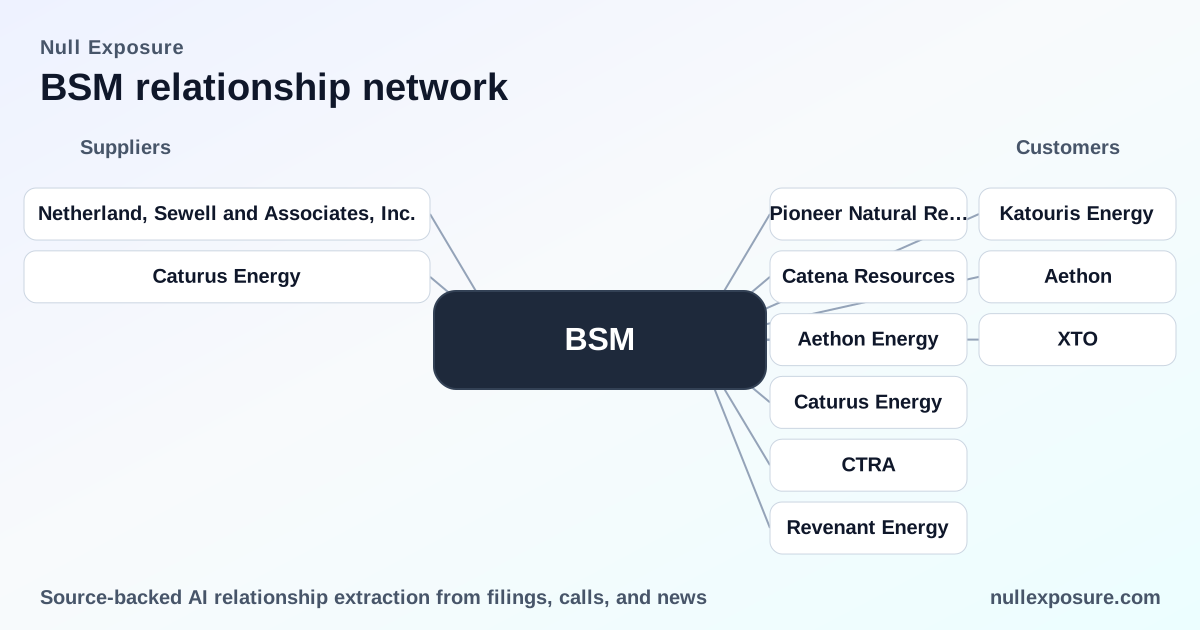
Investors should read supplier and advisor ties as a direct proxy for execution risk, reserve quality governance, and operator concentration. Two relationships surfaced in publicly available reports give a window into these dynamics: one is a third-party reserve evaluator, and the other is a large operator development pact across key gas acreage. Together they signal a combination of governance rigor and active acreage monetization that underpins cash flow visibility.
Two company-level constraint signals reinforce that reading: as of December 31, 2024 the partnership had seven counterparties, all rated Baa2 or better by Moody’s and lenders under its credit facility, which is a signal of preferred counterparty credit quality and a conservative contracting posture. Separately, the partnership continued to act as an acquirer of mineral and royalty interests, having completed purchases for $5.4 million subsequent to year-end — a signal of ongoing balance-sheet deployment into asset growth. These constraints are company-level operational signals and should be treated as part of the broader commercial picture rather than tied to a single supplier.
Independent technical validation: Netherland, Sewell and Associates, Inc.
Netherland, Sewell and Associates, Inc. performed an independent evaluation of Black Stone Minerals’ proved reserves and PV-10 as of December 31, 2025, providing an external technical check on BSM’s reserve reporting. According to Black Stone Minerals’ results announcement (reported March 9, 2026 by InvestingNews), Netherland Sewell validated the partnership’s proved reserves and PV-10 figures for FY2026. This relationship is evidence of reserve-reporting discipline and governance that supports investor confidence in reported asset economics. (InvestingNews, March 9, 2026)
Operator development partnership: Caturus Energy
Black Stone Minerals signed a multi-year development agreement with Caturus Energy covering roughly 220,000 gross acres in the Shelby Trough and Haynesville Expansion area to accelerate long-term natural gas development and supply Gulf Coast demand. World Oil reported this agreement on December 3, 2025, highlighting the scale of acreage under active operator development. This relationship demonstrates direct pathway-to-production via operator capital and execution, and it links BSM’s royalty cash flows to a focused set of development plans in a high-demand gas corridor. (World Oil, December 3, 2025)
What those relationships imply about contracting, concentration, and maturity
- Contracting posture: The existence of investment-grade lenders under the credit facility and the use of an independent reserve evaluator indicate a conservative, governance-oriented contracting posture. BSM structures its financial relationships to preserve access to institutional credit while validating reserve economics through third-party review.
- Counterparty concentration: The disclosure of seven core counterparties suggests a moderate concentration profile at the credit level, but the operator partnership with Caturus and ongoing asset purchases indicate broad exposure across multiple operators at the asset level. Investors should model for operator-specific production tail risk despite strong lender quality.
- Criticality and execution: A 220,000-acre development pact is a material operational lever; operator execution on that acreage is a critical driver of mid-term production growth and royalty receipts. Conversely, the role of Netherland Sewell is critical for valuation transparency—PV-10 validation reduces reserve uncertainty that would otherwise widen valuation multiples.
- Commercial maturity: Using a recognized engineering firm for reserve certification and securing multi-year drilling pacts demonstrates an institutionalized approach to asset monetization and a mature balance between capital markets and operational partnerships.
For deeper supplier mapping and counterparty credit signals, visit https://nullexposure.com/ for tailored diligence intelligence.
Risk and opportunity for investors
The visible supplier set presents a balanced risk/reward profile:
- Opportunity: Large-scale operator commitments to develop acreage accelerate near-term production optionality, which can convert holding-stage royalty assets into tangible cash flow growth. Caturus’ 220,000 gross acre program is a meaningful growth vector for BSM’s royalty stream (World Oil, Dec 2025).
- Risk: Execution dependence on operators exposes BSM’s revenue to activity cycles and operator capital discipline; underperformance or drilling delays materially affect royalty timing. Independent reserve validation helps compress valuation uncertainty but does not remove operator execution risk.
- Credit profile: Investment-grade lenders in the partnership’s credit facility reduce refinancing risk and provide a stable financing backdrop for acquisition and working-capital activity (company disclosure as of Dec 31, 2024).
Practical diligence checklist for partner and supplier evaluation
When underwriting BSM exposure or designing supplier risk limits, institutional investors should prioritize:
- Independent reserve reports and the auditors/engineers that produced them.
- The scope and duration of operator development agreements (acreage size, option mechanics, carried interests).
- Lender composition and covenants in the credit facility to understand funding flexibility.
- Recent acquisition trends for mineral and royalty interests to assess growth vs. dilution trade-offs.
Key actions for asset managers: validate the timing assumptions for Caturus’ drilling program, review the Netherland Sewell PV-10 methodology in investor filings, and stress-test cash flow under operator delay scenarios. A short list of these items with supporting documents will materially reduce execution risk in a sector driven by timing and operator capital cycles.
Final perspective and next steps
Black Stone Minerals presents a governance-forward operating model: independent reserve evaluation plus large-scale operator development agreements create a clear line of sight from acreage ownership to royalty cash flow. The company’s lender profile and acquisition activity indicate disciplined financial stewardship and active portfolio management. For investors focused on midstream-agnostic, acreage-driven cash flow exposure, BSM’s supplier relationships are a constructive signal—provided operator execution is monitored closely.
To translate these supplier signals into a diligence package or to subscribe to ongoing counterparty monitoring, go to https://nullexposure.com/ and request the supplier deep-dive.