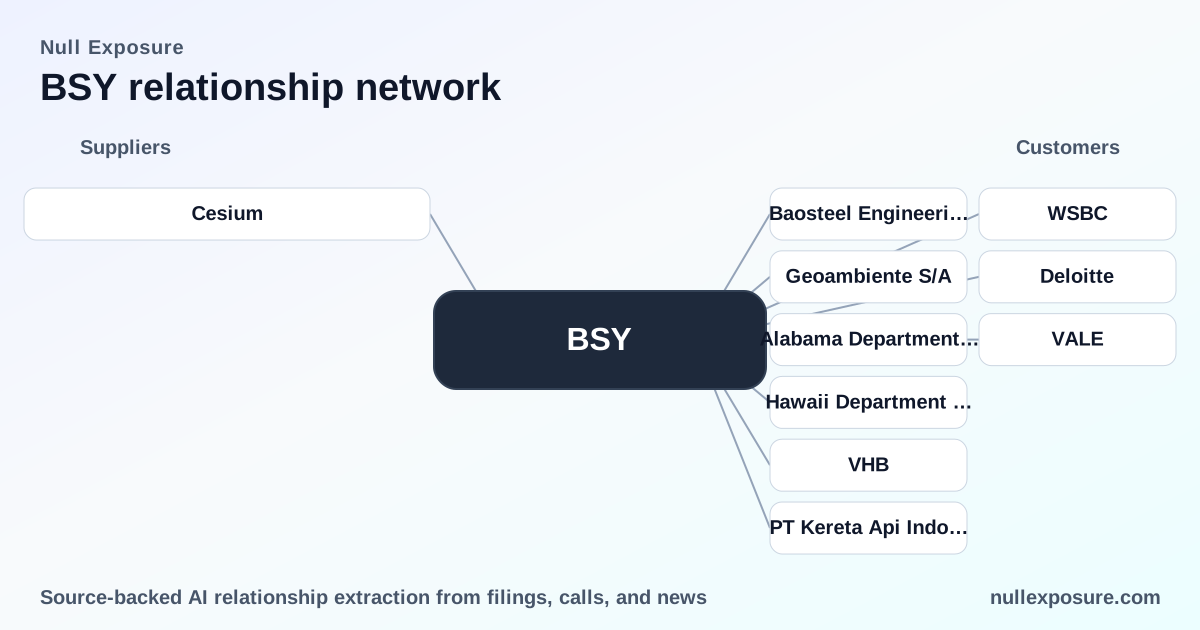
Bentley Systems (BSY) — Supplier Relationships and Operational Signals
Bentley Systems builds and sells software for infrastructure engineering and digital twin workflows, monetizing through recurring licenses, cloud-enabled software services, and enterprise deployments that tie clients into multi-year arrangements. For investors evaluating supplier risk and operational leverage, Bentley’s supplier posture reflects longer-term service contracts for cloud provisioning, modest per-supplier spend commitments, and targeted integrations that extend product differentiation.
Discover more supplier analytics at https://nullexposure.com/
Why supplier maps matter for software-enabled industrial platforms
Bentley’s product strategy depends on embedding geospatial context, compute capacity, and AI workflows into engineering design and construction processes. That creates two supplier vectors that matter to investors: (1) cloud and SaaS service providers that enable delivery and scale, and (2) specialized technology partners that supply data or domain-specific capabilities (for example, geospatial visualization and asset-context libraries). The company’s public disclosures show non-cancelable, multi-year purchase commitments and line items tied specifically to cloud services and internal-use software, which is consistent with a SaaS-like delivery model with persistent third-party service reliance.
For deeper supplier benchmarking and tailored exposure reports, visit https://nullexposure.com/
What Bentley’s supplier constraints reveal about operating and business model characteristics
Bentley’s supplier constraints—drawn from company filings and related disclosures—signal several operating model attributes that influence risk and upside:
-
Contracting posture — Long-term commitments. Bentley reported approximately $113,700 in total non-cancelable future cash purchase commitments as of December 31, 2024, split into roughly $59,200 due in the next 12 months and $54,500 payable through September 2029. This establishes a multi-year contracting posture for vendor relationships and capitalizes predictable third-party service costs. (Source: company filing as of December 31, 2024.)
-
Role skew — Service provider relationships. The company specifically disclosed non-cancelable commitments entered in the years ended December 31, 2024 and 2023—approximately $45,500 and $158,000, respectively—for services related to cloud provisioning of Bentley’s software solutions and for internal-use software costs. This identifies cloud and platform vendors as service providers central to product delivery and operations. (Source: company filing covering FY2023–FY2024.)
-
Spend scale — Modest per-vendor commitments. The spend band signal classifies typical supplier exposure in the $100k–$1M range, which is material but not concentration-level for a global software vendor. This implies Bentley distributes vendor spend across multiple specialized suppliers rather than concentrating risk with a single very large supplier.
Taken together, these constraints indicate a mature SaaS delivery posture with predictable multi-year vendor obligations and a supplier mix weighted to cloud and specialized data/visualization partners. These are company-level signals; they are not assigned to any single named supplier unless the filing explicitly does so.
Supplier relationships in the public record: full coverage
The following section covers every supplier relationship identified in the results provided.
Cesium — geospatial visualization and context
Bentley integrates Cesium to provide rich geospatial context inside its infrastructure and construction workflows, and it leverages AI to explore construction sequences with deeper and faster insights. This integration is presented as part of Bentley’s FY2025 product updates and expands the company’s digital twin and spatial-visualization capabilities. (According to a news article published March 9, 2026 by Aijourn: https://aijourn.com/bentley-systems-advances-infrastructure-ai-with-new-applications-and-industry-collaboration/)
What this relationship coverage implies for investors
The Cesium relationship is consistent with Bentley’s broader product strategy: augmenting engineering workflows with third-party geospatial engines and AI-led visualization to raise switching costs and support premium pricing for integrated solutions. Investors should treat such technology partnerships as strategic feature enrichments rather than high cash-flow obligations—because the principal spend drivers remain cloud provisioning and ongoing software services, as evidenced by Bentley’s disclosed purchase commitments.
Key implications:
- Product differentiation: Integrations like Cesium improve Bentley’s ability to offer higher-value digital-twin features that support recurring revenue and upsell into enterprise accounts.
- Operational dependency: Cloud provisioning commitments and internal-use software contracts are the more material operational dependencies; these require monitoring for cost inflation and service continuity risk.
- Spend dispersion: The identified spend band (~$100k–$1M per commitment) indicates no single supplier concentration at the scale of core infrastructure vendors, but aggregated vendor risk remains relevant because many mid-sized commitments cumulatively matter.
Risks and watchpoints for operators and investors
- Cost inflation on cloud services would directly affect gross margins because Bentley’s filing cites meaningful non-cancelable commitments tied to cloud provisioning. Monitor cloud contract renewals and any movement of costs from variable to fixed.
- Third-party feature reliance (e.g., geospatial engines) increases product stickiness, but it also implies potential negotiating leverage for specialized vendors; track integration depth and whether Bentley captures sufficient margin on top of these integrations.
- Contract maturity and liquidity timing: With commitments stretching through 2029, cash flow planning must reflect multi-year vendor cash outflows; investors should watch how these commitments evolve relative to subscription revenue growth.
Bottom line and next steps
Bentley’s supplier footprint is strategic, service-heavy, and structured around multi-year commitments that support a cloud-enabled, feature-rich software platform. The single named partner in the current results—Cesium—reinforces the company’s emphasis on geospatial and AI-enabled capability building, while the company-level constraints show meaningful long-term vendor commitments in the hundreds of thousands of dollars range rather than extremely concentrated single-vendor exposure.
For a customized supplier risk brief or to explore how these supplier relationships translate into portfolio exposure, visit https://nullexposure.com/
Investors should monitor cloud cost trends, renewal cadence for multi-year service contracts, and the extent to which Bentley internalizes or continues to rely on external specialist partners for differentiated features. For tailored analysis and ongoing supplier monitoring, return to https://nullexposure.com/ for updated relationship maps and signal-driven alerts.