BT Brands (BTBD): Supplier posture, capital partners, and what investors should price in
Bt Brands Inc operates a small-to-mid scale branded restaurant and consumer products business that monetizes through retail restaurant sales and related branded product lines, underpinned by owned and leased store locations and a concentrated set of foodservice suppliers. The company’s financials show modest scale — roughly $14.0M revenue (TTM) with negative EPS and narrow market capitalization — so supplier terms, leasing commitments, and capital-market access are immediate drivers of liquidity and operating leverage for investors. Explore deeper supplier and capital-partner signals at https://nullexposure.com/.
How BT Brands runs the back office: leases, vendors and concentration risk
BT Brands’ operating model is characterized by long-term occupancy commitments, active distributor relationships, and highly concentrated supplier spend. Two aspects are decisive for underwriting operational risk:
- Contracting posture: The company has entered long-term, non-cancelable leases for restaurant sites — including a 132-month triple-net lease tied to an acquisition of Keegan’s assets in March 2022 — which locks in fixed occupancy expense and limits short-term footprint flexibility. That lease structure increases fixed cost leverage but secures location continuity.
- Supplier concentration and criticality: Approximately 30% of BT Brands’ food, paper and packaging purchases originate from a single large vendor, while other large distributors such as Sysco and Performance Food Services are named counterparties in filings. That concentration creates a material vendor dependence that is operationally critical because these distributors provide frequent, routine deliveries.
- Maturity and staging: Vendor relationships are active and routine, but procurement posture shows mixed maturity — the firm shifted primary sourcing in July 2024 and agreed pricing with a new primary food service vendor without completing a formal executed contract, introducing near-term operational transition risk.
- Spend scale: Supplier balances in filings (approximately $257k–$273k reported at year end) indicate supplier spend in the $100k–$1M band for material counterparties, large enough to be meaningful to working capital but not so large as to be systemically stabilizing.
Together these signals indicate a business with fixed-location cost commitment, essential reliance on large national distributors, and a concentrated vendor profile that creates single-supplier risk. Governance and liquidity amplify this: insiders own roughly 49% of shares while institutional ownership is low (~4%), a structure that influences strategic decisions about supplier negotiations and capital raises.
Capital-market counterparties and recent financing activity
BT Brands’ access to capital markets has been mediated by small-cap investment banks serving as book-runners and placement agents. This matters because underwriting relationships determine the firm’s ability to execute equity raises or ATM programs to solve working-capital stress.
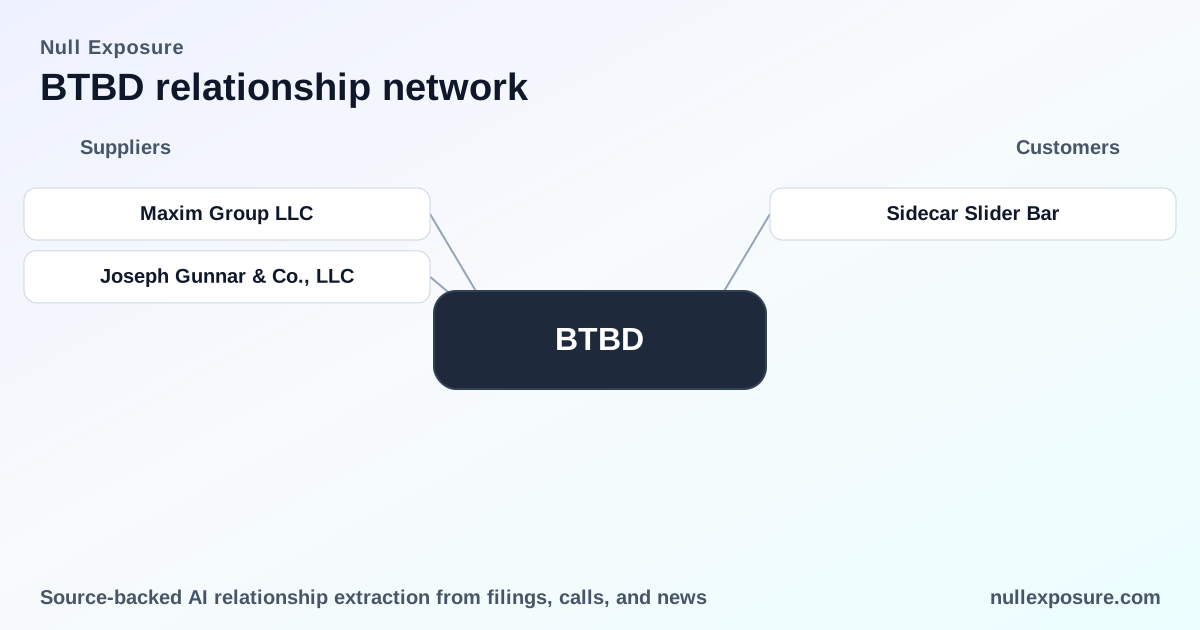
Maxim Group LLC — ATM amendment (FY2025)
BT Brands amended its Equity Distribution Agreement with Maxim Group to increase the size of its ATM offering from $3,005,000 to $3,565,880, expanding near-term equity issuance capacity under the program. According to a company press release posted on The Globe and Mail, the amendment was announced in March 2026 (first seen 2026-03-09).
Joseph Gunnar & Co., LLC — joint book-runner for 2021 offering (FY2021)
Joseph Gunnar acted as a joint book-runner alongside Maxim for BT Brands’ upsized initial public offering activity in 2021, supporting the firm’s prior equity issuance. This placement role was reported by AccessNewswire in a 2026-hosted press item referencing the FY2021 transaction.
Maxim Group LLC — joint book-runner for 2021 offering (FY2021)
Maxim Group served as a co-book-runner on the same FY2021 upsized $12 million offering that included Joseph Gunnar, evidencing an ongoing underwriting relationship that has been used both for IPO-era capital and later ATM program activity (reported via AccessNewswire).
Every external relationship in the public results, in plain English
- Maxim Group LLC — amendment to ATM Offering Program: In FY2025 BT Brands amended its Equity Distribution Agreement to raise the ATM program size from $3,005,000 to $3,565,880, increasing available equity placement capacity through Maxim (press release reported on The Globe and Mail, March 2026).
- Joseph Gunnar & Co., LLC — joint book-runner role in FY2021: Joseph Gunnar served as a joint book-runner on BT Brands’ upsized initial public offering activity in fiscal 2021, supporting primary equity issuance (reported on AccessNewswire; filing references FY2021).
- Maxim Group LLC — joint book-runner role in FY2021: Maxim functioned as a co-book-runner with Joseph Gunnar on the company’s FY2021 equity offering, establishing a recurring underwriting relationship that was later used for ATM activity (reported on AccessNewswire; filing references FY2021).
What these relationships and constraints mean for investors
- Liquidity lever through small-bank underwriters: The company relies on boutique underwriters (Maxim, Joseph Gunnar) for incremental equity — the enlarged ATM gives BT Brands tactical access to capital but signals dependence on dilution as a liquidity tool rather than internal cash generation.
- Operational fragility from supplier concentration: With roughly 30% of purchases tied to one supplier and large distributors like Sysco and Performance Food Services named, operational continuity depends on maintaining favourable terms with a handful of counterparties; any disruption increases cost or forces rapid rebidding of supply.
- Fixed-cost leverage from long-term leases: The 132‑month triple-net lease and other long-term, non-cancelable restaurant leases create high fixed-cost exposure — positive in stable same-store sales environments, adverse under demand shocks.
- Near-term negotiation risk during vendor transitions: The July 2024 procurement shift where pricing was agreed but contracts not executed is an execution risk that investors should mark to operational diligence.
Key investor takeaways:
- Capital access is operationally meaningful but dilutive; watch ATM utilization and timing of equity raises.
- Supplier concentration is a principal operational risk; monitor trade payables, delivery continuity, and any supplier dispute disclosures.
- Lease structure increases fixed-cost risk; model downside scenarios where same-store sales slip.
If you evaluate counterparties or need supplier-level intelligence for underwriting or operational diligence, explore our coverage and reports at https://nullexposure.com/.
Final recommendation and action steps
For investors and operators, prioritize near-term monitoring of ATM usage, supplier payment trends, and any contract execution updates with the new primary vendor. Stress-test cash needs against a scenario where equity issuance is slowed and supplier credit terms tighten. For direct access to regular updates and supplier relationship analytics, visit https://nullexposure.com/.
By focusing on these supplier and capital-market vectors, investors can convert a small-cap CPG operator’s structural exposures into actionable risk-management and valuation inputs.