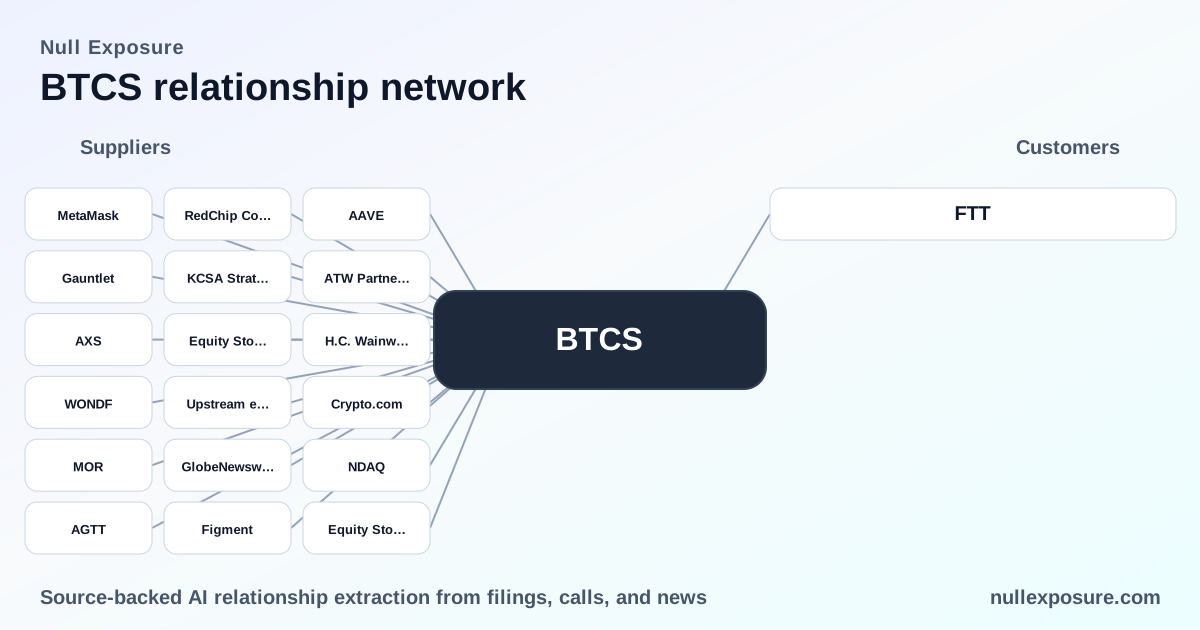
BTCS Inc — Supplier and Partner Map for Investors
BTCS Inc. operates as a blockchain infrastructure operator and Ethereum-focused asset accumulator, monetizing through a combination of staking and validator services (validator payments), on-chain liquidity strategies using DeFi lending, and opportunistic market transactions. The company finances ETH accumulation with a blended TradFi/DeFi strategy — convertible note facilities and placement agents on the capital markets side, and borrowing on decentralized protocols to scale ETH exposure while preserving equity. For a strategic supplier-risk overview and partner disclosures, review BTCS’s relationship map below. For a consolidated supplier-risk platform, visit https://nullexposure.com/.
How BTCS funds growth and where cash flow comes from
BTCS’s operating model is succinct: acquire ETH, leverage that collateral on DeFi rails to borrow stablecoin liquidity, deploy treasury into curated vaults and validator operations, and capture fees or yield through validator payments and on-chain yield strategies. This creates a flywheel: equity or convertible capital enlarges ETH holdings, which collateralize DeFi credit lines that finance further purchases or staking investments. Company-level metrics — modest historical revenue (Revenue TTM $7.5M) and negative EPS — reflect an organization still scaling commercial revenue while running a capital-intensive accumulation strategy.
Key operating characteristics:
- Contracting posture: hybrid — TradFi capital raises (convertible notes placed through placement agents) plus public DeFi counterparty interactions.
- Concentration & criticality: infrastructure-hosting dependencies and validator economics are material to revenue generation.
- Maturity: early commercial traction with growing revenues but negative profitability; financial leverage through convertible debt and DeFi borrowing is a central feature.
- Cash spend profile: validator payments are a material cost line (company disclosure: ~$2.77M in 2024), consistent with a $1M–$10M annual spend band for core validator operations.
If you want the full supplier-risk view and live relationship insights, start here: https://nullexposure.com/.
Operational constraints and company-level signals
BTCS’s public disclosures and press materials describe operational constraints that inform supplier risk:
- Infrastructure dependency: the company states validator nodes and block-builder infrastructure are hosted on a mix of cloud services (Amazon Web Services) and bare-metal servers operated by a third-party provider, Latitude, establishing a clear operational dependency on external hosting. (Company disclosure excerpts, regulatory filings and press releases.)
- Cost and revenue sensitivity: the firm recorded Validator Payments of approximately $2,766,000 in 2024, a meaningful recurring cash outflow tied directly to block-building economics. (Company disclosure excerpts.)
- Relationship posture: BTCS functions both as a buyer of block space (paying Validator Payments) and as a service provider through its validator and Builder+ products — that dual role shapes counterparty negotiations and operational priorities. (Company disclosure excerpts.)
For more detail on how these supplier signals translate into investable risk, see https://nullexposure.com/.
Supplier and partner map — what each relationship contributes
Below are every partner and supplier referenced in BTCS’s disclosures and press coverage, with concise summaries and sourceable citations.
Aave (AAVE)
BTCS borrows stablecoins on Aave using ETH as collateral and executed at least one 1,000 ETH borrowing for approximately $2.5 million; company disclosures also list Aave stablecoin loans totaling $40 million (about 21% of financing on that disclosure). Source: BTCS press releases distributed via Newsfile and GlobeNewswire (2025–2026).
ATW Partners LLC
ATW is the lead investor in a convertible note facility supporting BTCS’s ETH acquisition strategy — the company announced an arranged facility up to $57.8 million and subsequent issuance agreements for convertible notes including a $10 million draw under the ATW arrangement. Source: Newsfile and GlobeNewswire press releases (FY2025).
H.C. Wainwright Co.
H.C. Wainwright acted as the exclusive placement agent for BTCS’s financing offering, managing the capital markets placement process. Source: Newsfile press release (Mar 2026) and prior conference engagement disclosures (2022).
Crypto.com
BTCS executed the bulk of certain ETH acquisitions through Crypto.com’s institutional trading platform, using the venue for large secondary-market purchases. Source: market coverage and StockTwits report summarizing BTCS transactions (FY2025).
Nasdaq (NDAQ)
NASDAQ was referenced in relation to share distribution logistics and DTC eligibility timing for a Series V preferred stock distribution; ex-date scheduling is controlled by NASDAQ pending DTC confirmation. Source: GlobeNewswire press release (FY2023).
Equity Stock Transfer / Equity Stock Transfer, LLC
BTCS engaged Equity Stock Transfer (transfer agent) to coordinate logistics and processing for dividend and stock distribution events, including the company’s historic Bitcoin-payable dividend program. Source: GlobeNewswire press releases (FY2022 and FY2023).
RedChip Companies, Inc.
RedChip has been listed as an investor relations contact supporting BTCS’s external communications and investor engagement, including outreach tied to the company’s Bividend announcement. Source: GlobeNewswire press release (FY2022).
Upstream exchange
BTCS disclosed an application to list shares on Upstream exchange and noted it was working through the application process for listing. Source: GlobeNewswire press release (FY2023).
Figment
BTCS expanded relationships with Figment to increase builder order flow access and scale staking infrastructure, cited in corporate revenue preannouncements. Source: company preannouncement coverage (StockTitan / QuiverQuant, FY2026).
WonderFi (WONDF)
WonderFi is cited as an ecosystem participant in expanded operational relationships designed to increase access to builder order flow and infrastructure scale. Source: preannouncement coverage (FY2026).
Angstrom (AGTT)
BTCS listed Angstrom among ecosystem partners expanded during its growth phase to improve order flow and infrastructure throughput. Source: corporate preannouncement coverage (FY2026).
MetaMask
MetaMask is referenced as an ecosystem participant in partnerships aimed at broadening access to builder order flow and user-facing integrations. Source: QuiverQuant and StockTitan coverage of BTCS’s FY2026 preannouncement.
Gauntlet
BTCS deployed USDC treasury capital into Gauntlet-curated vaults to earn on-chain yield, using Gauntlet’s vault strategies as a noncustodial yield channel. Source: FXDailyReport (FY2026).
Morpho (MOR)
BTCS deployed capital into Gauntlet vault strategies hosted on the Morpho lending ecosystem, indicating use of layered DeFi yield primitives. Source: FXDailyReport (FY2026).
Axie Infinity (AXS)
BTCS completed technical work to run an Axie Infinity validator node as part of its Staking-as-a-Service platform expansion. Source: GlobeNewswire press release (FY2022).
KCSA Strategic Communications
KCSA is engaged to coordinate investor meeting requests and manage investor outreach following webcasts, functioning as an investor relations communications vendor. Source: StockTitan and ManilaTimes coverage of the company’s FY2026 investor events.
GlobeNewswire
GlobeNewswire served as a distribution channel for BTCS press releases that communicated financing plans, ETH holdings updates, and corporate disclosures; some aggregation services noted those releases. Source: press releases distributed via GlobeNewswire (2023–2025).
Investment takeaways and risk posture
- Strategic focus: BTCS has architected a TradFi/DeFi funding flywheel: convertible debt and placement agents fund ETH buys, Aave lending provides leverage, and Gauntlet/Morpho vaults plus validator operations generate yield and service revenue. This is a differentiated but capital-intensive model.
- Operational risk: reliance on external hosting (AWS and third-party bare-metal providers) plus meaningful validator payments expense make infrastructure continuity and counterparty stability material to revenue. (Company disclosure excerpts.)
- Counterparty diversity: BTCS uses a broad mix of counterparties — exchanges, DeFi protocols, placement agents, transfer agents, and IR vendors — reducing single-vendor concentration albeit increasing exposure to crypto-market liquidity and protocol risk.
For an analyst-level supplier risk scorecard and to track counterparties over time, explore the platform at https://nullexposure.com/.
If you are evaluating supplier dependency for BTCS or mapping counterparties across similar blockchain operators, this relationship map captures the active partners and contractual posture reflected in BTCS’s public disclosures and press coverage.