Baytex Energy (BTE): How reserves evaluators shape valuation and disclosure risk
Baytex Energy Corp is an upstream oil and gas operator that monetizes through hydrocarbons production, commodity sales and the value embedded in its proved and probable reserves. The company's public valuation and near-term cash flow outlook derive directly from reserve volumes, reserve life and the commodity price assumptions that feed those estimates; Baytex reports materially positive EBITDA and a market capitalization in the low single-digit billions, but negative net income per share in the latest trailing period. For investors and counterparties, the choice of independent reserves evaluators is a governance and valuation lever — not an administrative footnote. Learn more about supplier exposures and how they matter at https://nullexposure.com/.
Why independent reserve evaluators matter to Baytex's story
Baytex operates under Canadian disclosure standards that require third‑party qualification of reserves. Those independent reports translate geologic and production data into monetized reserve figures used in investor presentations, lending covenants and impairment testing. Reserve evaluators therefore sit at the intersection of regulatory compliance, investor perception and credit metrics — a small number of trusted firms can materially influence reported volumes and the forward-looking assumptions that drive enterprise value.
According to Baytex’s Form 6‑K filing covering its year‑end 2025 reserves (filed in March 2026), the company used multiple independent evaluators and their average commodity and inflation forecasts in preparing reserve disclosures. A contemporaneous sector note reiterated these same evaluator references in a February 2026 report. These filings make clear that evaluator output is a direct input to Baytex’s public metrics and to analyst and lender models.
Supplier relationships you need to know (complete list)
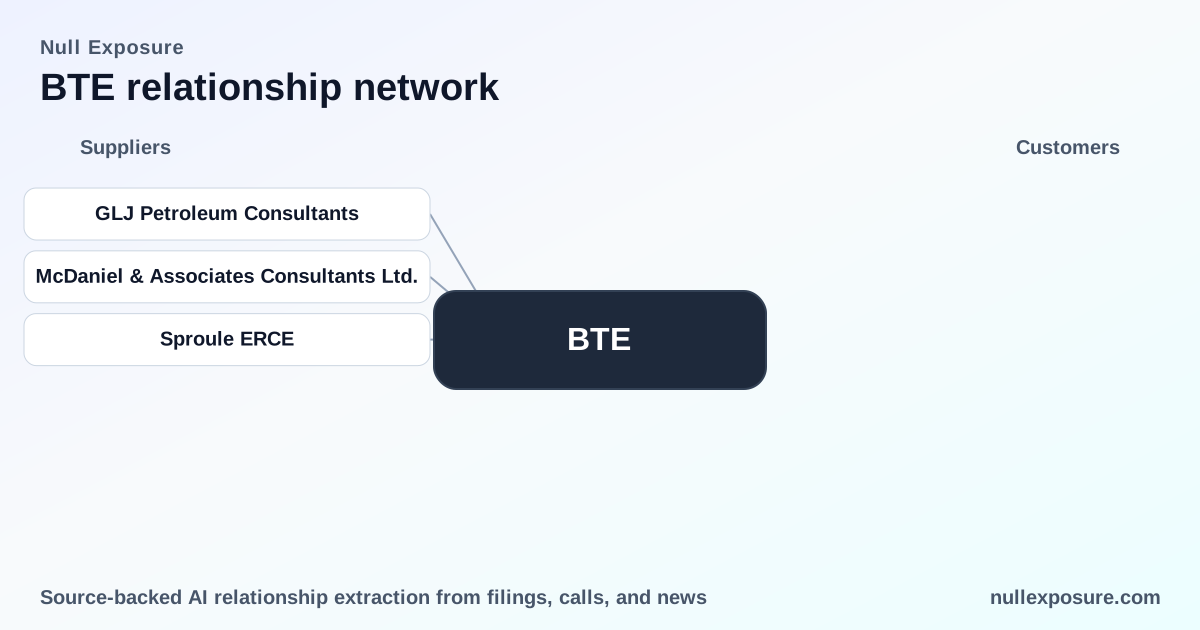
Baytex’s publicly disclosed FY2025 reserves materials reference three independent evaluators. Each relationship below reflects how the company documents its reserve evaluation process in FY2026 filings and press commentary.
GLJ Petroleum Consultants
Baytex used GLJ Petroleum Consultants as one of the independent firms supplying commodity forecasts and reserve evaluation inputs for its year‑end 2025 reserves disclosure. According to Baytex’s Form 6‑K filed March 2026, GLJ’s forecasts were explicitly incorporated into the reserve estimates (Form 6‑K, March 2026). A sector write‑up in February 2026 also referenced GLJ as part of the blended forecast approach (BoeReport, Feb 2026).
McDaniel & Associates Consultants Ltd.
McDaniel & Associates Consultants Ltd. conducted a year‑end 2025 evaluation of Baytex’s Canadian reserves and is named in the company’s FY2026 disclosure as an independent qualified reserves evaluator. Baytex’s Form 6‑K (March 2026) cites McDaniel’s work in support of the reported reserves, and press coverage summarized the company’s reliance on McDaniel’s assessment (Form 6‑K, March 2026; BoeReport, Feb 2026).
Sproule ERCE
Sproule ERCE provided third‑party price and inflation inputs and participated in the reserves evaluation process Baytex disclosed for 2025. Baytex’s March 2026 Form 6‑K lists Sproule among the firms whose forecasts were used for compliance with NI 51‑101, and industry reporting repeated Sproule’s role when Baytex released its reserve growth commentary (Form 6‑K, March 2026; BoeReport, Feb 2026).
What the supplier mix signals about Baytex’s operating posture
Baytex’s documented use of three established evaluators conveys several company‑level signals about how it contracts and manages disclosure risk:
- Contracting posture: Baytex outsources reserve quantification and commodity forecasting to independent firms, consistent with standard NI 51‑101 disclosure practice; this reduces internal model risk but places reliance on external methodologies.
- Concentration: Using multiple evaluators dilutes dependency on a single provider, which lowers single‑point‑failure risk for reserve estimates and associated covenant calculations.
- Criticality: Reserve reports are highly critical to Baytex’s valuation, lender covenants and impairment processes; evaluator output is therefore a control point for financial reporting and capital access.
- Maturity: Baytex’s approach aligns with mature upstream governance — established evaluator names, formal filings and public disclosure timing suggest institutionalized reserve reporting practices.
These are company‑level signals you can use to assess operational resilience and disclosure quality.
How these relationships affect investment risk and upside
From an investor perspective, the supplier mix influences both downside exposure and upside optionality:
- Valuation sensitivity: Reserve volumes and the evaluators’ commodity price assumptions feed EBITDA-to-valuation multiples; changes in evaluator forecasts can produce step changes in reported reserves and carrying value.
- Regulatory and reputational risk: Errors or disagreements between evaluators and management could trigger restatements or lender renegotiations, which are acute for firms with modest profit margins and leverage.
- Diversification benefit: Multiple evaluators provide a practical hedge — divergent methodology or corrections from one firm are less likely to cause catastrophic revisions when a blended view is used in disclosure.
- Operational signal: The presence of established evaluators signals Baytex’s commitment to transparent reserve reporting, which supports dialogue with equity analysts and creditors.
What investors and operators should watch next
- Monitor Baytex’s subsequent Form 6‑K and annual report cycles for any changes in evaluator selection, material revisions to reserve estimates, or shifts in the commodity assumptions underpinning reserves.
- Review note disclosures where evaluator methodologies and average price forecasts are summarized; these lines drive valuation and are first-order inputs to impairment tests and covenant calculations.
- If you are a lender or service provider, confirm contractual language around reserve delivery timing, formats and remediation processes — these operational details dictate the speed and certainty of information flow.
For a succinct tracker of supplier exposures and reserve‑report evolution, visit https://nullexposure.com/ and start a watchlist.
Bottom line and recommended actions
Baytex’s use of GLJ, McDaniel and Sproule for its FY2025 reserve work is an intentional governance choice that reduces single‑vendor concentration while placing evaluator outputs at the center of valuation and covenant mechanics. Investors should treat evaluator reports as primary financial drivers, not background documentation. Stay disciplined: read the Form 6‑K reserve notes, compare evaluator price decks to market futures, and incorporate the potential for reserve revisions into downside scenarios.
To explore how supplier disclosures like these affect counterparty risk and valuation modeling, visit https://nullexposure.com/ — it’s the quickest way to see supplier relationships mapped to disclosure events and filings.