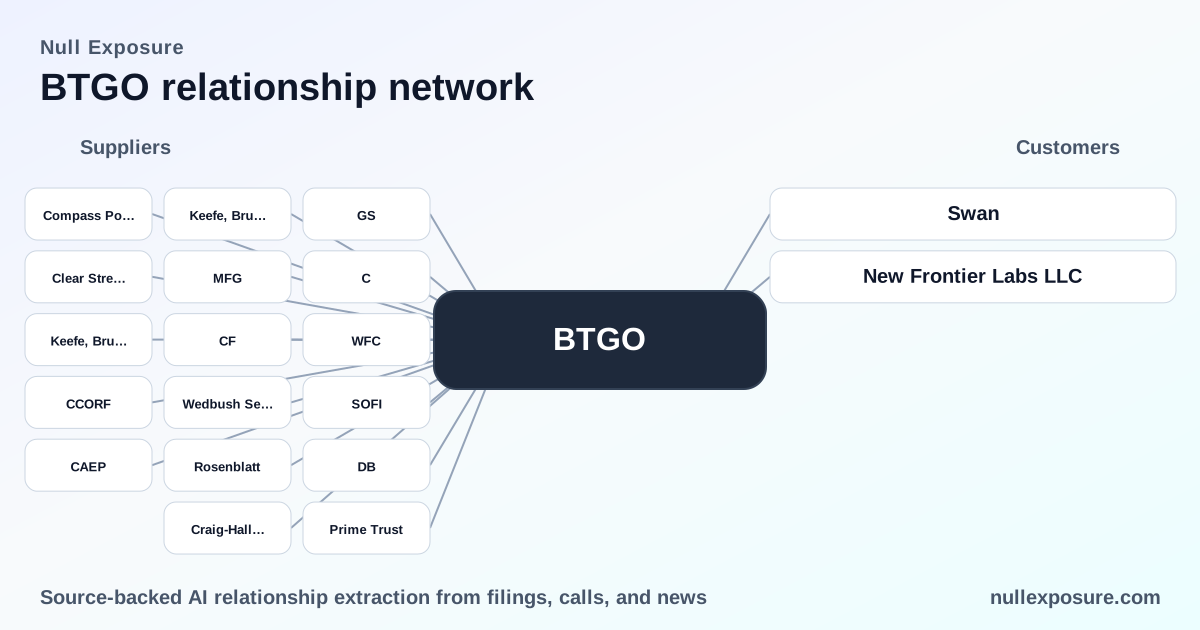
BitGo Holdings (BTGO): Supplier relationships and what they mean for investors
BitGo is an institutional digital-asset infrastructure provider that monetizes through custody, transaction services, staking and enterprise product fees, selling security and settlement capabilities to exchanges, funds and fintech platforms. The company’s revenue base is sizeable relative to its market cap, but margins are thin; investors should evaluate counterparty concentration, underwriting partners for the IPO, and strategic tuck-ins as core inputs to valuation and operational risk. For ongoing supplier monitoring and relationship intelligence, visit https://nullexposure.com/.
A concise operating thesis for investors
BitGo runs a custody-first business that packages security, settlement and compliance tools for institutional crypto clients and charges predictable custody and service fees alongside episodic revenue from integrations and strategic acquisitions. Revenue TTM is listed at $11.14 billion with gross profit of $182.99 million, indicating a high-throughput, low-margin operating profile that depends on scale and trusted third-party relationships to sustain growth.
Why the IPO syndicate matters for supplier credibility
BitGo’s IPO process draws a broad underwriter syndicate — a public market certification effect that matters for counterparties, enterprise sales and custodial trust. The size and composition of that syndicate indicate institutional distribution capacity and a willingness among major banks to underwrite crypto infrastructure, reducing execution risk on public markets and potentially improving access to capital.
Visit https://nullexposure.com/ for deeper coverage of underwriting networks and counterparty profiles.
The full list of named relationships and what they signal
Below I cover every named counterparty in the collected results and summarize the role they play in plain English.
-
Goldman Sachs / Goldman Sachs & Co. LLC — BitGo engaged Goldman Sachs as the lead book-running manager for the IPO, which signals top-tier distribution and institutional endorsement. Source: Sahm Capital / Benzinga coverage of the IPO (January–March 2026) — https://www.sahmcapital.com/news/content/crypto-custodian-company-bitgo-targets-nearly-2-billion-valuation-in-nyse-ipo-2026-01-14 and https://www.benzinga.com/crypto/cryptocurrency/26/01/49898351/crypto-custodian-company-bitgo-targets-nearly-2-billion-valuation-in-nyse-ipo
-
Citigroup — Citi is listed as a book-running manager and core underwriter in the syndicate, supporting distribution to institutional clients. Source: TradingView / ad-hoc-news reporting on the IPO filing (March 2026) — https://www.tradingview.com/news/tradingview:a79b1dd62db9f:0-bitgo-institutional-digital-asset-infrastructure-provider-files-for-nyse-ipo/ and https://www.ad-hoc-news.de/boerse/news/marktberichte/bitgo-holdings-announces-pricing-of-initial-public-offering/68508400
-
Deutsche Bank Securities — Named among the lead managers, Deutsche Bank provides additional European distribution and underwriting capacity. Source: TradingCalendar / ad-hoc-news IPO coverage (March 2026) — https://www.tradingcalendar.com/post/bitgo-btgo-ipo and https://www.ad-hoc-news.de/boerse/news/marktberichte/bitgo-holdings-announces-pricing-of-initial-public-offering/68508400
-
Wells Fargo Securities — Included in the book-running group, Wells Fargo expands retail and institutional access in U.S. channels. Source: TradingCalendar / TradingView IPO notes (March 2026) — https://www.tradingcalendar.com/post/bitgo-btgo-ipo and https://www.tradingview.com/news/tradingview:a79b1dd62db9f:0-bitgo-institutional-digital-asset-infrastructure-provider-files-for-nyse-ipo/
-
Mizuho — Mizuho is named as a book-running manager, representing additional Asian and global underwriting relationships. Source: ad-hoc-news and TradingCalendar (March 2026) — https://www.ad-hoc-news.de/boerse/news/marktberichte/bitgo-holdings-announces-pricing-of-initial-public-offering/68508400 and https://www.tradingcalendar.com/post/bitgo-btgo-ipo
-
Canaccord Genuity — Listed among syndicate managers, Canaccord brings middle-market equity distribution capabilities often used for fintech and specialist coverage. Source: TradingCalendar / TradingView IPO summaries (March 2026) — https://www.tradingcalendar.com/post/bitgo-btgo-ipo and https://www.tradingview.com/news/tradingview:a79b1dd62db9f:0-bitgo-institutional-digital-asset-infrastructure-provider-files-for-nyse-ipo/
-
Cantor — Cantor is included in the bank group, contributing capital markets execution depth for the offering. Source: TradingCalendar / ad-hoc-news IPO announcements (March 2026) — https://www.tradingcalendar.com/post/bitgo-btgo-ipo and https://www.ad-hoc-news.de/boerse/news/marktberichte/bitgo-holdings-announces-pricing-of-initial-public-offering/68508400
-
SoFi — SoFi is listed as a co-manager, reflecting fintech channel presence and retail distribution support for the IPO. Source: ad-hoc-news and TradingCalendar (March 2026) — https://www.ad-hoc-news.de/boerse/news/marktberichte/bitgo-holdings-announces-pricing-of-initial-public-offering/68508400 and https://www.tradingcalendar.com/post/bitgo-btgo-ipo
-
Keefe, Bruyette & Woods (A Stifel Company) — Named as a book-running manager, KBW contributes sector-focused capital markets coverage, particularly for financial services investors. Source: TradingView / ad-hoc-news IPO reports (March 2026) — https://www.tradingview.com/news/tradingview:a79b1dd62db9f:0-bitgo-institutional-digital-asset-infrastructure-provider-files-for-nyse-ipo/ and https://www.ad-hoc-news.de/boerse/news/marktberichte/bitgo-holdings-announces-pricing-of-initial-public-offering/68508400
-
Clear Street — Acting as a co-manager, Clear Street provides fintech execution and institutional access for electronic trading desks. Source: ad-hoc-news co-manager listing (March 2026) — https://www.ad-hoc-news.de/boerse/news/marktberichte/bitgo-holdings-announces-pricing-of-initial-public-offering/68508400
-
Compass Point — Included among co-managers, Compass Point adds boutique sell-side coverage and research distribution. Source: ad-hoc-news co-manager list (March 2026) — https://www.ad-hoc-news.de/boerse/news/marktberichte/bitgo-holdings-announces-pricing-of-initial-public-offering/68508400
-
Craig-Hallum — Cited as a co-manager, Craig-Hallum supports middle-market investor distribution for the IPO. Source: ad-hoc-news co-manager list (March 2026) — https://www.ad-hoc-news.de/boerse/news/marktberichte/bitgo-holdings-announces-pricing-of-initial-public-offering/68508400
-
Rosenblatt — Rosenblatt appears as a co-manager, offering specialist coverage for trading and institutional access. Source: ad-hoc-news / TradingView (March 2026) — https://www.ad-hoc-news.de/boerse/news/marktberichte/bitgo-holdings-announces-pricing-of-initial-public-offering/68508400 and https://www.tradingview.com/news/tradingview:a79b1dd62db9f:0-bitgo-institutional-digital-asset-infrastructure-provider-files-for-nyse-ipo/
-
Wedbush Securities — Named among the co-managers, Wedbush contributes investor outreach and regional distribution. Source: ad-hoc-news co-manager listing (March 2026) — https://www.ad-hoc-news.de/boerse/news/marktberichte/bitgo-holdings-announces-pricing-of-initial-public-offering/68508400
-
Clear operational tie: Prime Trust — BitGo announced a preliminary deal to acquire Prime Trust, which the company and reporting outlets described as reinforcing BitGo’s custody, liquidity, settlement and compliance capabilities through Prime Trust’s API infrastructure and exchange network. Source: Bitcoin Magazine business reporting (article on the proposed acquisition, 2026) — https://bitcoinmagazine.com/business/bitgo-announces-preliminary-deal-to-acquire-prime-trust-custody-firm
How these relationships map back to BitGo’s risk profile
-
Contracting posture: The broad, multi-bank underwriting syndicate signals disciplined market entry and diversified capital-market relationships rather than dependence on a single bookrunner. That lowers execution risk for the IPO and suggests a deliberate route to public markets.
-
Concentration and criticality: The Prime Trust deal is operationally critical because it expands settlement and API layers; failure to integrate would be a material execution risk. The underwriting group is less operationally critical but essential for liquidity and market access at listing.
-
Maturity and partner mix: The mix of global banks (Goldman, Citi, Deutsche) and boutique fintech/co-managers (Clear Street, Rosenblatt, Craig-Hallum) indicates a hybrid maturity approach: Tier-1 distribution paired with specialist desks to reach fintech and digital-asset investors.
-
Ownership signals: Company-level data shows a thin institutional ownership figure and a concentrated float, which implies that these supplier and underwriter relationships are especially important to provide external validation and broaden institutional uptake post-IPO.
For monitoring supply-side exposures and integration execution, see actionable relationship intelligence at https://nullexposure.com/.
Bottom line and investor actions
BitGo’s supplier network for its IPO and its strategic tie to Prime Trust are positive operational signals: underwriters provide market credibility and Prime Trust augments core custody and settlement capabilities. Investors should prioritize monitoring the Prime Trust integration, post-IPO institutional uptake driven by the underwriting syndicate, and margin expansion given the company’s large top-line and low current margins.
If you evaluate counterparty risk and integration outcomes, check the company’s partner tracking and due-diligence tools at https://nullexposure.com/.