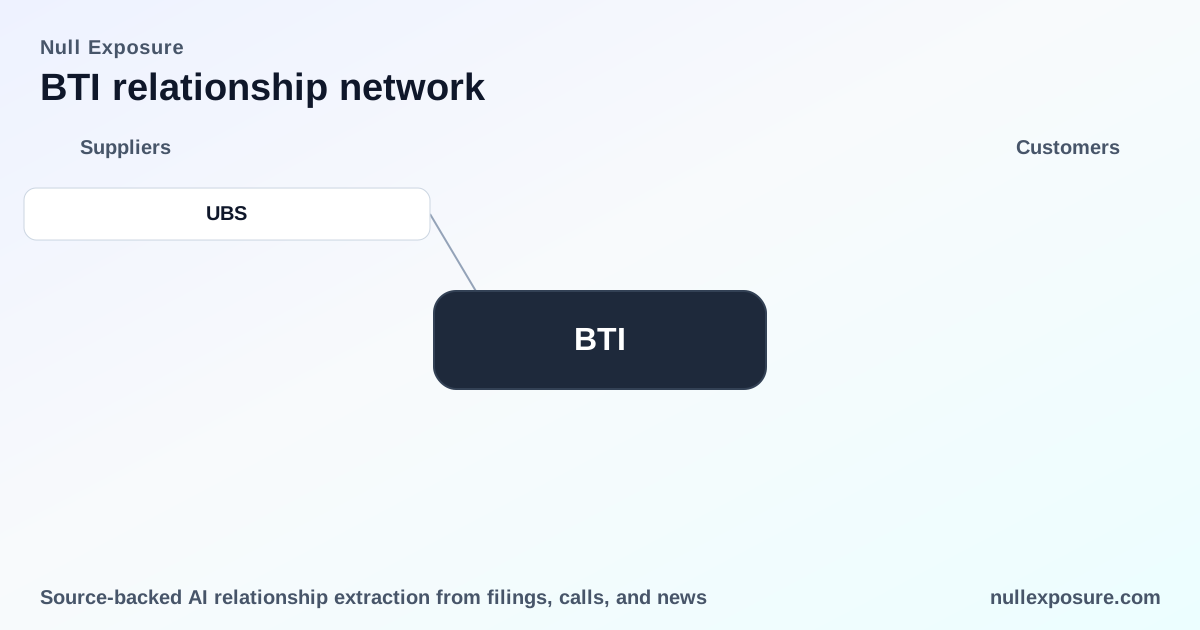
British American Tobacco (BTI) — what the UBS buyback relationship signals for investors
British American Tobacco is a global consumer staples company that sells tobacco and nicotine products and monetizes through product sales, pricing power, dividends, and disciplined capital return programs. Capital allocation — in particular share repurchases executed through third‑party banks — is an explicit lever BAT uses to sustain per‑share returns and manage leverage, and the recent disclosures show UBS acting as the primary intermediary for those programs. For investors and operators evaluating supplier counterparty exposure, the UBS relationship is a window into BAT’s contracting posture on capital markets execution and the operational mechanics of buybacks. Explore more research and relationship intelligence at https://nullexposure.com/.
One sentence framing: why a bank agent matters for shareholders
When a large issuer like BAT appoints an external broker to execute buybacks during closed periods, it transfers execution risk and regulatory interface to the counterparty while preserving corporate confidentiality and timing flexibility, which has implications for custody, settlement, and reputational exposure.
What the public record shows — every relationship in the file
Below I summarize each reported item in the results set so investors can see exactly what has been disclosed. Each entry is a concise plain‑English recap with the original source noted.
-
On BAT’s decision to extend its repurchase programme by up to £1.3 billion for 2026 and to place UBS in charge of buying shares independently during the closed period from Jan. 2 to Feb. 11, TS2.Tech reported that BAT extended the program and appointed UBS to execute purchases on its behalf for the closed period (reported March 9, 2026).
Source: TS2.Tech coverage of BAT buyback extension (reported March 9, 2026). -
A filing showed BAT repurchased 121,668 shares from UBS on Feb. 5 at a volume‑weighted average price of 4,535.6560 pence per share, according to a TS2.Tech report that highlighted the trade details (reported March 9, 2026).
Source: TS2.Tech article reporting the Feb. 5 purchase (reported March 9, 2026). -
BAT disclosed the repurchase of 135,314 shares on Jan. 28, paying an average of 4,335.8629 pence per share through UBS, with plans to cancel those shares, as covered in TS2.Tech’s market note (reported March 9, 2026).
Source: TS2.Tech report on the Jan. 28 buyback disclosure (reported March 9, 2026). -
In a December Nasdaq notice, BAT revealed an irrevocable deal with UBS to buy shares during its closed period from Jan. 2 to Feb. 11 — the period before results when insiders typically cannot trade — a fact highlighted by TS2.Tech’s market coverage (reported March 9, 2026).
Source: TS2.Tech summarizing the December Nasdaq notice (reported March 9, 2026). -
On Jan. 9 BAT purchased 132,817 ordinary shares from UBS AG London Branch, paying between 3,984p and 4,052p per share, according to TS2.Tech’s report documenting the execution window (reported March 9, 2026).
Source: TS2.Tech coverage of the Jan. 9 purchase from UBS AG London Branch (reported March 9, 2026).
How these relationship items fit together for investors
Together, the disclosures show a consistent operational pattern: BAT uses UBS (including UBS AG London Branch) as the executing broker for scheduled repurchases across several dates and has contracted UBS for buyback activity during closed periods. That pattern signals three practical realities for shareholders and counterparties:
- Contracting posture: BAT prefers to outsource execution of share repurchases to a large global bank rather than execute internally or through multiple smaller brokers; this centralization reduces execution fragmentation and supports price‑sensitive timing.
- Concentration: The choice of UBS as a single executing agent for the closed period represents counterparty concentration in capital markets execution; this is efficient but raises single‑point operational and reputational risk if the intermediary has a problem.
- Criticality and maturity: Share repurchases are a mature, recurring capital‑allocation tool for BAT and are operationally critical for its per‑share metrics; using an established bank for execution is consistent with a low‑surprise approach to capital returns.
If you want to see how BAT’s supplier and financial relationships map against broader market patterns, visit https://nullexposure.com/ for comparative exposure analytics.
Operational implications for treasury, legal, and ops teams
For corporate treasuries and operators, the UBS relationship implies specific governance and operational levers:
- Execution agreements for closed‑period buybacks will include irrevocable mandates, pre‑agreed trading windows, and detailed settlement procedures, transferring day‑to‑day execution responsibility to the bank while keeping legal accountability with BAT.
- Settlement timing and trade reporting (VWAPs, per‑share prices and quantities as seen in the filings) creates predictable post‑trade disclosure obligations that directly affect investor perception and the share count schedule.
- Counterparty selection criteria should be periodically reviewed given the concentration in a single bank; operational contingency plans should exist should the executing broker be unable to trade.
Investor takeaways and risk considerations
- Positive: The use of a global bank like UBS to execute buybacks is an operationally conservative choice that supports disciplined and confidential capital returns and helps BAT deliver per‑share metrics and dividend stability.
- Watch list: Counterparty concentration — UBS is the evident default executing agent in these disclosures — exposes BAT to execution, settlement, and reputational risk if market or regulatory conditions disrupt the bank. Investors should track both the size of buybacks and any shifts to new executing banks.
- Disclosure behavior: The granular reporting of share counts and VWAPs demonstrates regulatory compliance and transparency in capital allocation, which is a governance positive for long‑term equity holders.
For a structured review of supplier exposures across similar capital‑markets relationships, consult our detailed coverage at https://nullexposure.com/.
Bottom line
BAT’s public filings and market reports document a straightforward and repeatable pattern: UBS, including its London branch, is the principal executing counterparty for BAT’s 2026 share repurchases, including activity during closed periods and multiple specific trades with disclosed share counts and VWAPs. That choice reflects a deliberate contracting approach — centralized execution with a reputable bank — which supports efficient capital returns but concentrates execution risk. Investors should treat this as an operational signal about BAT’s capital‑allocation governance and monitor any material changes in executing counterparties or buyback scale.
If you need a tailored supplier‑risk briefing or comparative counterparty analysis for portfolio positions, continue your research at https://nullexposure.com/.