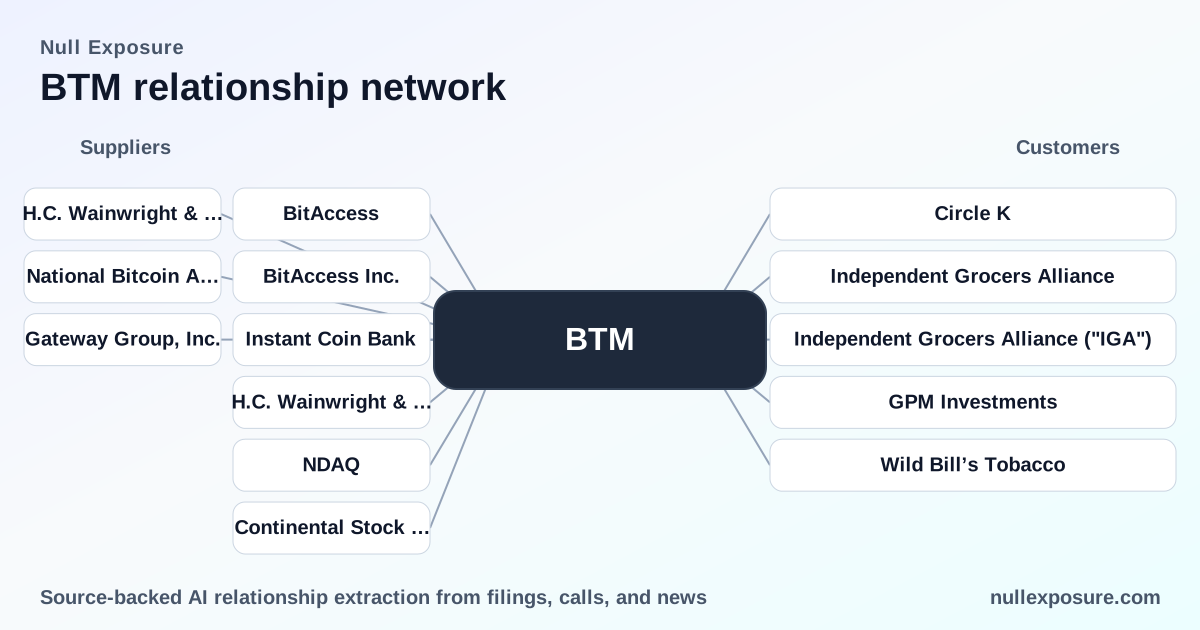
Bitcoin Depot (BTM): supplier relationships that shape margin, risk and growth
Bitcoin Depot operates and monetizes a North American-focused—and increasingly international—network of cryptocurrency kiosks by selling Bitcoin to retail users at kiosks and through its mobile app, capturing transaction spreads and service fees while outsourcing hardware, logistics, armored cash handling and liquidity procurement to third parties. The company reported trailing revenue of $635.6 million and operates with a lean capital structure that depends on third‑party liquidity and service partners to deliver transaction volume and uptime. For investors and operators, the supplier map reveals where operational leverage, concentration risk, and integration complexity sit on the balance sheet and the P&L.
Explore deeper supplier risk intelligence at https://nullexposure.com/.
How Bitcoin Depot sources product and service — the operating model in plain terms
Bitcoin Depot’s core economic engine is retail buy/sell spreads executed across a physical kiosk footprint and mobile channels. The company purchases Bitcoin on a just‑in‑time (spot) basis from liquidity providers to maintain inventory for anticipated transaction volumes, then sells to customers at markup. This contracting posture—spot purchases rather than long‑term hedges—creates direct exposure to execution and settlement risk but preserves working‑capital flexibility. (Company disclosure in its FY2024 Form 10‑K describes the just‑in‑time liquidity purchasing approach.)
Beyond liquidity, the company relies on an ecosystem of kiosk manufacturers, logistics vendors, armored cash carriers, wireless connectivity providers and app distribution platforms. The FY2024 disclosures list a geographically broad supplier base spanning the U.S., Canada, Australia and Puerto Rico, signaling a global supplier footprint for operational services even though the kiosk business remains concentrated in North America. Cumberland and Abra are named as liquidity counterparties, with Cumberland described as a multi‑year supplier and Abra as a newer relationship—indicating heterogeneous maturity across critical supplier relationships.
Supplier roster investors should monitor
BitAccess
BitAccess provides operating software to third‑party BTM operators, which creates potential information flows and competitive exposure for Bitcoin Depot’s operations. According to Bitcoin Depot’s FY2024 Form 10‑K, the company flagged BitAccess’s software as a source of potential anti‑competitive information access and associated litigation risk.
BitAccess Inc.
The filing also notes that BitAccess Inc. and Express Vending, Inc. are taxed as Canadian corporations, a tax status disclosure that is relevant for cross‑border vendor arrangements and procurement contracts. This detail is included in Bitcoin Depot’s FY2024 10‑K.
Instant Coin Bank
Bitcoin Depot confirmed an asset acquisition from Instant Coin Bank, a regional Bitcoin ATM operator, with the transaction dated January 13, 2026; that purchase expands install base and regional market share. A March 2026 Ad‑hoc News report documented the asset acquisition and its timing.
H.C. Wainwright & Co.
H.C. Wainwright & Co. is acting as the exclusive placement agent for a $15 million registered direct offering and is listed as the sales agent for an at‑the‑market prospectus enabling up to $50 million of future Class A common stock sales—an explicit financing and capital markets relationship disclosed in public filings and press releases in late 2025. (See the company’s press release and related QuiverQuant and GlobeNewswire items in FY2025–FY2026.)
The Nasdaq Capital Market (Nasdaq)
Nasdaq is the trading venue for BTM’s Class A Common Stock and was the vehicle referenced for the one‑for‑seven reverse stock split effective February 23, 2026, a corporate action announced in the company’s public notices. The reverse split announcement was published in March 2026 market notices.
Continental Stock Transfer & Trust
Continental Stock Transfer & Trust is identified as the company’s transfer agent and the communications conduit to shareholders following the reverse stock split, per the company’s reverse split announcement in early 2026.
National Bitcoin ATM
Bitcoin Depot acquired assets from National Bitcoin ATM as part of its expansion and retail roll‑up strategy, noted in the company’s November 2025 press release describing retail partnerships and asset acquisitions that support geographic expansion, including into Asia.
Gateway Group, Inc.
Gateway Group, Inc. is the external communications and investor relations firm tied to Bitcoin Depot press releases and contact points for media and investors, cited in press materials for both the October 2025 financing announcement and a February 2026 compliance policy release.
What the relationship map means for investors and operators
-
Liquidity and execution are central. The firm purchases Bitcoin on a spot basis from named liquidity providers such as Cumberland DRW and Abra; Cumberland is a multi‑year counterparty while Abra is relatively new, which means Bitcoin Depot’s cost of goods and inventory management depend directly on these counterparties’ execution and credit terms. This is a company‑level signal drawn from the FY2024 filings identifying those providers and relationship tenors.
-
Operational criticality is distributed but concentrated in functions. Manufacturing, armored cash pickup, installations and wireless connectivity are outsourced across multiple vendors and geographies, which reduces single‑vendor operational risk but increases coordination complexity and vendor management requirements. The FY2024 disclosures list specific providers across the U.S., Canada, Australia and Puerto Rico, signaling a global supplier footprint for operations.
-
Capital markets and liquidity access are active. Use of H.C. Wainwright for a direct offering and an ATM sales mechanism indicates ongoing capital‑raising options that can dilute equity but preserve cash runway and growth capital; the company disclosed a $15 million registered direct offering and an ATM prospectus supporting up to $50 million of share sales in FY2025–FY2026.
-
Roll‑up strategy increases integration risk. Recent asset purchases from Instant Coin Bank and National Bitcoin ATM accelerate footprint growth but require seamless integration of machines, compliance protocols, and local banking relationships—operational execution that is visible in public announcements from late 2025 and early 2026.
-
Regulatory and litigation risk is explicit. The 10‑K highlights the potential for information access and anti‑competitive litigation stemming from third‑party kiosk software providers such as BitAccess, placing legal and compliance controls among top operational priorities.
Explore supplier risk and concentration analytics on the platform: https://nullexposure.com/.
Actionable takeaways for investors and operators
-
Monitor liquidity provider exposure and tenure. Cumberland’s multi‑year relationship is an operational stabilizer; Abra’s newer status increases short‑term uncertainty in execution economics. This dynamic directly affects gross margin variability on kiosk sales.
-
Treat acquisitions as operational tests. The Instant Coin Bank and National Bitcoin ATM purchases expand footprint but raise integration and compliance execution questions that will be visible in subsequent uptime, transaction volume and working capital metrics.
-
Capital strategy is explicit and accessible. With an active placement agent and ATM prospectus in place, Bitcoin Depot can access equity markets for working capital—this reduces immediate financing risk but creates potential dilution.
-
Track vendor concentration in armored and connectivity services. A geographically diversified supplier base reduces single‑point failures, but it demands robust vendor management to maintain service levels across jurisdictions.
For a consolidated view of where supplier concentration, contract posture and operational criticality intersect in BTM’s model, visit https://nullexposure.com/.
Bitcoin Depot’s model is capital‑efficient but supplier‑dependent: margins scale with transaction volume while execution depends on a small set of critical counterparties. Investors should weigh the upside of kiosk roll‑ups and capital access against the operational complexity introduced by spot liquidity procurement, vendor coordination across multiple jurisdictions, and the legal exposure called out in the company’s FY2024 disclosures.