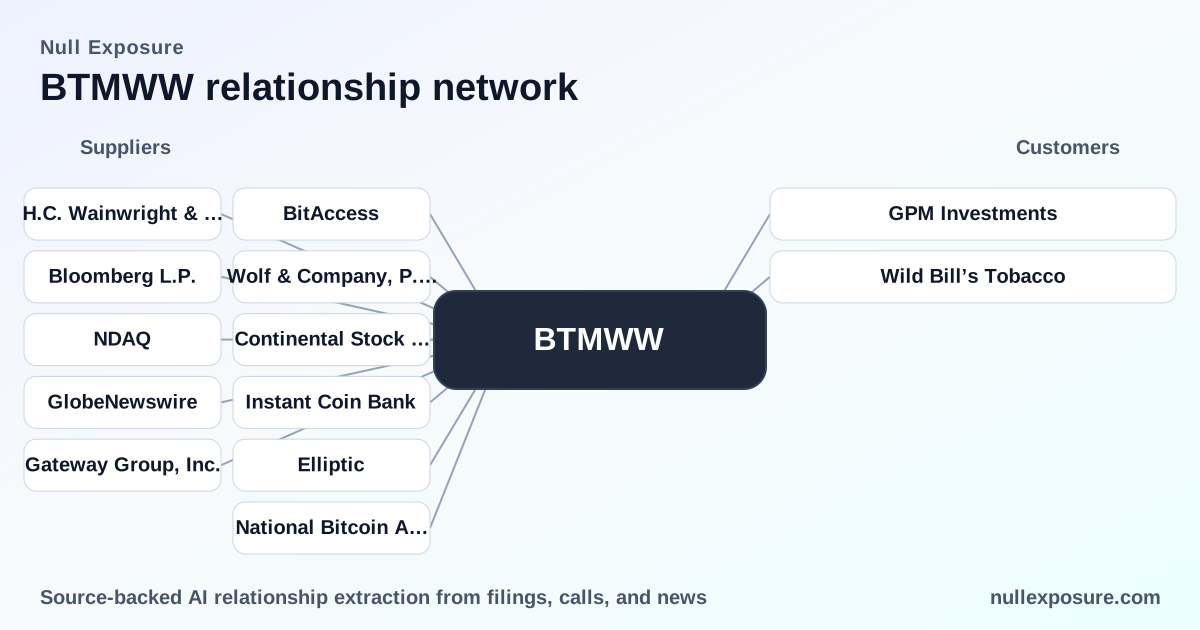
Bitcoin Depot (BTMWW) — supplier relationships and what they mean for investors
Bitcoin Depot owns and operates a North American network of cryptocurrency kiosks and monetizes by collecting transaction fees and spreads on on‑ramp Bitcoin purchases at its kiosks while scaling footprint through acquisitions and third‑party deployments. Revenue depends on kiosk throughput, cash logistics, liquidity provider terms, and software/manufacturing partnerships that keep machines online and compliant. For a structured view of counterparties, obligations, and operational constraints, review the supplier map below — or visit the full platform for deeper counterparty analysis: https://nullexposure.com/.
How the company runs and where suppliers drive value
Bitcoin Depot’s operating model is a transactional retail network requiring four core supplier classes: kiosk manufacturers/software vendors, armored cash logistics, liquidity providers/exchanges, and service providers (audit, transfer agent, placement agents, PR). The business monetizes at the kiosk level but is sensitive to counterparty cost and availability — armored courier contracts determine cash collection reliability, liquidity providers set funding terms for just‑in‑time Bitcoin purchases, and software firms control machine uptime and data flows. These relationships are operationally critical because downtime or funding friction directly reduces fee revenue and increases reputational risk.
Key company‑level signals from public filings and disclosures:
- Contracting posture: Bitcoin Depot contracts with large, reputable armored courier services, indicating enterprise‑grade logistics and a preference for established counterparties.
- Relationship roles: Suppliers are predominantly service providers (software, cash logistics, insurance, maintenance) with the company also acting as an active buyer of Bitcoin from liquidity providers on a just‑in‑time basis.
- Concentration & spend: Balance‑sheet excerpts place short‑term accrued liabilities in the low‑single‑digit millions, suggesting mid‑market spend bands rather than high‑volume single supplier concentration.
- Maturity: The company uses multiple kiosk manufacturers and deploys pre‑loaded operating software, showing an ecosystem approach rather than single‑source manufacturing.
If you want a structured supplier risk profile or to monitor counterparties in real time, see the platform overview here: https://nullexposure.com/.
Supplier map — what every named partner provides and why it matters
BitAccess
BitAccess supplies kiosk operating software to third‑party BTM operators, which gives Bitcoin Depot a software dependency that can affect uptime and competitive intelligence about kiosk operations. This relationship is disclosed in Bitcoin Depot’s FY2024 Form 10‑K.
Wolf & Company, P.C.
Wolf & Company was ratified as Bitcoin Depot’s independent registered public accounting firm for the fiscal year ending December 31, 2025, indicating the firm will handle the company’s external audit and financial reporting assurances. This appointment was reported in an 8‑K disclosed via StockTitan on March 9, 2026.
Continental Stock Transfer & Trust
Continental is acting as the company’s transfer agent and handled shareholder communications related to the one‑for‑seven reverse stock split effective February 23, 2026, including fractional share cash‑out notices. This is described in press filings and 8‑K notices reported in March 2026.
Instant Coin Bank
Bitcoin Depot acquired Instant Coin Bank, a regional BTM operator with locations across Texas and Oklahoma, to strengthen its South‑Central footprint and accelerate kiosk roll‑out in that region. The acquisition was disclosed in a company announcement summarized by StockTitan in March 2026.
Elliptic
Bitcoin Depot partners with crypto analytics firm Elliptic to provide law‑enforcement tracing capabilities for victim recovery and transaction tracing, reinforcing the company’s compliance and post‑incident response capabilities. This partnership was discussed in a Decrypt news article in 2025 covering law‑enforcement coordination.
National Bitcoin ATM
Bitcoin Depot acquired the assets of National Bitcoin ATM, adding over 500 kiosks across 27 states and raising its stated U.S. market share to roughly 30% as per the company’s public statements. This acquisition was reported in StockTitan coverage in March 2026.
H.C. Wainwright & Co.
H.C. Wainwright served as exclusive placement agent for a $15 million registered direct offering, indicating reliance on investment bankers for capital raises and market placement of securities. This engagement was reported by StockTitan in March 2026.
Bloomberg L.P.
Bloomberg L.P. is cited as the authoritative source for calculating the Nasdaq volume‑weighted average price used to determine cash payments for fractional shares following the reverse split; the company referenced Bloomberg in its split mechanics described in March 2026 filings and press releases.
The Nasdaq Capital Market (Nasdaq)
Nasdaq remains the trading venue for Bitcoin Depot Class A common stock (ticker BTM), and the company confirmed split‑adjusted trading effective February 23, 2026, under Nasdaq rules as reported in the company’s reverse split announcement in March 2026.
GlobeNewswire
GlobeNewswire distributed the company’s reverse split press material; a March 2026 note also flagged that the summary was AI‑generated, so investors should trace to the underlying filing for primary text and numbers.
Gateway Group, Inc.
Gateway Group, Inc. acted as investor and media contact in 8‑K communications around corporate events, supplying investor relations support referenced in the company’s March 2026 filings.
What the counterparty map implies for operations and risk
Bitcoin Depot operates with service‑heavy, mission‑critical supplier relationships. The combination of software dependency (BitAccess), multiple manufacturers, and armored courier contracts points to an operating posture that is resilient through diversification but sensitive to vendor performance. The company sources Bitcoin from liquidity providers on a just‑in‑time basis, making liquidity counterparty terms a direct driver of gross margins. Short‑term accrued liabilities in the low‑millions indicate operating scale where single supplier disruptions are manageable but repeated friction could compress cash flow and capex for kiosk expansion.
- Concentration: Multiple manufacturers and service providers suggest deliberate diversification, reducing single‑supplier concentration risk.
- Criticality: Software, armored logistics, and liquidity providers are critical; any persistent failure in these areas reduces throughput and fee revenue immediately.
- Maturity: Use of established transfer agents, auditors, and placement agents reflects corporate maturity in governance and capital markets processes.
If you need an investor‑grade counterparty scorecard or continuous monitoring of these supplier ties, see the service overview here: https://nullexposure.com/.
Investment implications and recommended next steps
For investors evaluating Bitcoin Depot, focus on three items: throughput trends at kiosks (same‑store sales), liquidity provider economics (funding spreads and credit), and software/logistics uptime metrics. Recent acquisitions (Instant Coin Bank, National Bitcoin ATM) accelerate rollout but also raise integration execution risk; watch how costs scale relative to transaction volumes. Governance signals — a new auditor, an active transfer agent, and a placement agent relationship — show the company is managing capital markets obligations and corporate communications.
Actionable next steps:
- Track short‑term liquidity provider arrangements and any disclosures about credit extensions, since these directly affect margins.
- Monitor operational KPIs tied to BitAccess software performance and armored courier uptime.
- Review integration results for recent acquisitions to determine whether kiosk economics are improving at scale.
For a comparative supplier risk assessment or to commission a tailored counterparty report, visit https://nullexposure.com/ for onboarding and live monitoring options.
Bold final takeaway: Bitcoin Depot’s value proposition is simple — scale kiosks and collect transaction fees — but execution hinges on a small set of high‑criticality suppliers whose costs and availability directly determine cash flow and growth potential.