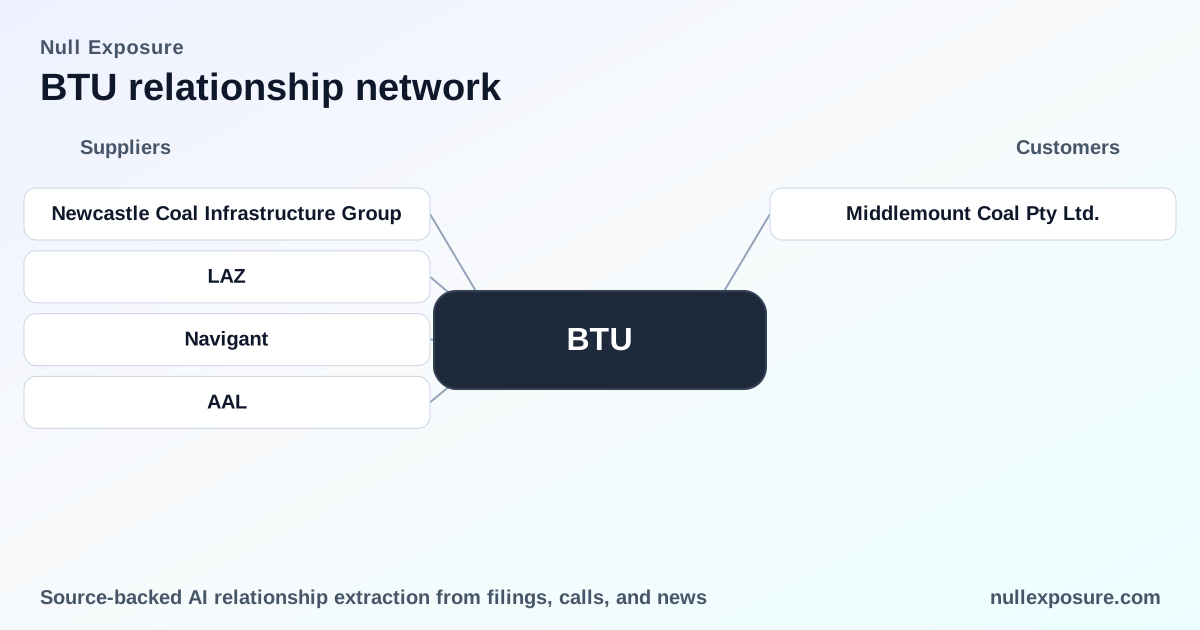
Peabody Energy (BTU) — supplier relationships that shape cash flow and operational risk
Peabody Energy monetizes its mining footprint by producing and selling thermal and metallurgical coal into global markets, leveraging long-term export infrastructure and a mix of short-term and acquisition financing to scale volumes. Revenue comes from coal sales to utilities and steel producers, while margins and free cash flow are driven by port and rail access, contract tenor for logistics, and the company’s ability to integrate acquired Australian assets into existing distribution channels. For investors and operators, the critical lens is how these external relationships convert to reliable throughput and capital commitments. Learn more at https://nullexposure.com/.
The commercial profile that matters to counterparties
Peabody is a global coal merchant with a market capitalization near $3.5 billion and roughly $3.96 billion in trailing revenue; its operating and financing posture is contract-heavy and capital intensive. The company discloses substantial take-or-pay arrangements with port access and rail providers in Australia — approximately $1.0 billion in commitments with terms up to 19 years — which locks in minimum payments even if volumes decline. These agreements convert infrastructure availability into fixed cost obligations and create asymmetric counterparty risk: service providers enjoy revenue stability, while Peabody carries volume and market-price exposure.
Capital structure and liquidity actions supplement that commercial posture. Filings describe a 364-day bridge facility and other acquisition financing constructs, which point to reliance on short-duration wholesale funding to execute large asset purchases. On a net basis, the business is operationally mature in its coal-producing regions but financially levered toward execution of inorganic growth. For more situational intelligence, visit https://nullexposure.com/.
Named counterparties you should track
Below are every relationship called out in the supplier results, summarized plainly with source context.
Newcastle Coal Infrastructure Group
Peabody lists Newcastle Coal Infrastructure Group as one of the operators at the Port of Newcastle used to export thermal and metallurgical coal out of New South Wales, indicating reliance on that terminal for Australian export logistics. This is documented in Peabody’s 2024 Form 10‑K (FY2024) as part of the company’s primary export port network.
Lazard
Peabody engaged Lazard to assist with finding buyers for the Navajo Generating Station in a 2017 transaction process; Lazard acted as a financial advisor during that strategic divestiture effort. A 2017 report in AZ Central noted Peabody hired Lazard for that mandate (FY2017).
Navigant
In the same 2017 advisory effort, Peabody retained Navigant to provide economic analysis of the plant, supporting transaction diligence and valuation work. AZ Central’s 2017 coverage references Navigant’s role in the Navajo negotiations (FY2017).
Anglo American
Peabody entered definitive agreements in late 2024 to acquire a portion of Anglo American’s Australian coal portfolio, but Peabody subsequently withdrew from the bid after a methane-related fire at the Moranbah North mine, an outcome that ended the contemplated asset transfer. The Institute for Energy Economics and Financial Analysis (IEEFA) covered the withdrawal and the incident in FY2025, and Peabody’s own purchase-agreement disclosures (dated November 25, 2024) describe the targeted assets and the transaction structure.
How these relationships map to company constraints and operational risk
Peabody’s public disclosures and the relationship set imply several structural constraints that determine counterparty dynamics:
- Contracting posture — long-term, fixed commitments. The company-level signal is strong: take-or-pay logistics commitments of roughly $1.0 billion with terms up to 19 years convert transport availability into minimum-cost obligations and raise fixed-cost leverage across commodity cycles.
- Financing mix — short-dated bridge funding and structured loans. Filings describe a 364-day bridge facility commitment and other acquisition-related loan notes, indicating episodic dependency on short-term financing to execute large transactions and acquisitions.
- Global operations with concentrated node dependence. Peabody operates across multiple jurisdictions, but export flows funnel through a small set of terminals and rail corridors in Australia and the U.S., elevating the criticality of a handful of service providers.
- Service-provider intensity. The company contracts maintenance, temporary labor, explosives, and other site services, creating persistent third-party vendor relationships that are operationally critical even if individually non-strategic.
- Seller role in M&A. At the company level, Peabody pursues and negotiates asset purchases and disposals; the November 2024 agreements with Anglo American demonstrate the company’s willingness to assume seller/buyer bargaining dynamics and associated contingent liabilities.
None of these signals is trivial: they shape cash flow volatility, counterparty concentration risk, and the sensitivity of earnings to rail/port throughput.
Investment implications — what operators and analysts should prioritize
- Counterparty concentration risk is material. A small number of port and rail providers stand between production and revenue realization; loss of access or cost shocks at these nodes would be direct earnings impairments.
- Fixed-cost obligations reduce flexibility. Long-term take-or-pay contracts protect providers but constrain Peabody’s ability to flex costs in down cycles.
- Acquisition financing is a wildcard. Use of a large 364-day bridge facility and other transactional loans elevates refinancing and execution risk around big purchases.
- Reputational and ESG events translate to commercial fallout. The Anglo withdrawal after a methane incident illustrates how operational incidents elsewhere can derail strategic transactions and reshape counterparty calculus.
Bold takeaway: Peabody’s supply chain and financing relationships convert market exposures into predictable but potentially burdensome obligations; investors should underwrite those fixed commitments into any valuation or counterparty credit assessment.
For a practical view of how these relationship dynamics alter counterparty risk scoring, check https://nullexposure.com/.
Actionable next steps for due diligence
- Request the latest schedules of port and rail contracts (tenor, take-or-pay minima, termination triggers) and map them to volume forecasts.
- Model refinancing scenarios for any bridge or acquisition financing assuming multiple maturity and rate outcomes.
- Monitor operational incident reports around Australian mines tied to the Anglo assets and any other assets where Peabody seeks exposure.
- Validate counterparties’ concentration metrics and stress-test throughput interruptions for 30–90 day windows.
Bottom line
Peabody’s supplier ecosystem combines long-term logistics commitments, concentrated export nodes, and episodic acquisition financing in ways that are predictable but binding. For investors and operators evaluating supplier relationships with Peabody, the focus should be on contract tenor, minimum-payment exposure, and the interaction between operational uptime and short-term funding maturity. For ongoing monitoring and a deeper counterparty view, go to https://nullexposure.com/.