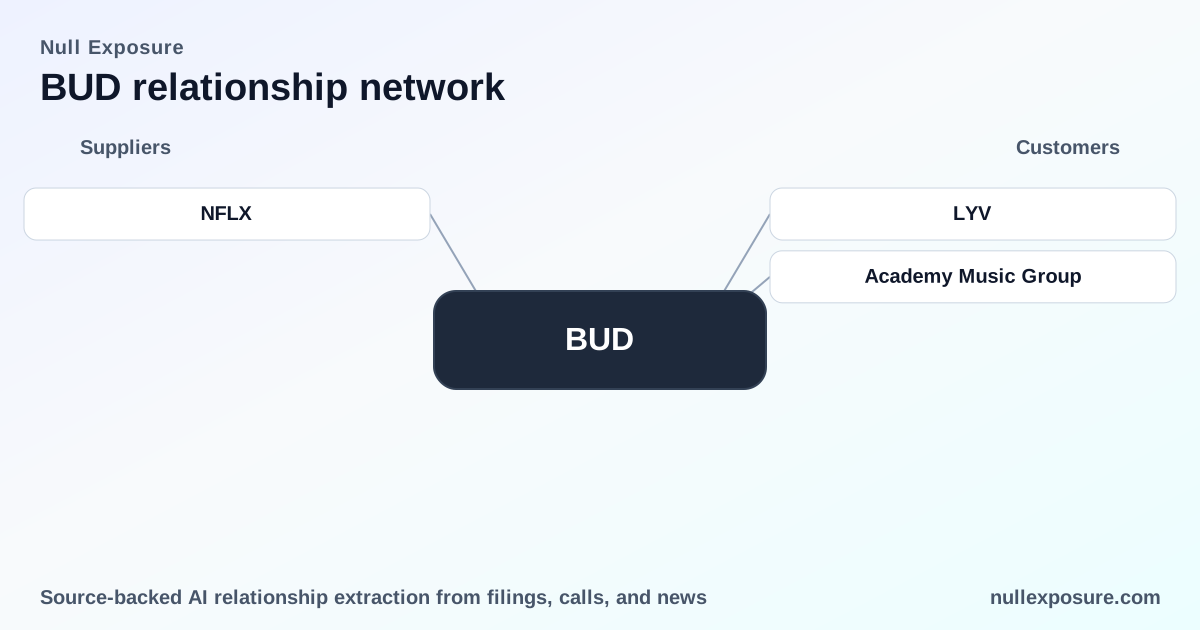
AB InBev (BUD) — Supplier ties, advertising reach, and what investors should price in
Anheuser‑Busch InBev monetizes as a global branded consumer staples platform: it sells beer and related beverages through a vast network of owned and third‑party distributors while investing in high‑visibility marketing and media partnerships to protect brand equity and accelerate volume growth. Revenue is generated through unit sales and premiumization of brand portfolios, while marketing partnerships drive demand rather than direct top‑line monetization. Explore supplier intelligence and partner tracking at https://nullexposure.com/ for a consolidated view of BUD’s external relationships.
What the Netflix placement actually is — a marketing play, not a revenue stream
AB InBev’s reported relationship with Netflix is a targeted advertising placement: the company will advertise during Netflix’s 2025 live NFL Christmas Game Day. This is a promotional, short‑term engagement intended to capture a large live audience and reinforce brand presence during a premium sporting event window. According to a StockTitan news report published March 9, 2026, AB InBev will advertise on Netflix’s live NFL broadcast for the 2025 Christmas Game Day (StockTitan, 2026).
This class of relationship is transactional and campaign‑oriented — valuable for brand reach but not a supplier linkage that alters cost of goods sold or supply chain risk. For investors, categorize this as marketing intensity rather than supplier dependency.
Supplier relationships observed (complete list)
- Netflix, Inc. — AB InBev will advertise during Netflix’s 2025 live NFL Christmas Game Day, a tactical marketing placement to reach large live audiences; reported March 9, 2026 in a StockTitan news article: https://www.stocktitan.net/news/BUD/ab-in-bev-and-netflix-announce-global-brand-t63f2ez2y50q.html.
The relationship above is the only supplier‑scope entry surfaced in the dataset; it is a promotional collaboration rather than a procurement or manufacturing supply contract.
How this fits AB InBev’s operating model and supplier posture
AB InBev’s operating model mixes a capital‑intensive manufacturing base with flexible, high‑frequency marketing and distribution contracts. From the available company indicators, several company‑level signals are clear:
- Contracting posture — predominantly short to medium term for marketing partners. Campaigns like the Netflix NFL placement are executed under time‑boxed agreements rather than long‑dated strategic supply contracts.
- Concentration — low supplier concentration for marketing channels. A global brewer of AB InBev’s scale sources advertising inventory across many platforms and wholesalers; a single streaming partner is not a concentrated operational dependency.
- Criticality — low for production, medium for brand health. Advertising relationships do not affect production continuity, but they are critical to maintaining premium pricing and volume trajectories in competitive markets.
- Maturity — high. AB InBev is a mature, globally diversified company with $59.32B trailing revenue and $19.42B EBITDA (FY data through 2025), giving it flexibility in channel mix and bargaining leverage with media partners.
These are company‑level signals derived from the business profile and the nature of the reported partnership; they do not attach any constraint to the Netflix relationship specifically.
Financial framing — what marketing buys mean for valuation
AB InBev’s financial profile underpins its ability to fund high‑reach marketing: market capitalization of $142.4B, trailing revenue $59.32B, operating margin ~24.9%, and EV/EBITDA ~9.7. These metrics indicate a large, cash‑generative platform that can sustain episodic marketing spends without perturbing capex or working capital. Key investor takeaways:
- Marketing spend is a demand driver, not a capital sink. A placement like Netflix’s live NFL broadcast amplifies share of voice in a premium window; it is a cost of goods sold‑adjacent line to the P&L, but it does not change production economics.
- Profitability supports optionality. With meaningful EBITDA and an EV/EBITDA below many growth peers, management can continue aggressive promotional activity without refinancing pressure.
- Brand risk management matters for valuation. Investors should watch marketing cadence and cost‑per‑reach; consistent high‑quality placements support premium multiples by protecting volume and pricing power.
If you want a unified view of how supplier and partner engagements translate into brand and financial risk, review Null Exposure’s aggregated supplier profiles at https://nullexposure.com/.
Risks and monitoring priorities for operators and investors
- Brand concentration risk in premium events. High‑frequency placement in marquee events is beneficial, but overreliance on expensive live windows can compress margins if ROI on incremental volume weakens.
- Channel fragmentation and measurement. Streaming and live streaming buy‑side measurement differ from linear TV; ensure rigorous post‑campaign lift analysis to verify demand elasticity.
- Short‑term contractual nature. Because media buys are usually short duration, negotiating leverage can swing quickly; operators should secure data rights and performance clauses where possible.
How to act on this intelligence
- Monitor quarter‑over‑quarter marketing ROI disclosures and regional volume trends; advertising partnerships are signal events for demand acceleration, but not for supplier risk to production.
- For M&A or procurement teams, distinguish between marketing partners (brand reach, short‑term) and manufacturing suppliers (long‑term, critical for continuity).
- If you need ongoing tracking of BUD’s partner ecosystem and potential supplier risks, start with a consolidated supplier mapping on Null Exposure: https://nullexposure.com/.
Bottom line
The Netflix placement is a high‑visibility marketing tactic consistent with AB InBev’s strategy to protect brands and stimulate volume through premium live‑event exposure. It is not a supplier relationship that impacts production resilience or input cost structures, but it is meaningful for demand and brand valuation. For investors and operators, the proper response is to monitor campaign effectiveness and maintain separation between marketing partner analysis and supplier continuity risk assessment.
For continuous updates and a centralized view of BUD’s partner network, visit https://nullexposure.com/.