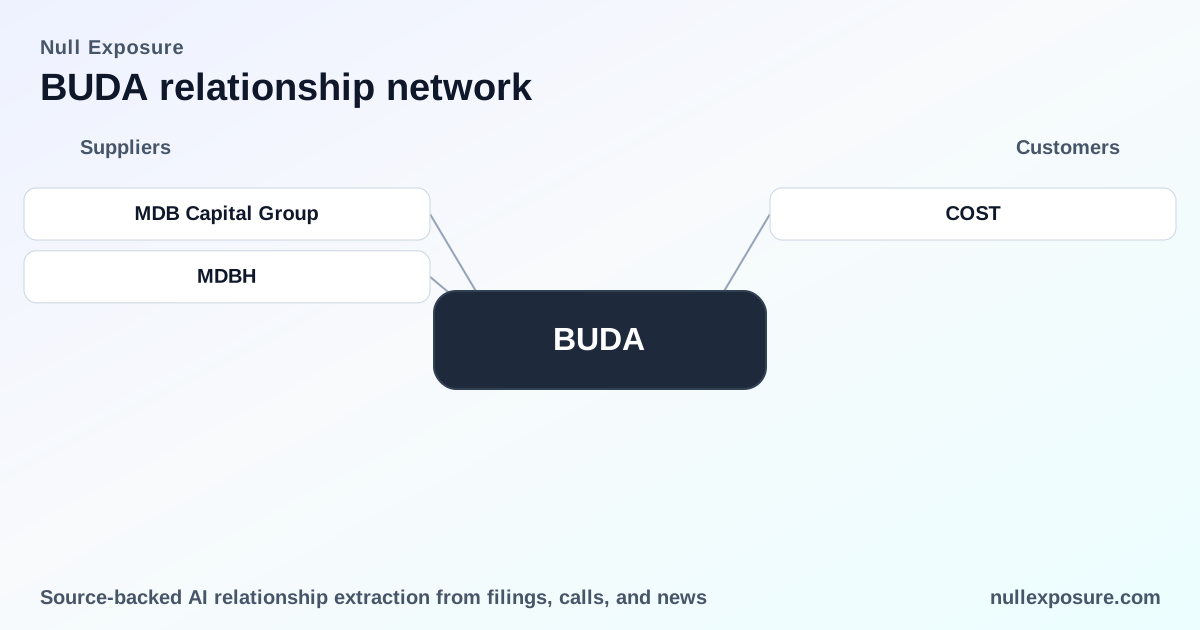
Buda Juice (BUDA): Underwriting Concentration and What It Means for Supplier Risk
Buda Juice produces and distributes UltraFresh branded juices, lemonades, limeades, and wellness shots out of Dallas, Texas, and monetizes through direct product sales to retail and foodservice channels. The company’s public-market liquidity and near-term capital structure were established through an IPO underwritten by a single lead — a setup that concentrates execution risk and shapes counterparty leverage. Investors should evaluate BUDA as a high-insider, small-float consumer beverages company with solid unit economics but material financing concentration. For more structured counterparty intelligence and monitoring, visit https://nullexposure.com/.
How Buda Juice operates and where the economics come from
Buda Juice is a branded non-alcoholic beverages manufacturer selling finished liquid products under the UltraFresh name. The core monetization is retail and wholesale product sales; the latest trailing-twelve-months figures show Revenue of $12.486m and Gross Profit of $5.669m, with a Profit Margin of 30.6% and Operating Margin of 27.2%, indicating healthy per-unit profitability for a consumer-defensive business. Balance-sheet and market signals are consequential: Market Capitalization stands at $130.275m, Shares Outstanding about 13.07m, Shares Float only ~2.28m, and Insiders hold ~66.44%, creating a governance and liquidity profile that concentrates decision-making and limits tradable supply.
The company’s public capitalization followed a concentrated underwriting process, which directly affects trading float, aftermarket support, and the terms of any follow-on financing. For direct monitoring of the market counterparties that underwrote BUDA’s public listing, see https://nullexposure.com/.
The underwriting and capital markets counterparties you need to know
Below are every relationship pulled from available reporting. Each entry is described in plain language and linked to the original coverage.
-
Renaissance Capital reported that MDB Capital Group acted as the sole bookrunner when Buda Juice set terms for a planned $22 million IPO; this places MDB Capital Group in a pivotal role for deal pricing and allocation during the offering (Renaissance Capital, March 2026). Source: https://www.renaissancecapital.com/IPO-Center/News/114351/Juice-manufacturer-Buda-Juice-sets-terms-for-$22-million-IPO
-
In an earlier filing report, Renaissance Capital again noted MDB Capital Group as the sole bookrunner when Buda Juice filed for a $22 million IPO, confirming the same lead-manager posture at the time of registration and syndication planning (Renaissance Capital, March 2026). Source: https://www.renaissancecapital.com/IPO-Center/News/113024/Juice-manufacturer-Buda-Juice-files-for-a-$22-million-IPO
-
Renaissance Capital later covered Buda Juice’s pricing and reported that MDB Capital Group acted as sole bookrunner as the deal priced, indicating the firm maintained lead underwriter responsibilities through deal execution (Renaissance Capital, March 2026). Source: https://www.renaissancecapital.com/IPO-Center/News/115994/Texas-based-juice-brand-Buda-Juice-raises-$20-million-pricing-IPO-at-$7.50-
-
A company press release carried on GlobeNewswire states MDB Capital acted as the underwriter of the offering and that Buda exercised the underwriters’ over-allotment option, underscoring that MDB Capital handled underwriting execution and aftermarket mechanics in connection with the IPO (GlobeNewswire, January 22, 2026). Source: https://www.globenewswire.com/news-release/2026/01/22/3223594/0/en/Buda-Juice-Announces-Full-Exercise-of-Underwriters-Over-Allotment-Option-in-Connection-with-Initial-Public-Offering.html
What the counterparty picture implies for BUDA’s operating model
The documented relationships show a single underwriting counterparty executing the IPO, which creates several company-level operational signals:
-
Contracting posture: transactional and concentrated. The underwriting relationship was structured through a single lead, not a broad syndicate, giving the counterparty substantial influence over pricing, allocation, and aftermarket stabilization decisions during and immediately after the IPO.
-
Counterparty concentration: high. Reliance on one underwriter compresses negotiation leverage for the issuer on underwriting fees, lock-up provisions, and distribution strategy. The GlobeNewswire note that the over-allotment was exercised demonstrates active aftermarket management tied to that same counterparty.
-
Criticality to capital access: material for near-term financing. MDB Capital’s role in underwriting converts into a gatekeeper function for any near-term follow-on equity activity or coordinated secondary placement, especially given the small public float and elevated insider ownership.
-
Relationship maturity: new and execution-phase. The interactions recorded all cluster around the IPO window (FY2025–FY2026 reportage), indicating a nascent capital markets relationship rather than a long-tenured banking partnership.
Those company-level signals combine with financial facts to shape risk: high insider ownership (66%+) and low institutional participation (~9.6%) reduce liquidity and second-guessing but raise governance dependence on controlling parties; a small float (~2.28m shares) increases price sensitivity to block trades or follow-on supply.
For tailored counterparty reports and continuous alerts on underwriting or supplier changes, explore https://nullexposure.com/.
Investment implications and a concise risk checklist
Buda Juice is an operationally profitable consumer beverages operator with a public-market structure that imposes distinct financing and liquidity risks. Key takeaways:
- Positive: Strong gross and operating margins provide resiliency around unit economics and protect cash generation in typical retail channels.
- Negative: Underwriting concentration and minimal float amplify execution risk for any capital markets activity and elevate price volatility on news.
- Governance risk: Insider control over two-thirds of shares centralizes strategic decisions and reduces the immediate influence of institutional holders.
- Valuation caution: Market multiples are rich—Price-to-Sales ~10.4 and Price-to-Book ~34.0—so future appreciation requires sustained top-line expansion or margin expansion to justify the current market cap.
Checklist for diligence:
- Confirm any lock-up expirations and insider sell schedules.
- Monitor MDB Capital communications for indications of aftermarket support or follow-on placements.
- Track float changes and institutional interest as secondary trades or placements occur.
Actionable next steps for investors
For investors and operators assessing counterparty exposure and supplier concentration, the practical path is clear: validate the underwriting economics and timelines, model the impact of low float on liquidity under stress scenarios, and monitor any developments from MDB Capital for signals on future capital raises. For continuous monitoring and deeper counterparty analytics, visit https://nullexposure.com/.
In summary, Buda Juice’s core business shows durable margins, but capital markets concentration—centered on MDB Capital—creates a single-point dependency that materially affects financing flexibility and aftermarket behavior. Investors should weight the company’s operating strength against the structural liquidity and governance constraints before increasing exposure.