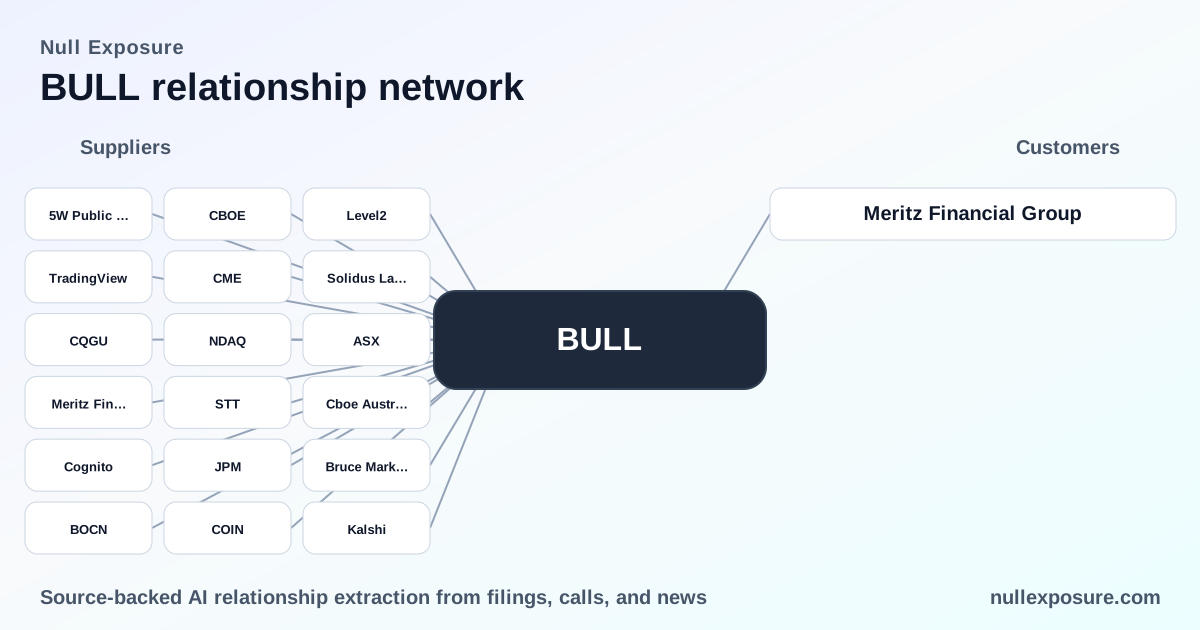
Webull Corp (BULL) — a supplier relationships brief for investors
Webull is a retail-first digital brokerage that monetizes through market data, order flow and execution services, cash-management spreads, custody and crypto execution partnerships, and ancillary product fees; the company reported roughly $571 million in trailing twelve‑month revenue and a public market capitalization near $2.78 billion. This supplier map shows a deliberate model: Webull outsources specialized infrastructure (surveillance, market data, futures connectivity, institutional custody) while keeping the consumer interface and customer acquisition in-house. For investors and operators, the key questions are whether this partner mix constrains growth, concentrates operational risk, or creates durable moat through differentiated integrations. Learn more at https://nullexposure.com/.
What the supplier footprint tells you about how Webull operates
Webull’s commercial posture is platform-centric and partnership-driven. The company layers third‑party capabilities (exchanges, data venues, surveillance engines, liquidity and custody providers) into a single retail experience. From an operating-model perspective, that implies:
- Contracting posture: Webull contracts widely for specialized services rather than building costly back‑end infrastructure internally, which accelerates feature rollout but increases vendor dependency.
- Concentration: The supplier set is diverse across categories, which reduces single‑vendor concentration overall; however, a small number of critical vendors (market data and custody/settlement partners) are operationally high‑impact.
- Criticality: Market data, trade surveillance, and institutional custody are mission‑critical — outages or commercial disputes in these areas would immediately impair core trading and cash management functions.
- Maturity: Partnerships range from incumbent exchanges (NASDAQ, CME, ASX/Cboe) to newer fintechs (Kalshi, Level2, Solidus Labs), indicating a mix of stable, regulated inputs and experimental product relationships.
No supplier-level contractual constraints are disclosed in the provided feed; the absence of explicit limits is itself a company-level signal that Webull’s public commentary emphasizes growth via partnerships rather than strict vendor lock statements.
The supplier roster — each relationship and why it matters
Below are every supplier relationship mentioned in the compiled results, with concise takeaways and source context.
-
Level2 — Webull embedded a no‑code strategy automation tool into its trading environment, expanding self‑service algorithmic capabilities for retail traders. Source: Level2 partnership announcement reported January 13, 2026 by StockTitan and FXNewsGroup (early 2026 press coverage).
-
Solidus Labs — Webull contracted Solidus Labs to provide crypto‑native trade surveillance and risk monitoring for U.S. and Canadian digital asset markets, strengthening compliance and market‑integrity controls. Source: partnership coverage in FXNewsGroup and StockTitan (Mar 2026).
-
Australian Securities Exchange (ASX) — Webull is a trading participant of the ASX as part of its initiative to launch advanced U.S. options and adviser platform services in Australia, reinforcing its local market access and regulatory standing. Source: PR Newswire/PR Asia release about Webull Connect (March 2026).
-
Cboe Australia / Cboe — Webull holds participant status with Cboe Australia and references Cboe for derivatives market information, supporting product distribution and local derivatives access in Australia. Source: PR Newswire and Yahoo Finance coverage (March 2026).
-
Bruce Markets — Webull launched a consolidated market data feed that aggregates overnight U.S. equities liquidity from venues including Bruce Markets, improving order‑book visibility for users. Source: Yahoo Finance and FinanceFeeds coverage of the consolidated feed (March 2026).
-
Blue Ocean — Included alongside Bruce Markets in Webull’s consolidated overnight market data feed, Blue Ocean contributes liquidity and price signals to Webull’s unified view. Source: multiple articles on the consolidated market data feed (March 2026).
-
Kalshi — Webull introduced zero‑commission sports and event prediction markets supplied by Kalshi, using prediction contracts to expand engagement and non‑traditional trading products. Source: Stocktwits and FXNewsGroup reports describing the Kalshi partnership (Jan–Mar 2026).
-
J.P. Morgan Asset Management — Webull Cash Management uses a direct integration with J.P. Morgan Asset Management to invest uninvested client cash into J.P. Morgan liquidity products, enabling competitive yields and real‑time settlement. Source: AAP press release citing the J.P. Morgan integration (Nov 2024 / referenced in FY2026 coverage).
-
Coinbase Prime — Webull’s Australian cryptocurrency offering accesses up to 240 digital assets through a partnership with Coinbase Prime, outsourcing custody/execution for crypto in that jurisdiction. Source: Finance Magnates coverage of Webull’s Australian crypto launch (reported in 2026).
-
NASDAQ — Webull maintains data relationships with NASDAQ for U.S. equities and options data in regional operations such as Thailand and broader market feeds, anchoring primary market data inputs. Source: markets.financialcontent reporting on Webull Thailand’s data relationships (March 2026).
-
CME Group — Webull sources futures market data from CME Group for its derivatives offering and regional futures expansions. Source: markets.financialcontent article detailing data relationships (March 2026).
-
State Street — Webull uses State Street for ETF data and analytics inputs, supporting ETF product information and reporting. Source: markets.financialcontent overview of data suppliers to Webull Thailand (March 2026).
-
TradingView — Webull integrates TradingView charting and technical analysis tools into regional platforms (e.g., Thailand), improving the retail interface with established charting capabilities. Source: markets.financialcontent coverage (March 2026).
-
CQG — Webull expanded futures capabilities through CQG partnerships across Asia (Singapore, Hong Kong, Malaysia), building out a shared futures connectivity backbone. Source: CQG partnership reporting in StockTitan and Finance Magnates (noted Nov 2025 / referenced in FY2026 materials).
-
Meritz Financial Group — Named as a partner supporting Webull’s entry into South Korea, representing local distribution and market access relationships in APAC expansion. Source: StockTitan coverage of Webull’s partnership strategy (FY2026 reporting).
-
5W Public Relations — 5WPR is listed as Webull’s media relations firm for U.S. disclosures and investor communications. Source: Morningstar/StockTitan press release details (Feb–Mar 2026).
-
Cognito — Cognito functions as a media contact/agency for APAC communications tied to Webull Connect in Australia. Source: PR Newswire press release for Webull Connect (March 2026).
What this supplier mix implies for investors
- Revenue diversification: Webull monetizes beyond trading commissions (market‑data products, cash management spreads, crypto execution partnerships, and novel offerings like prediction markets), which supports multiple revenue levers while preserving a low‑cost consumer entry point.
- Operational risk focal points: Market data vendors, custody/cash managers, and surveillance providers are single points of failure for core operations; contracts and SLA terms with those vendors will determine outage risk and negotiating leverage.
- Strategic agility: Partnerships with nimble fintechs (Level2, Solidus Labs, Kalshi) indicate a go‑to‑market strategy that prioritizes product breadth and speed of rollout over vertically integrated control.
- Regional execution: Multiple APAC partnerships (CQG, Meritz, ASX/Cboe Australia) show an explicit strategy to localize product delivery rather than centralize from the U.S. hub.
Learn more about supplier risk and opportunity assessments at https://nullexposure.com/.
Investment action checklist (operational)
- Verify contractual terms and SLAs with critical partners (market data, custody, surveillance).
- Track product adoption metrics for new features (no‑code automation, prediction markets, consolidated overnight feed).
- Monitor regulatory updates tied to surveillance and crypto execution partnerships that might affect commercial terms.
For a deeper vendor risk profile and comparative analysis, visit https://nullexposure.com/.
Closing summary: Webull’s supplier architecture is intentionally hybrid — leveraging established exchanges for core market data and liquidity while integrating fintech partners to accelerate product innovation. That combination supports fast product expansion but concentrates risk around a few mission‑critical suppliers; understanding those contracts and SLAs is the next step for investors evaluating durable earnings and operational resilience.