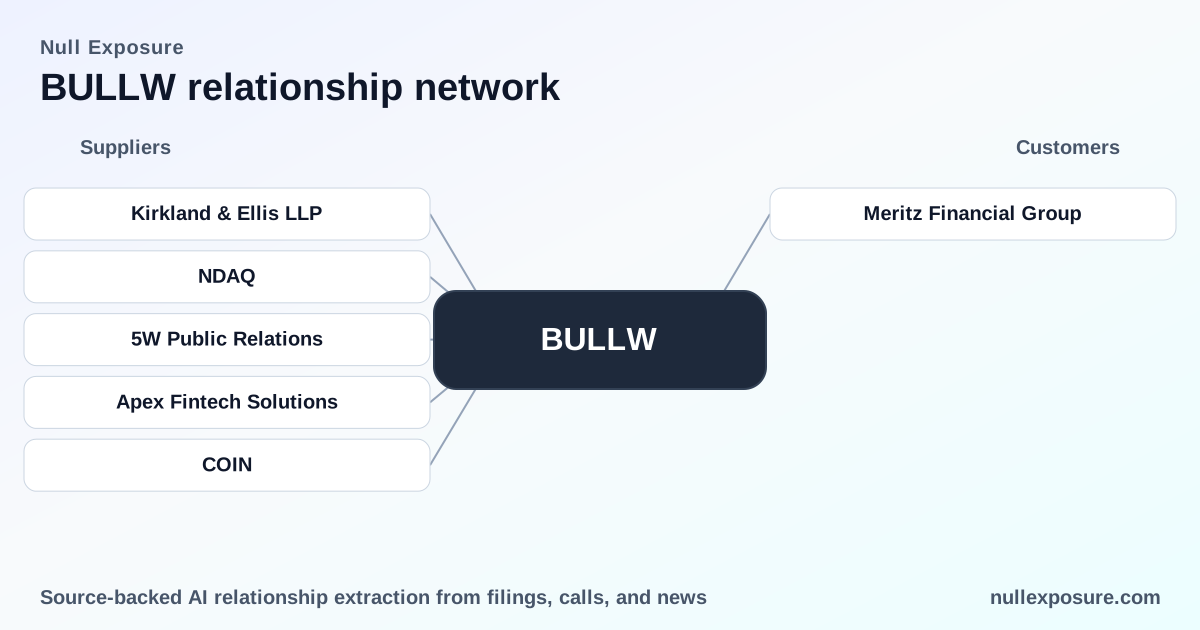
BULLW — Supplier Relationship Landscape: Webull’s external counterparties and what they mean for investors
Webull is a digital brokerage platform that monetizes through trading revenues, interest margin, subscription and data services, and marketplace fees; its reported TTM revenue of roughly $571 million and a slim positive profit margin reflect a business that scales with customer assets and trading volume. This note maps the supplier relationships surfaced in public reporting and press coverage, assesses their operational relevance, and highlights the vendor-related signals investors should track when evaluating Webull warrants (BULLW). For a deeper supplier-risk view, visit the NullExposure homepage: https://nullexposure.com/.
Why supplier relationships matter for an exchange-listed fintech
Supplier relationships for a retail broker like Webull are not peripheral line items — they are part of the plumbing that enables access to markets, custody, legal compliance, and go-to-market communications. A mix of mature incumbents (exchanges, large law firms) and fintech partners (clearing, crypto on-ramps, backend providers) creates a predictable operating base but also concentrates counterparty risk in a few critical services. Investors should evaluate counterparty concentration, contract maturity, and whether any suppliers are mission-critical to live trading, custody, or regulatory compliance.
At the company level, there are no explicit supplier constraints recorded in the available relationship data, which itself is a signal: public communications and filings emphasize routine operational tie-ins rather than disclosed restrictive vendor covenants. From an operating-model perspective, expect a standard commercial contracting posture, moderate concentration around market infrastructure and legal/comms advisors, and a mix of mature and commercially available supplier maturity profiles that are typical for a fast-scaling fintech.
Explore structured supplier profiles and exposure scoring at NullExposure: https://nullexposure.com/.
The relationships you need to know (full coverage)
Below are every named relationship identified in the collected results, each with a concise investor-focused description and a source reference.
-
Kirkland & Ellis LLP — Webull engaged Kirkland as its U.S. legal counsel in connection with the closing of a business combination, signaling use of a top-tier, full-service law firm for transactional and regulatory work. (According to a Yahoo Finance press release covering the transaction closing, March 2026: https://sg.finance.yahoo.com/news/webull-announces-closing-business-combination-133500958.html and a StockTitan republication, March 2026: https://www.stocktitan.net/news/BULL/webull-announces-closing-of-business-combination-transaction-with-sk-46tcgg8tr65e.html)
-
Nasdaq — Webull completed its listing process and commenced trading on Nasdaq with ticker family “BULL,” “BULLW,” and “BULLZ” effective 11 April 2025, which places market access and post-listing obligations under the governance and technical infrastructure of a major exchange. (Reported by Mashable’s SEA edition referencing the April 2025 listing: https://sea.mashable.com/post/37273/)
-
5W Public Relations — Webull lists 5W Public Relations as its media contact for investor and corporate communications, indicating a retained PR capability to manage shareholder and market messaging. (See the press distribution that cites Webull Media Relations and 5W contact details in a StockTitan posting and Yahoo Finance release, March 2026: https://www.stocktitan.net/news/BULL/webull-announces-closing-of-business-combination-transaction-with-sk-46tcgg8tr65e.html and https://sg.finance.yahoo.com/news/webull-announces-closing-business-combination-133500958.html)
-
Apex Fintech Solutions — Webull uses Apex as a backend partner enabling certain distribution arrangements, notably facilitating access for overseas intermediaries so that local investors can access U.S. equities and Webull’s trading tools. This is a functional partnership that supports cross-border client onboarding and execution capabilities. (Described in a Q3 2025 coverage piece on Webull’s results and distribution partnerships: https://ts2.tech/en/webull-corporation-nasdaq-bull-q3-2025-earnings-55-revenue-surge-record-assets-and-ai-push/)
-
Coinbase — Webull has established a relationship with Coinbase to enable cryptocurrency trading in specific markets (notably Brazil in the coverage cited), which broadens Webull’s product set and ties it to a leading crypto liquidity and custody provider. (Noted in a market commentary on Webull’s product expansion: https://www.timothysykes.com/news/webull-corporation-bull-news-2025_07_18-2/)
What these relationships imply for operational risk and upside
-
Market-access and listing risk is non-negotiable and highly material. The Nasdaq listing is foundational to the company’s public valuation and liquidity for BULLW holders; exchange rules and technical uptime are therefore mission-critical.
-
Legal and regulatory support is centralized and high-grade. Retaining an elite law firm for the business combination signals a conservative legal posture on major transactions and regulatory navigation.
-
Backend fintech partners determine product scope and geographic reach. Partnerships with firms like Apex and Coinbase materially expand product distribution and asset coverage, which supports revenue diversification but introduces third-party operational dependencies.
-
Communications and investor relations are outsourced to specialized PR, a standard posture that reduces in-house channel risk but concentrates narrative control externally.
Constraint and operating-model signals investors should track
Although the relationship data includes no explicit vendor constraints, the company-level signals relevant to underwriting Webull are clear: contracting posture is commercial and transaction-driven; counterparty concentration is moderate with elevated criticality on market infrastructure; supplier maturity is mixed (established law and exchange partners versus commercial fintech providers); and dependency timelines are operationally immediate for listed-company activities. For investors, that means stress-testing scenarios should center on exchange-level disruptions, regulatory interventions, and third-party fintech outages.
Bottom line and investor actions
Webull’s visible supplier map combines market infrastructure (Nasdaq), high-grade legal counsel (Kirkland), distribution/back-end fintech (Apex), and crypto execution partners (Coinbase) — a blend that supports product breadth and listing stability but concentrates risk where trading, custody, and compliance intersect. For BULLW holders, the critical lenses are uptime/regulatory risk at the exchange layer and continuity of fintech back-end services that underwrite product availability.
For a deeper supplier-risk scorecard and ongoing monitoring of these counterparties, visit NullExposure’s supplier intelligence hub: https://nullexposure.com/. If you want a tailored supplier risk brief for BULLW or comparable fintech issuers, request a customized briefing via our homepage: https://nullexposure.com/.
Keep monitoring public filings and press releases for changes in these arrangements; counterparties that enable market access and custody will determine both operational resilience and the upside path for Webull’s public securities.